

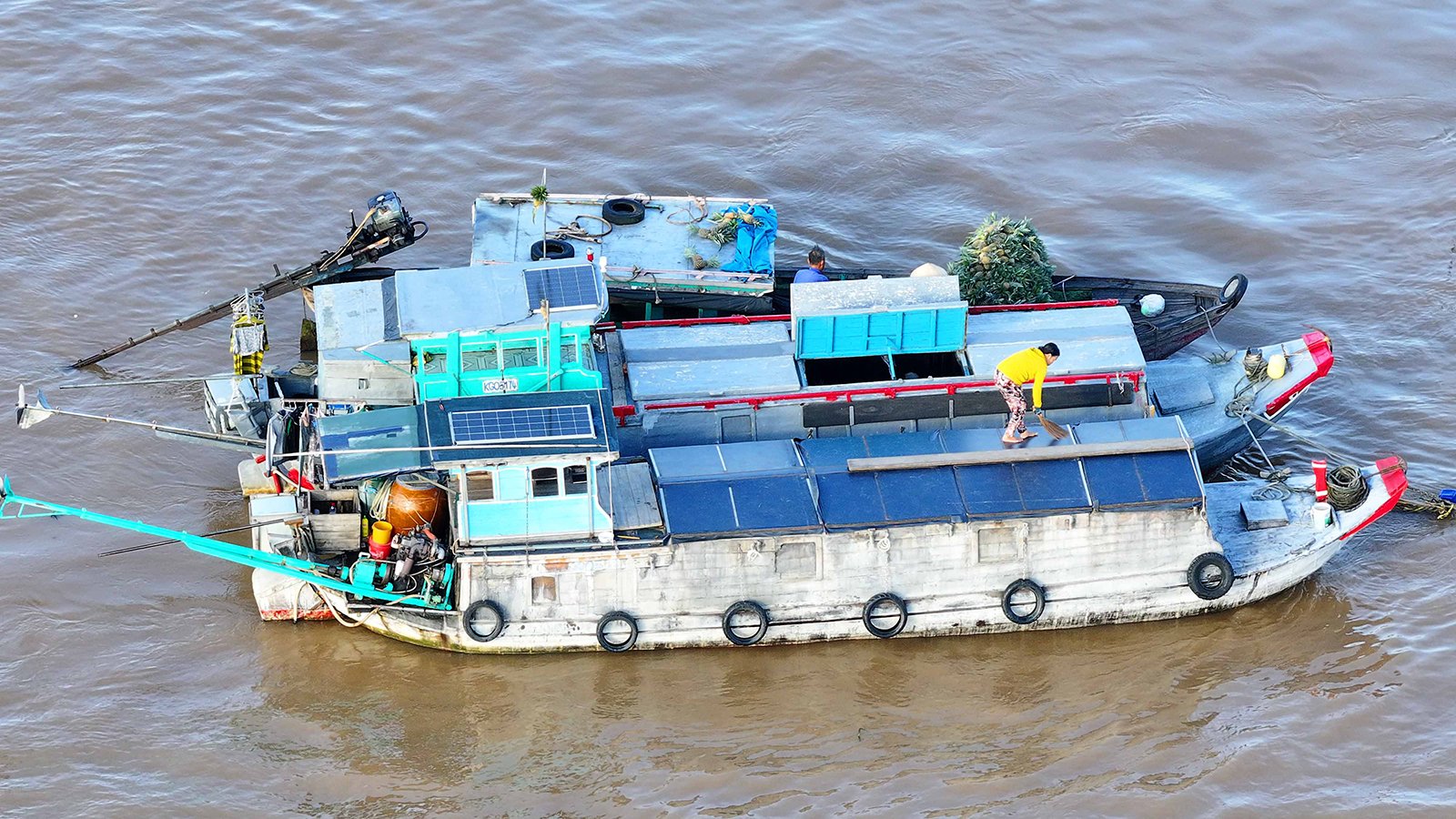
A familiar boat used by traders. Photo: THANH CHINH
Drifting on the waves
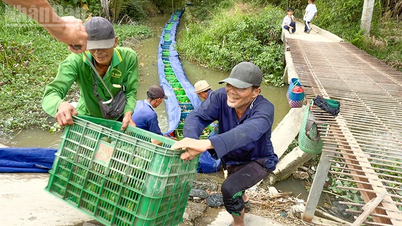
This season, the north wind whistles, a gentle chill sweeping across the river. In the distance, the water swirls towards an unknown destination, boats carrying goods back and forth. Time flies, yet this riverine trade continues to exist. It seems that river traders are unique to the Mekong Delta, becoming a distinctive cultural feature of the region. Early in the morning, while the mist still hung low, we arrived at Long Xuyen market and saw red-prowed barges slowly unloading coal. Rubbing his eyes, Mr. Nguyen Van Nhan (52 years old), residing in Phung Hiep commune, Can Tho city, quickly jumped ashore, securing his boat, waiting for buyers to arrive to sell the coal.
It took Mr. Nhan 10 hours to get his boat, loaded with 32 tons of coal, to Long Xuyen. “From dusk, my wife and I rushed here until dawn the next day. After anchoring, we quickly ate a packet of instant noodles and delivered the coal to our buyers. Life as a traveling merchant is a constant struggle to make ends meet, so we can get back to our hometown in time to pick up another shipment,” Mr. Nhan confided.
As dawn broke, tearing through the thin mist, activity on the river became bustling. On the shore, traders brought their carts to the riverbank to transport coal. Soon, the carts were full of coal and transported back to the depot, allowing Mr. Nhan to take a few minutes to rest. Watching the swift, silt-laden water flow, he slowly recounted how the trade of a river trader had been closely intertwined with his life since childhood. This profession was passed down from his father to the present day. "In the past, when times were tough, my father sold coal in a small boat. Without machinery, he used his own strength to row the boat and deliver goods to the local markets, which was very hard work. Later, I continued the family tradition of this river trade," Mr. Nhan said.
However, thanks to the charcoal selling business, Mr. Nhan became quite well-off. He and his wife only have one son, who is married and has also followed in their footsteps as a merchant. This job is hard but enjoyable. Although staying up all night driving the boat is very tiring, the income from the trips on the river is quite good. Currently, the demand for charcoal in the city is very high, so Mr. Nhan has to hire people to make charcoal in his hometown. From now until the Lunar New Year, small traders will buy and store large quantities of charcoal to sell retail during the holiday. "In my hometown, there are dozens of households that make a living making charcoal and trading it everywhere. It's hard work, young man!" Mr. Nhan boasted.
Many people quit the job.
In the past, the Mekong River was a bustling and vibrant trading route. However, with the opening of land routes, many people abandoned their boats and transported goods by truck. Recalling those bygone days, Mr. Ya Pha (67 years old), a resident of Chau Phong Cham village, said that when it comes to trading, the Cham people were the pioneers in connecting domestic goods with countries around the world . In the past, people in the Cham village would travel by boat to Phnom Penh, Cambodia, and then down to Chau Doc. Sometimes, traders would even travel further south and up to Ho Chi Minh City to deliver goods. “We bought rice, salt, and sugarcane at the Chau Doc floating market, loaded them onto our boats, and rowed along the Mekong River to sell them in Kandal province and Phnom Penh market. Back then, there were no machines, so the young men in the village would row against the current to Cambodia to deliver goods,” Mr. Ya Pha reminisced.
During the flood season or even during a storm, fearing their boats would sink, the people had to quickly row their boats into the canals for shelter. Each trip took a whole month. Besides trading essential goods, in the past, many traders also traded timber and other goods from Phnom Penh to Chau Doc and vice versa. "After selling their goods, the Cham people would buy household items, load them onto their boats, and bring them back to distribute in the domestic market. In this way, after each trip, the traders would make two trips, and after deducting expenses, they would earn a considerable profit," Mr. Ya Pha explained.
Besides trading goods with other countries, the Cham people also sell their handmade products such as soap, towels, sarongs, shawls, duck eggs, and mung beans throughout the Mekong Delta provinces. They transport their goods deep into the canals, reaching remote areas to sell them. In the late 19th century, the Cham villages of Chau Giang, Chau Phong, Con Tien, and Vinh Truong became bustling trading centers. The Chau Doc river junction became a popular destination for merchants, connecting them to a vibrant market on the waterways. However, nowadays, many families have moved ashore to live by farming, weaving brocade, or engaging in tourism . Traditional products are mainly sold to tourists or quickly transported by truck to neighboring provinces.
| As evening falls quickly over the beautiful Mekong River, red-pronged barges hurry along, carrying goods to the market, creating a tranquil scene in the waterways of the Western region. |
Source: https://baoangiang.com.vn/thuong-ho-soi-bong-nuoc-cuu-long-a466650.html
![[Photo] National Assembly Chairman Tran Thanh Man attends the policy seminar to promote Vietnam-Türkiye cooperation.](https://vphoto.vietnam.vn/thumb/1200x675/vietnam/resource/IMAGE/2026/04/16/1776351415367_vna-potal-chu-tich-quoc-hoi-tran-thanh-man-du-toa-dam-chinh-sach-thuc-day-hop-tac-viet-nam-tho-nhi-ky-8705791-jpg.webp)













































































Comment (0)