

Mang Den, a town in Kon Plong District (Kon Tum Province), is considered a dynamic economic region and a tourist "paradise" of the province. However, few people know that this land has long been steeped in stories about mysterious and fantastical deities.
Land of Fairies
Located at an altitude of over 1,200 meters above sea level, Mang Den has an average temperature of 16-20 degrees Celsius. With its predominantly hilly and mountainous terrain and 82% forest cover, it boasts numerous scenic spots, lakes, waterfalls, rocky streams, and pristine indigenous culture. In early spring, Mang Den is cool, with the hills and mountain peaks covered in a thin, milky white mist. Hidden behind the pine forests are hundreds of villas, partially obscured by the fog. Cherry blossom trees are densely planted along the roads in Mang Den. Mr. Tran Van Lam, Deputy Head of the Heritage Department, Kon Tum Provincial Department of Culture, Sports and Tourism, shared: "Besides its hilly terrain and pristine forests, Mang Den also possesses many beautiful lakes and waterfalls. This is also a strength for Kon Plong District to develop tourism in the direction of ecotourism, resort tourism, and cultural-historical tourism."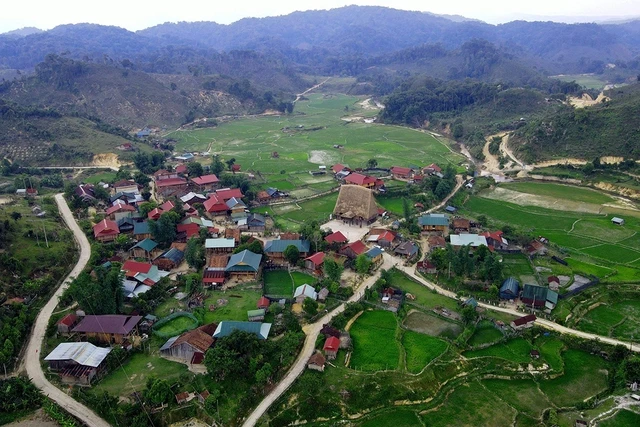
Mang Den still retains its pristine indigenous cultural values (DUC NHAT)
Mr. Lam recounted that since ancient times, the Mơ Nâm people have always passed down a legend to explain the formation of the 7 lakes and 3 waterfalls in Măng Đen. According to the legend, Măng Đen was called T'Măng Deeng. T'Măng means dwelling place, and Deeng means deity. T'Măng Deeng means the dwelling place of the deities.
In the primordial era, T'Măng Deeng was a wild and untamed land. Everywhere there were only forests and mountains, untouched by human footsteps. Herds of deer grazed peacefully on the edge of the forest. A clear river meandered across the high mountains like a soft silk ribbon. At that time, Plinh Huynh was the supreme deity in heaven, possessing the power to create all things. Seeing that T'Măng Deeng was prosperous yet wild, Plinh Huynh sent his seven sons down to establish villages and live there. When his seven sons reached marriageable age, Plinh Huynh descended to earth, seeking out beautiful, talented, and skillful girls from neighboring villages to marry his sons. After the marriages, these seven couples formed seven villages around T'Măng Deeng. Plinh Huynh then appointed his seven sons as gods to govern that land. As for the wives, they transform into spirit animals representing pigs, deer, fish, lizards, etc. The deity Plinh Huynh demands that the governing deity swear an oath not to eat the meat of the animal whose spirit animal his wife represents. Anyone who violates this oath will be punished by Plinh Huynh.
The hills and mountain peaks of Kon Plông are covered in a thin, white mist. (DUC NHAT)
Legend of "7 lakes, 3 waterfalls"
Initially, once a year, the seven sons would fly to heaven to report to the god Plinh Huynh about their lives and affairs on earth. Gradually, none of the sons returned to heaven anymore. Each year, the granaries were full of rice, the yards overflowed with pigs and chickens, the kitchen cupboards were filled with dried wild game meat, and the buffaloes, cows, and goats roamed in the forest, fat and healthy. The seven gods in charge taught the people how to perform the Deeng ritual. One day, during the Deeng New Year's celebration, the villagers held a grand feast, singing and drinking from night to night. Then, in their drunken stupor, the gods gathered around the ceremonial pole, drinking and eating all the food the villagers brought, including the meat of the animals their wives used as sacred animals. From heaven, the god Plinh Huynh looked down and saw his sons violating the forbidden law. He became furious and used his magic to punish those who had broken their vows. While the villagers were celebrating and feasting, the ground in the villages suddenly collapsed, creating large sinkholes. From underground, fire and smoke billowed up in thick clouds.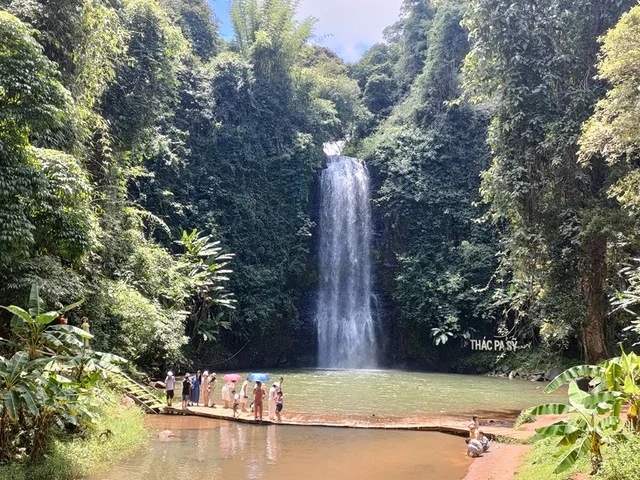
Pa Sy Waterfall, one of the famous destinations in the Mang Den eco-tourism area (DUC NHAT)
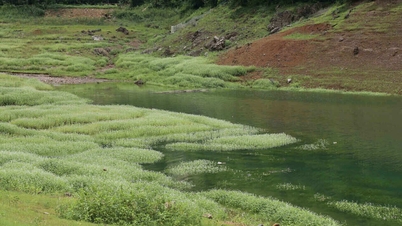
Villages and houses were engulfed in flames. Sparks struck the cliffs, creating three large waterfalls. Water from the waterfalls extinguished the fires in the deep pits, transforming them into seven lakes. These seven lakes are named after the children of the god Plinh Huynh: Toong Dam, Toong Rpong, Toong Zo Ri, Toong Ziu, Toong Sang, Toong Li Lung, and Toong Po. The three sparks that formed the waterfalls are named Pa Sy, Dak Ke, and Pne. From this story, the survivors always teach their descendants to keep their vows, never break their promises, and be grateful to those who sacrificed themselves to protect the peace of the village.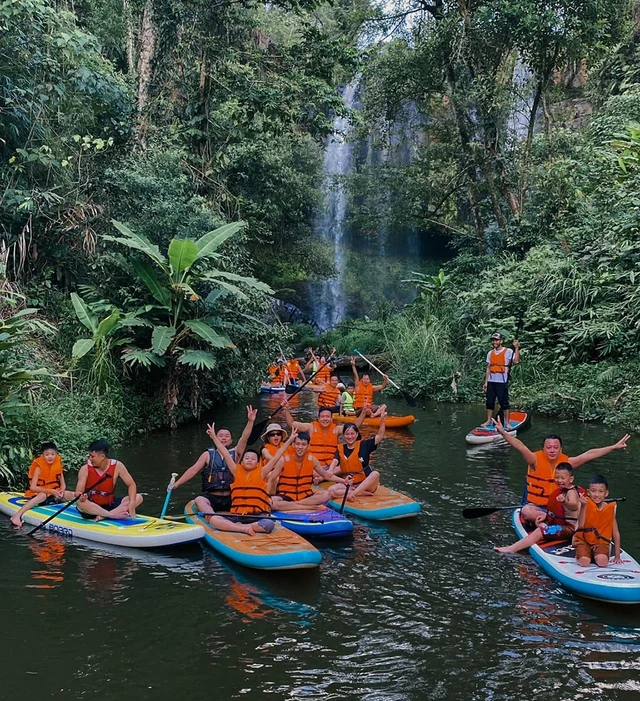
Mang Den attracts tourists with its pristine beauty (SANG NGUYEN)
A National-Level Tourism Center : A Mơ Nâm ethnic minority member, Mr. A Tạm, Deputy Head of the Culture and Tourism Department of Kon Plông District, stated that no one knows exactly when the legend of "7 lakes and 3 waterfalls" originated. Besides the story above, there are several variations passed down through the oral traditions of the Mơ Nâm people in the Măng Đen area. Today, the 7 lakes and 3 waterfalls are among the attractions that draw tourists to Măng Đen. However, some lakes have dried up, so the local authorities have a plan to restore and renovate them to develop tourism. The locality is calling for and attracting large investors to match the tourism potential of this area. According to Mr. Tạm, several lakes and waterfalls in the area have already been developed into tourist destinations by local authorities or individuals and organizations. Even so, Kon Plông District still requires individuals and organizations to develop tourism while simultaneously preserving the ecological environment. The local authorities also planted more than 12,000 cherry blossom trees to create a beautiful landscape, attract tourists, and greener the Mang Den area.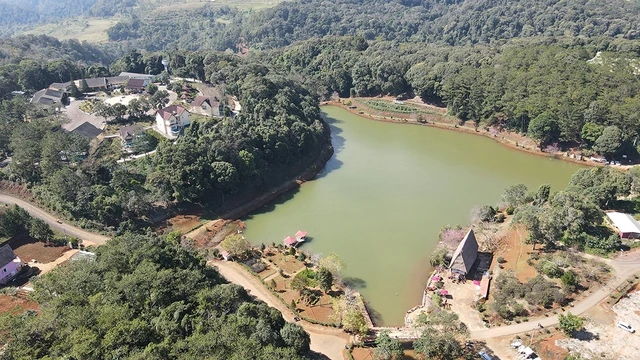
































































Comment (0)