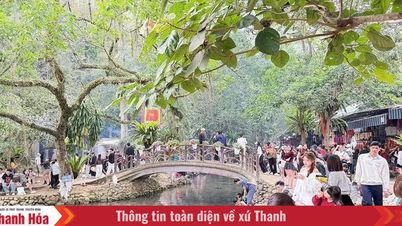
I was born in the Viet Bac war zone and moved to Hanoi when I was two years old. It wasn't until I was seven that I learned about another province, Thanh Hoa. And somehow, Thanh Hoa became the place with many cherished memories for my family.
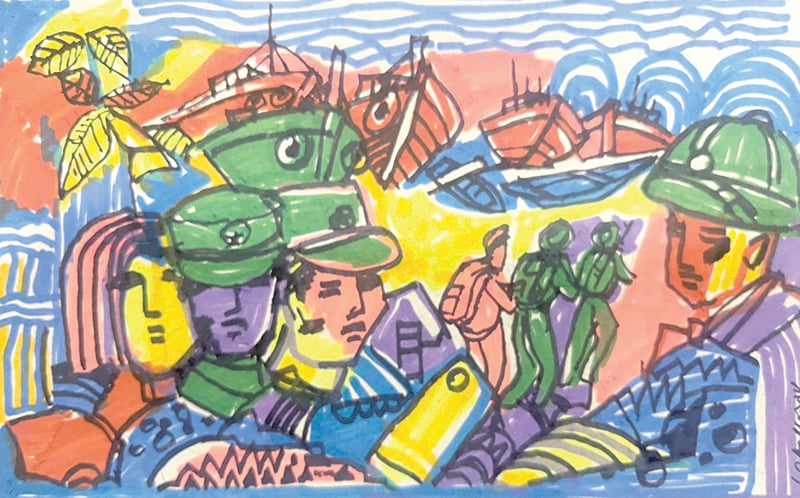
In early 1954, my father, then an officer in the Central Youth Volunteer Command, was assigned to Ngoc Lac district to organize the Thanh Hoa civilian labor teams to serve in the Dien Bien Phu campaign. Once, my father took me along with a group of children from his office to Sam Son for a camping trip. At that time, it was just a small commune, a fishing village with makeshift huts, rows of casuarina trees, and white sand beaches. We had a campfire and socialized with the local children. It was the first time I had eaten fresh seafood, had fun with the children there, and received some pretty seashells as gifts.
Later, from 1988 onwards, I often took my family to Sam Son for summer vacations with colleagues, probably more than a dozen times. I witnessed the transformation of Sam Son from a place where the only large building was the Ministry of Health 's nursing home near the Doc Cuoc Temple, with hardly any large hotels or guesthouses around. Returning five years ago, it was impossible to recognize Sam Son from the subsidy era. Even less could I recognize the location of the children's camp I had visited. The teenagers who gave us seashells back then are now grandparents; where are they now?
Along with the overall development of the country, Thanh Hoa has changed a lot today. The standard of living is much higher. In my memories, during a work trip here while I was still a university student, I can redraw the route from Thanh Hoa train station to Dong Tho commune (now Dong Tho ward, Thanh Hoa city) with my classmate, Dam Tien Quan. However, the landscape of Dong Tho today is almost completely different. When I revisited this place, I had to ask Quan to be my guide so I could visualize some of the old scenes. Dam Tien Quan was my classmate in the Radio Engineering class at Hanoi University of Technology, and later worked at Thanh Hoa Television Station. We still occasionally meet at class reunions.
Thanh Hoa and its people hold many cherished memories for me, but the most profound is undoubtedly with Deputy Company Commander Nguyen Quang Tan, my superior during the war against the Americans. I fought alongside him during the final months of the conflict.


It was early 1975, our 320A Division secretly moved its base from Pleiku to Dak Lak to prepare for a new campaign, which we later learned was the Spring 1975 Campaign on the plateau. Due to the new mission, the regiment's special forces company was disbanded, and Tan was assigned as the deputy commander of my company. During the war, most special forces units, especially naval special forces, mainly recruited people from Thanh Hoa. They were strong, resilient, and had a very tenacious fighting spirit. Tan was very knowledgeable about the mountains and forests, so we soldiers immediately benefited greatly from his resourcefulness.
The unit's march from West Pleiku to Dak Lak followed the western side of Highway 14, a distance of about ten kilometers. This area had never been a battleground before, so it was covered in pristine forests. We encountered many wild animals along the way, and they were very tame because they had never seen humans. But because we had to maintain secrecy, we weren't allowed to shoot them. Seeing our disappointment, Tan smiled and reassured us that he would find a way to improve our situation. So, one day, walking beside a dry stream, we saw several large holes, like bomb craters, teeming with fish. Tan explained that during the rainy season, the fish swam into these holes, unable to escape when the water receded, and thus had to survive the dry season. He suggested that the company command allow the unit to stop for about an hour. We used mosquito netting as nets. After just a few sweeps across the holes, we caught nearly ten kilograms of fish, many as big as our hands. That evening, the entire company had a fresh meal.
Upon arriving at our new location, while preparing for an ambush to cut off Route 14 and prevent the enemy from reinforcing Buon Ma Thuot, we managed to celebrate the Lunar New Year of the Rabbit in the middle of the jungle. With only a small amount of sticky rice, mung beans, and pork provided on the spot, we organized the making of banh chung (traditional Vietnamese rice cakes), each person receiving one. But we were unexpectedly treated to fresh banh chung thanks to Tan's resourcefulness. Having noticed it during several search trips, Tan led a dozen soldiers to a shallow stream one afternoon. A herd of wild boars was foraging in the streambed. Tan had his soldiers block both ends with sticks. The boars scattered in both directions, but we managed to catch two. So, in addition to banh chung, we had wild boar meat.
Then we went to Cheo Reo, Phu Bon, to intercept enemy units that were evacuating. The jungle trail, a constant 12 kilometers of movement, left us breathless. Tan stayed close to his comrades, constantly carrying supplies for the weaker soldiers. Then we followed Route 7B to pursue the enemy and liberate Tuy Hoa town. The enemy had suffered many defeats and were demoralized, but many of their units remained stubborn, holding out in various places. The company commander was killed early on, and Tan took command of the main assault, leading the unit to pursue the enemy along the main road in the town. We destroyed many enemy resistance strongholds. But while pursuing the attacking tanks near the sea, the enemy set one of our tanks on fire, and Tan and two soldiers who were following behind were seriously wounded.
We still had over a month to go before the final match, but I've been separated from Tan ever since.
Later, after returning to normal life, I went to Thanh Hoa many times, inquiring but couldn't find Mr. Tan's house; I only knew he lived in Dong Son.

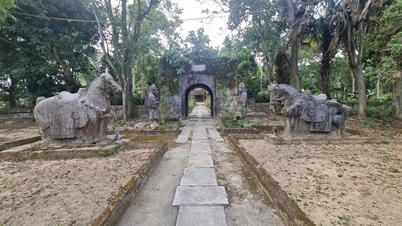
Thanh Hoa is a vast and beautiful land, famous for its many national heroes and great figures. I worked at the Bim Son Cement Factory for several years, visited the Lam Kinh historical site, the Ho Dynasty Citadel, the Cam Luong sacred fish stream, and more.
2025 marks the 50th anniversary of the end of the war and the reunification of the country. For us soldiers who once fought on the battlefield, there are many things to remember about the lands we have traveled through; and Thanh Hoa, for me, is a memorable place with many cherished memories.
Writer Vu Cong Chien
Source: https://baothanhhoa.vn/manh-dat-tinh-nguoi-238009.htm