

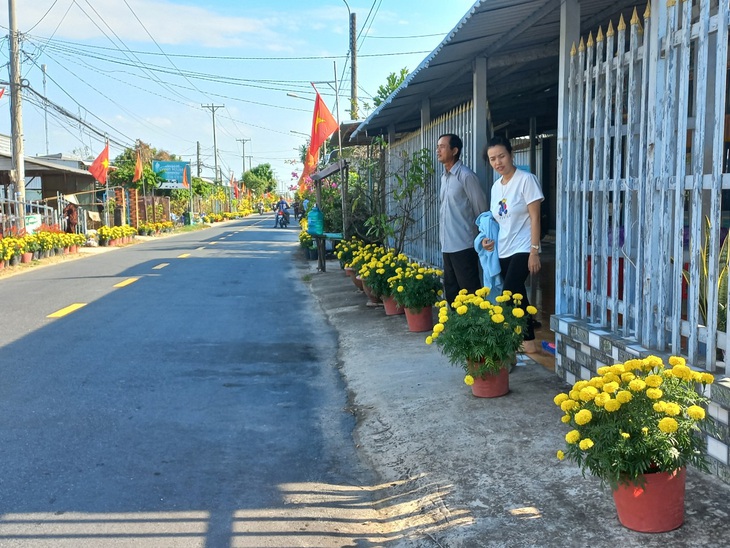
The traditional Tet (Lunar New Year) atmosphere in the countryside is further enhanced by thousands of vibrant yellow marigold pots - Illustration photo: LAN NGOC
The door to my house was made of old planks of wood pieced together. The wood had turned a faded color like an old man's skin, rough and uneven, with small chunks peeling off in places. It stood there, blocking the view between inside and outside, between the smell of kitchen smoke and the river breeze, between the laughter of Tet (Lunar New Year) and the nights of incessant rain that seeped to the bone.
The front of the door, facing the yard, bears witness to the rain and sunshine of the Mekong Delta. And on the back, a lifetime of hard work by my mother is recorded, in chalk, in shaky handwriting that has changed with the years.
The ledger was covered with scribbled notes: "Mrs. Sau Bong: 1 bushel of rice," "Uncle Tu Lam: 20,000 dong," "Aunt Ba Huong: 2 cans of rice," "Mother Hai Duc: a bottle of fish sauce"... Some entries listed debts owed to her, while others were reserved for her to record debts she owed others. Back then, everyone was poor. Poor in the Mekong Delta way—not starving, but always lacking.
It was a ledger of debt without paper, cover, or date, a burden the door would carry on its back for the rest of its life.
It remembered everything, without complaint or questioning, silently absorbing each trembling stroke of the pen, allowing another name, another number, another life to cling to its very being.
My mother frowned, calculating. The writing was densely packed. The chalk scraped against her hand, making a scraping sound like clenched teeth. Not to show off, nor to remind anyone of their fault. Just to record it, so she wouldn't forget.
Some lines are written in bold, some in faint letters, and some are just short strokes, like a silent nod. Some lines are circled, others are crossed out halfway. Some lines are clearly written, while others simply state "leave it there," without distinguishing whose debt it is.
My mother wasn't good at writing, but she had a good memory. Yet she still had to write it down, because a person's memory can be fickle at times, while a door is always faithful.
But the chalk didn't stick to the wood for long. Rainwater would fade it. The children would run by and brush their hands on it, and it would all fly away. Yet my mother still wrote. As if she believed that debts were only temporary things – to be recorded to remember, not to be kept forever.
I grew up with those inscriptions. Even as a child, I could read the names of people in the neighborhood on the back of the doors. A quick glance at the name told me which houses were poorer than ours, which were struggling to make ends meet. Like Auntie Năm Lựu, whose husband left her to go fishing on a boat, leaving her to raise four children on a meager income from vegetables by the canal. Her debts stretched on endlessly, a jumble of different kinds.
There was Uncle Bay Kha, a heavy drinker and troublemaker, who would stand outside the door every year around Tet, scratching his head and saying, "Little sister, can I owe you some rice?" My mother didn't ask any more questions, just nodded and went back inside.
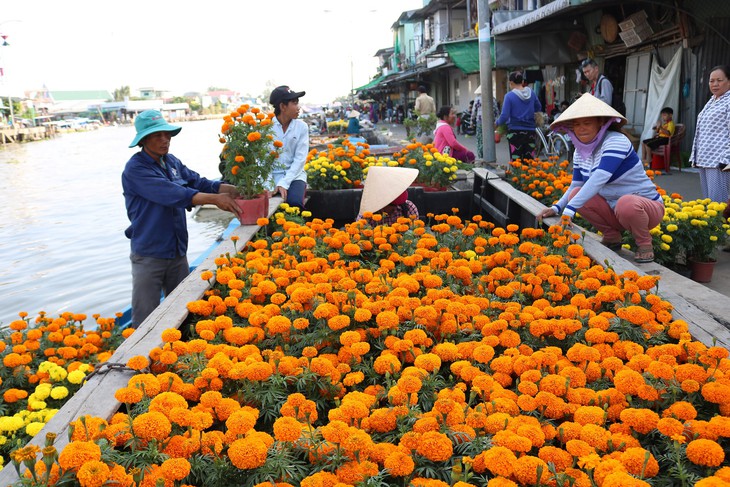
The Tet atmosphere in the Southwestern region of Vietnam - Illustration photo: NGUYET NHI
In the days leading up to Tet, the sun in the Mekong Delta is much gentler. Sunlight streams through the holes in the thatched roof, shining directly onto the back of the door. The lines of white chalk become clearly visible. The line recording the debt my mother owes lies next to the line recording the debt my mother owes my mother. The sun doesn't differentiate, shining evenly, making all the debts seem the same, none higher than the other.
One day, my mother stood there for a long time, chalk in hand, without writing anything more. Her eyes were fixed on the old lines, deep and profound. I knew she was calculating for others in her head: this person had a bad harvest last year, that person was constantly ill, another had several young children. She didn't say anything, but the door heard everything. It heard the sighs that were swallowed back inside.
Then, on nights leading up to December, Mother would stand for a long time in front of the door. The oil lamp cast her shadow onto the dimly lit lines of debt, like a sacred scripture of life.
The shadow of a thin woman superimposed on the jumbled words looked like Mother standing in the middle of the whole neighborhood. Mother held a wet rag, silently wiping away the debt, slowly and carefully, as if afraid of hurting someone.
Once, I asked in surprise, "Mom, will people forget?" She whispered, still wiping, "Well, so be it. It's the Lunar New Year, let them have some peace of mind. We can still look each other in the eye and live our lives." The door stood still, and I heard it let out a long sigh.
During the first few days of Tet, the doors are wide open to welcome the new sunshine and neighbors coming and going to greet each other. The worries and anxieties behind the doors are closed inside.
I realized that the door didn't just record debts of money or food. It recorded debts of life, debts of kindness, debts of love. The door was a ledger that never closed, where my mother entrusted all her worries and silent sacrifices. It stood in the middle of the house, separating inside and outside, yet connecting people with kindness.
Later, our house was renovated. They replaced the wooden door with an iron one. My mother stood watching the old door being taken down, silently. I saw her reach out and touch the back of the door. Her hand was thin and trembling. She whispered, "Keep it safe, don't throw it away."
It stood against the wall, its back facing inward, silent. But every spring, watching the marigolds sway in the wind, I still felt the door breathing. Breathing through the old inscriptions, through the silent hardship, through my mother's sweet affection: "In this poor neighborhood, people forgive each other's debts so they can look at each other and continue living."
Springtime Home Writing Contest
As a source of spiritual nourishment during the Lunar New Year season, newspapers Youth Together with our partner, INSEE Cement Company, we are organizing the "Springtime Home" writing contest to share and introduce your home – your warm and cozy haven, its features, and the memories you will never forget.
The house where your grandparents, parents, and you were born and raised; the house you built with your own hands; the house where you celebrated your first Lunar New Year with your small family...
The Springtime Shelter Award Ceremony and the Launch of the Youth Spring Special Edition
The judging panel included renowned journalists, cultural figures, and representatives from the press. Youth The judging panel will review the entries that have passed the preliminary round and select winners.
The awards ceremony and launch of the Tuoi Tre Spring special issue are scheduled to be held at Nguyen Van Binh Book Street, Ho Chi Minh City, at the end of January 2026.
Prize:
1st prize: 10 million VND + certificate, Tuoi Tre Spring issue;
1 second prize: 7 million VND + certificate, Tuoi Tre Spring issue;
1 third prize: 5 million VND + certificate, Tuoi Tre Spring issue;
5 consolation prizes: 2 million VND each + certificate, Tuoi Tre Spring issue.
10 Readers' Choice Awards: 1 million VND each + certificate, Tuoi Tre Spring Edition.
The voting points are calculated based on interaction with the post, where 1 star = 15 points, 1 heart = 3 points, and 1 like = 2 points.
Source: https://tuoitre.vn/mat-sau-canh-cua-20260116080120434.htm
![[Photo] Commemorating the unwavering friendship between Vietnam and Laos](/_next/image?url=https%3A%2F%2Fvphoto.vietnam.vn%2Fthumb%2F1200x675%2Fvietnam%2Fresource%2FIMAGE%2F2026%2F01%2F27%2F1769518372051_ndo_br_1-jpg.webp&w=3840&q=75)


![[Photo] Announcement Ceremony of the Art Program “Light Concert – Welcoming the New Year 2026”](/_next/image?url=https%3A%2F%2Fvphoto.vietnam.vn%2Fthumb%2F1200x675%2Fvietnam%2Fresource%2FIMAGE%2F2026%2F01%2F27%2F1769514762857_le-cong-bo-ct-hoa-nhac-anh-sang-1772-9042-jpg.webp&w=3840&q=75)


![OCOP during Tet season: [Part 3] Ultra-thin rice paper takes off.](/_next/image?url=https%3A%2F%2Fvphoto.vietnam.vn%2Fthumb%2F402x226%2Fvietnam%2Fresource%2FIMAGE%2F2026%2F01%2F28%2F1769562783429_004-194121_651-081010.jpeg&w=3840&q=75)


![OCOP during Tet season: [Part 2] Hoa Thanh incense village glows red.](/_next/image?url=https%3A%2F%2Fvphoto.vietnam.vn%2Fthumb%2F402x226%2Fvietnam%2Fresource%2FIMAGE%2F2026%2F01%2F27%2F1769480573807_505139049_683408031333867_2820052735775418136_n-180643_808-092229.jpeg&w=3840&q=75)
![OCOP during Tet season: [Part 1] Ba Den custard apples in their 'golden season'](/_next/image?url=https%3A%2F%2Fvphoto.vietnam.vn%2Fthumb%2F402x226%2Fvietnam%2Fresource%2FIMAGE%2F2026%2F01%2F26%2F1769417540049_03-174213_554-154843.jpeg&w=3840&q=75)


Comment (0)