

In a study published in the journal Frontiers in Astronomy and Space Sciences, astrophysicist Ayisha Ashruf and colleagues at the Vikram Sarabhai Space Centre (India) tracked the orbits of 17 pieces of space debris in low Earth orbit from 1986 to 2024. The results showed that the rate of orbital decline increased sharply when the number of sunspots reached approximately 70% of the peak of their 11-year activity cycle.
This is the first time scientists have clearly demonstrated a long-suspected link between solar activity and the descent of space debris.
The sun undergoes an activity cycle lasting approximately 11 years, during which the number of sunspots on its surface increases and decreases in stages. When activity peaks, the emitted radiation is stronger and heats the thermosphere—a very thin layer of atmosphere located at an altitude of about 160-2,000 km above the Earth's surface.
The expansion of this atmospheric layer causes the density of air in low orbit to increase. Therefore, objects orbiting Earth at this altitude experience greater atmospheric drag. This drag is sufficient to slow down space debris over time and gradually reduce its orbital altitude.
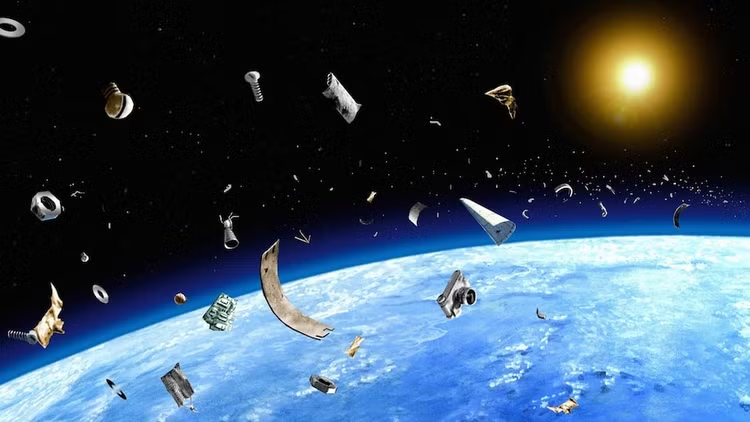
Research by experts has found that every time the solar cycle exceeds the aforementioned activity threshold, space debris begins to lose several more kilometers in altitude.
The objects tracked by the research team mainly orbit the Earth every 90-120 minutes at an altitude of 600-800 km. The rate of orbital decay varies depending on the intensity of each solar cycle, but the general pattern repeats quite clearly over three consecutive cycles.
According to the research team, understanding the impact of solar activity could help space agencies choose safer times for launching spacecraft and operating satellites. This is especially important given the increasing density of space debris, which poses not only a threat in orbit but also risks to civil aviation.
Source: https://khoahocdoisong.vn/mat-troi-giup-don-sach-rac-vu-tru-quanh-trai-dat-post2149099878.html









![[INFOGRAPHIC] Ugreen FineTrack 2 Soccer Design](https://vphoto.vietnam.vn/thumb/402x226/vietnam/resource/IMAGE/2026/05/25/1779680273219_info-bongdinhvi-a-thumb-jpg.webp)









![[GALLERY] Elon Musk shocks with the statement that people may not need to go to work.](https://vphoto.vietnam.vn/thumb/402x226/vietnam/resource/IMAGE/2026/05/24/1779625359765_el-png.webp)





































































Comment (0)