

According to the China Manned Space Administration (CMSA), the Shenzhou 21 crew aboard the Tiangong Space Station opened its hatch at 5:13 a.m. on May 25 (China time) to welcome the three astronauts aboard the Shenzhou 23 spacecraft. The Shenzhou 23 crew consists of: Commander Zhu Yangzhu, pilot Zhang Zhiyua, and payload specialist Lai Ka Ying.
China Central Television (CCTV) broadcast video showing the Long March 2-F rocket launching at 11:08 PM on May 24th from the Jiuquan launch center in the Gobi Desert in northwestern China. The Shenzhou 23 spacecraft separated from the rocket about 10 minutes later and entered orbit.
In the future, the Shenzhou 23 crew will undertake numerous scientific projects in the fields of life sciences, materials science, fluid physics, and medicine.
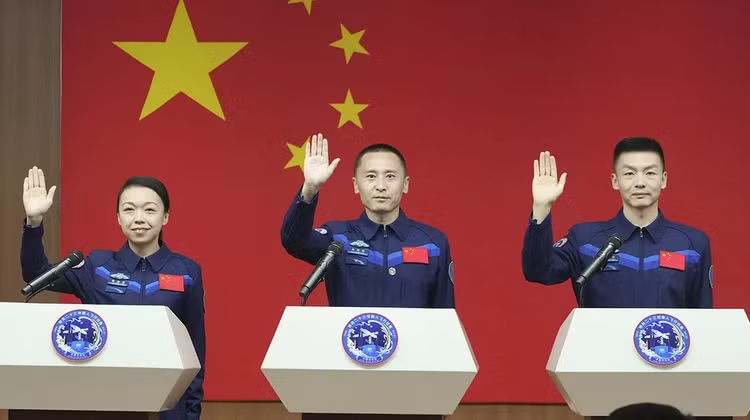
CMSA announced that one of the three astronauts on the Shenzhou 23 mission will remain at the Tiangong Space Station for one year. The identity of the astronaut assigned to this special role will be decided later, depending on the progress and practical requirements of the mission. The crew member remaining at Tiangong will conduct research on the effects of prolonged stay in a weightless environment. This experiment is part of China's preparation for future lunar missions, as well as its missions to Mars.
The Shenzhou-23 mission is considered a crucial test in China's plan to land on the Moon before 2030. If this historic landing mission is completed before 2030, China will take a significant step towards its goal of establishing a permanent base on the Moon by 2035.
To date, the crews on the Tiangong space station have mostly spent six months in orbit before returning to Earth. China's recent Shenzhou missions demonstrate the rapid development of its space capabilities.
Source: https://khoahocdoisong.vn/phi-hanh-gia-trung-quoc-len-tram-thien-cung-chuan-bi-do-bo-mat-trang-post2149101517.html
![[Photo] General Secretary and President To Lam presides over a meeting on preparations for the review of one year of operation of the three-tiered government system.](https://vphoto.vietnam.vn/thumb/1200x675/vietnam/resource/IMAGE/2026/06/02/1780391821195_a1-bnd-4595-9717-jpg.webp)













![[Video] What to do when changing phones from June 15, 2026?](https://vphoto.vietnam.vn/thumb/402x226/vietnam/resource/IMAGE/2026/06/02/1780386426938_dt-jpg.webp)













































































Comment (0)