

In *Men Trầm* , journalist and poet Vân Phi leads readers back to the soil of his hometown, Gò Sành, where layers of broken pottery, traces of alluvial soil, and the breezes of Bình Định (now part of Gia Lai province) have permeated every word he writes.
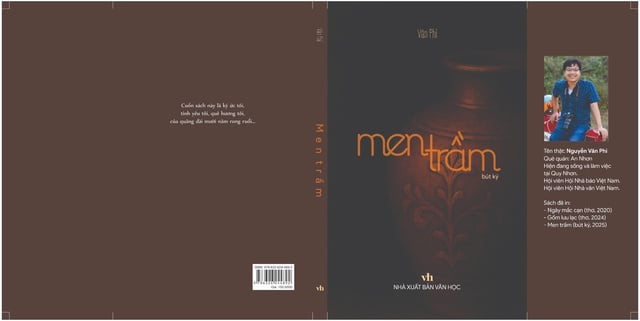
Cover of the collection of essays "Men Trầm" (Literature Publishing House, 2025)
PHOTO: PROVIDED BY THE SUBJECT
I still remember that sea voyage (a trip along the central islands organized by the Coast Guard), ten days adrift at sea, the two of us on the same ship, both seasick, both "enchanted" by our country.
It was during that trip that he wrote *The Blue of the Sea* , a memoir steeped in the scent of the sea, where the color of soldiers' uniforms blends with the color of the sky, where the sound of waves, laughter, and songs of artists and sailors become the sound of patriotism.
In every word, I recognize the images of those days: the strong east wind, the sun beating down on the ship's deck, the singing rising from the ocean. It all felt like a melancholic melody, both majestic and gentle, both ordinary and sacred.
For me, Men Tram is not just a realm of memories, a space of land and people, "sculpted" with words.
I sculpt shapes with clay, with wood, with emotions accumulated over the years, seeping into the layers of brick and stone of my homeland, so I understand that the undercurrent in Phi's writing also originates from the deepest part of the earth, where the love for one's homeland settles into the intoxicating essence of memory.
In each page, I hear the echoes of the wind from Gò Sành, the sound of apricot blossoms heralding Tet, the chirping of birds calling for dawn, the sounds of Tây Sơn martial arts, the melodies of t'rưng and goòng instruments, the hơ'mon dances amidst the vast forest, and the quiet rhythm of life imbued with the soul of Bình Định. For Phi, these sounds are not just scenery – they are breath, heartbeat, something that those who leave always carry with them, even if only remaining in a line of text.
"From the small outdoor stage, the sound of the ceremonial drums resonates in the hearts of the listeners, a lively yet familiar melody . " These words seem to echo from the memories of the Nẫu region, where the sounds of drums, martial arts, and musical instruments blend together, becoming the cultural soul of Binh Dinh. For Van Phi, each sound of her homeland is not only the rhythm of life, but also the echo of memories, of the lives of people who have been intimately connected to the land and their craft for generations.
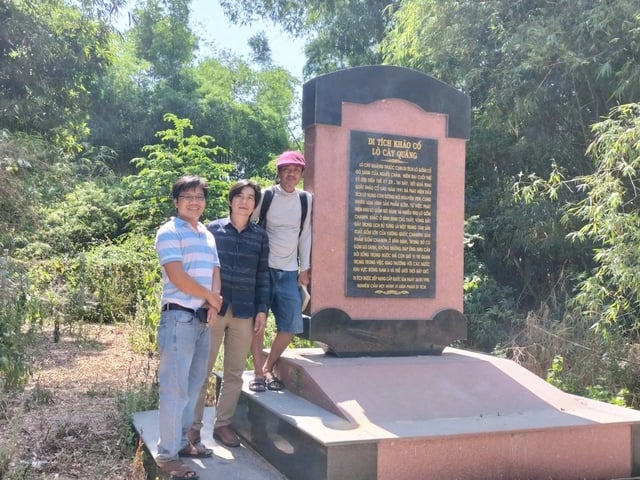
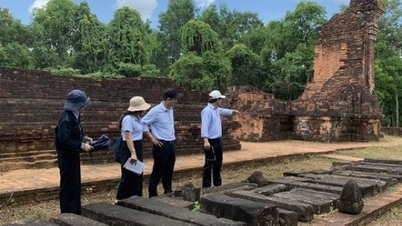
Journalist and poet Van Phi (left) at the Lo Cay Quang archaeological site (part of the Go Sanh ancient pottery kiln complex). He is a member of the Vietnam Writers Association and the Vietnam Journalists Association; he has published two poetry collections: "Day Stranded" (2020) and "Lost Pottery" (2024).
PHOTO: PROVIDED BY THE SUBJECT
Van Phi makes a living as a journalist, but he's rarely seen swaggering or making a fuss in the news. He chooses a quiet, humble corner for himself, away from the dazzling lights, a dark, somber space that mirrors his own demeanor. Yet, within that quiet exterior lies the sensitive, kind, and profound soul of a poet.
He has published two poetry collections, "The Day I Was Stranded" and "Wandering Pottery ," leaving a distinct mark on readers. His poetry, like his prose, subtly reflects a wanderlust but is imbued with the rustic, simple spirit of the countryside, like pottery and earth once buried in wind and rain. From this poetic vein, he transitioned into essays as a natural shift: still an observer of life, but deeper, quieter, like the earth breathing beneath his feet.
He doesn't write about celebrities, he doesn't chase after the spotlight. He chooses to look at the small things, the simple faces, the quiet but bright lives of people, like a small flame persistently burning in a rural kitchen. He writes mostly about the beauty of everyday life, as if wanting to preserve it, as if fearing that in today's hurried and pragmatic pace, that beauty will gradually fade away. Therefore, his words always contain a hidden sorrow, a quiet regret – as if he is touching memories, afraid they will shatter and vanish with the wind.
Reading his work, I am reminded of Bui Xuan Phai, the painter who depicted old street corners, not to beautify them, but to preserve the beauty that was fading. Van Phi is the same. He writes as a way of preserving, preserving the breath of his homeland, preserving the light of people's hearts, preserving those seemingly small things that turn out to be the most weighty and enduring in the soul.
Dark glaze : when letters are fired in the fire of life.
In *Men Tram * , readers encounter a whole landscape of Binh Dinh province: the apricot blossom grower in An Nhon, who spends her life waiting for the flowers to bloom as if waiting for good fortune; Mother Thien in Con Chim, a small woman who carries the burden of water for her livelihood yet still maintains a gentle smile; Martial arts master Nam Hanh, who ignites the flame of martial arts amidst a changing world; Le An, the "lovable wanderer," free-spirited yet kind-hearted; and Diep Chi Huy, the wandering minstrel whose music roams with the wind, living freely and profoundly, just like the romantic sounds he creates.
In Phi's writings, these people appear like reliefs carved not in stone but in words, not glittering on the outside, but shining from within: the light of labor, honesty, and compassion.
And just as clay gives birth to pottery, his writing is also fired in the flames of life.
In Phi's handwriting, I sense the scent of kitchen smoke, the salty taste of the sea breeze, the dampness of the earthenware fields—earth that has transformed into pottery and preserved countless layers of human memories. It is a handwriting that is unpretentious, unostentatious, but shines with a genuine light—the light of a kind heart.
He was born in Go Sanh, a place where ancient bricks still retain their rich history, where memories and the present intertwine like still-warm glaze. Deep within that land, broken pottery fragments remain hidden, like silently shining seeds of memory. I believe that essence of the land has seeped into his blood, so that every word he writes carries the breath of his homeland: simple yet enduring, imbued with the earth's essence, and brimming with the spirit of his native land.
Vân Phi's writings are not merely grandiose pronouncements. Each piece by Vân Phi is a calm breath, exuding the earthy scent of village wine and terracotta, deeply ingrained and warm, like the heavy, unending flow of his homeland. Like the silent alluvial soil flowing beneath the broken glaze of Gò Sành pottery, becoming clearer the more it settles, carrying with it fragments of culture and the fate of the people of Nẫu region. And I believe that this alluvial soil continues to nourish the land of the Côn River day and night, and Vân Phi's writings will remain, silently spreading, warm and authentic, like the fading sound of the traditional opera drums still echoing in people's hearts...
Source: https://thanhnien.vn/men-chu-tu-long-dat-go-sanh-185251114095824386.htm






















































































Comment (0)