

Remember the bucket...
Surely, generations born in the 70s and 80s and earlier are all familiar with the folk verse: "Yesterday I was scooping water at the village well / I forgot my shirt on a lotus flower branch." This verse reflects the working and productive life of Northern Vietnamese farmers, with the banyan tree, the riverbank, the village courtyard, and the blossoming love between couples in this beautiful and simple rural setting.
And generations of farmers in general, and the San Diu people in Thien Ke commune in particular, have grown up in that village, brimming with affection and camaraderie. That's why, even today, San Diu families still preserve familiar items from their daily lives and production activities, such as water buckets, water jars, rice mortars, pot stands, winnowing trays, and sieves... All of these are carefully preserved by the elders and displayed and introduced at the Ethnic Culture Festival in Thien Ke, with pride in the ancient cultural treasures of their people.
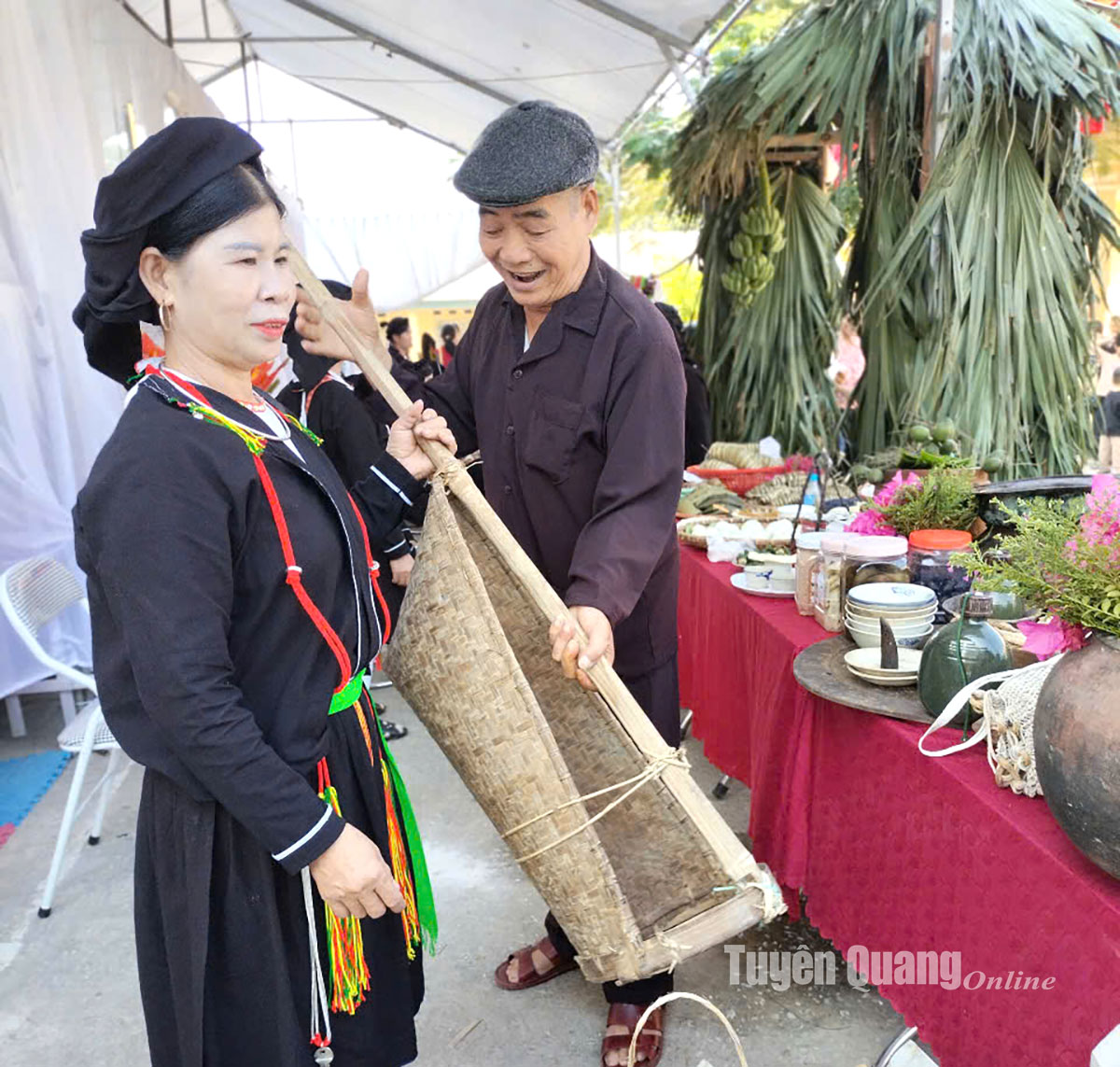
The "Gàu sòng" (a type of water bucket) is closely associated with the farming practices of the Sán Dìu people.
Introducing the farming tools he collected and displayed at his booth during the festival, Mr. On Van Long demonstrated the action of scooping water into the rice fields while sharing about the value and significance of the water scoop. He said that looking at this tool brings back many memories of the old days. During the planting season, especially during dry weather, every household would stay up all night and day scooping water into their fields. The old water scoops were usually woven from bamboo, shaped like a funnel with a flared mouth. A large bamboo ring was used to reinforce the rim, and the sides were fitted with a frame, with a bamboo bar running across the middle to divide the bucket. Without pumps, relying only on human strength, the atmosphere of scooping water with these buckets was as lively as a festival.
Mr. On Van Long's exhibition of old tools and production equipment also features many items associated with the old wood-burning stoves. There's a trivet woven from bamboo and rattan to protect the stove floor from getting blackened. Next to it are several blackened pots used for cooking rice and soup. There are also winnowing trays, baskets, and containers for storing corn and drying rice; rice threshing sieves and vegetable baskets used by women, all woven from bamboo. And finally, there's the rice mortar, not only providing warm and satisfying meals but also the matchmaker for many San Diu couples.
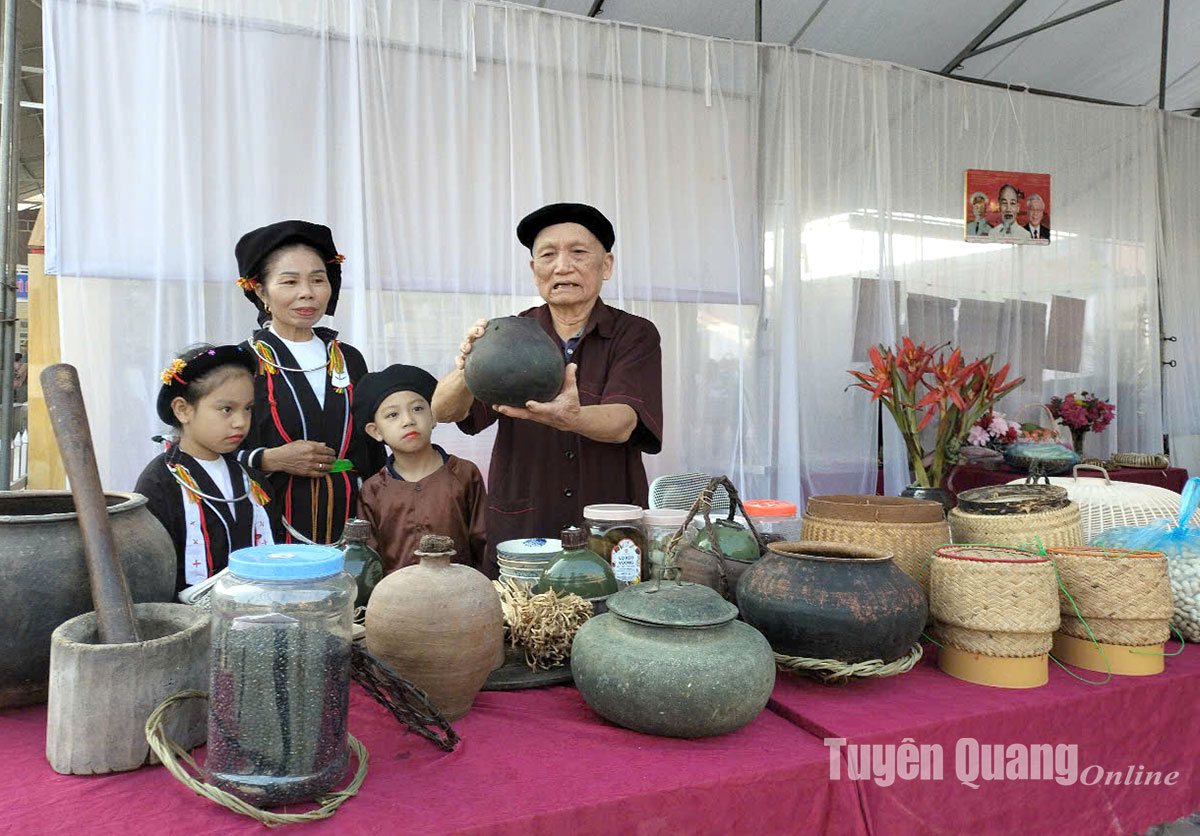
Some household items were displayed and introduced at the Ethnic Culture Festival in Thien Ke commune.
According to Mr. On Van Long, life is very different now than it used to be, but the rudimentary tools and equipment remind the younger generation of the difficult times their ancestors went through. That is history, that no San Diu person should ever forget.
Men say culture
The San Diu people's cultural space is also impressive due to its rich and diverse culinary culture. There, you'll find not only the unique "chao im" (white porridge) but also a variety of cakes with the distinctive flavors of the mountains and forests. These include "banh chung gu" (humpback sticky rice cake), "banh tro" (ash cake), and "banh nep" (sticky rice cake)...
Carefully cutting each piece of the rice cake and arranging them on a plate, Mrs. Diep Thi Vong said: "The humpback rice cake is also a sacred cake in the culinary culture of the San Diu ethnic group. As the name suggests, the humpback rice cake mimics the shape of a woman working in the fields, toiling year-round under the sun and rain. The shape of the cake reminds the San Diu generation of their resilience and hard work in labor and production. Therefore, on Tet (Lunar New Year), every household makes rice cakes to offer to their ancestors."
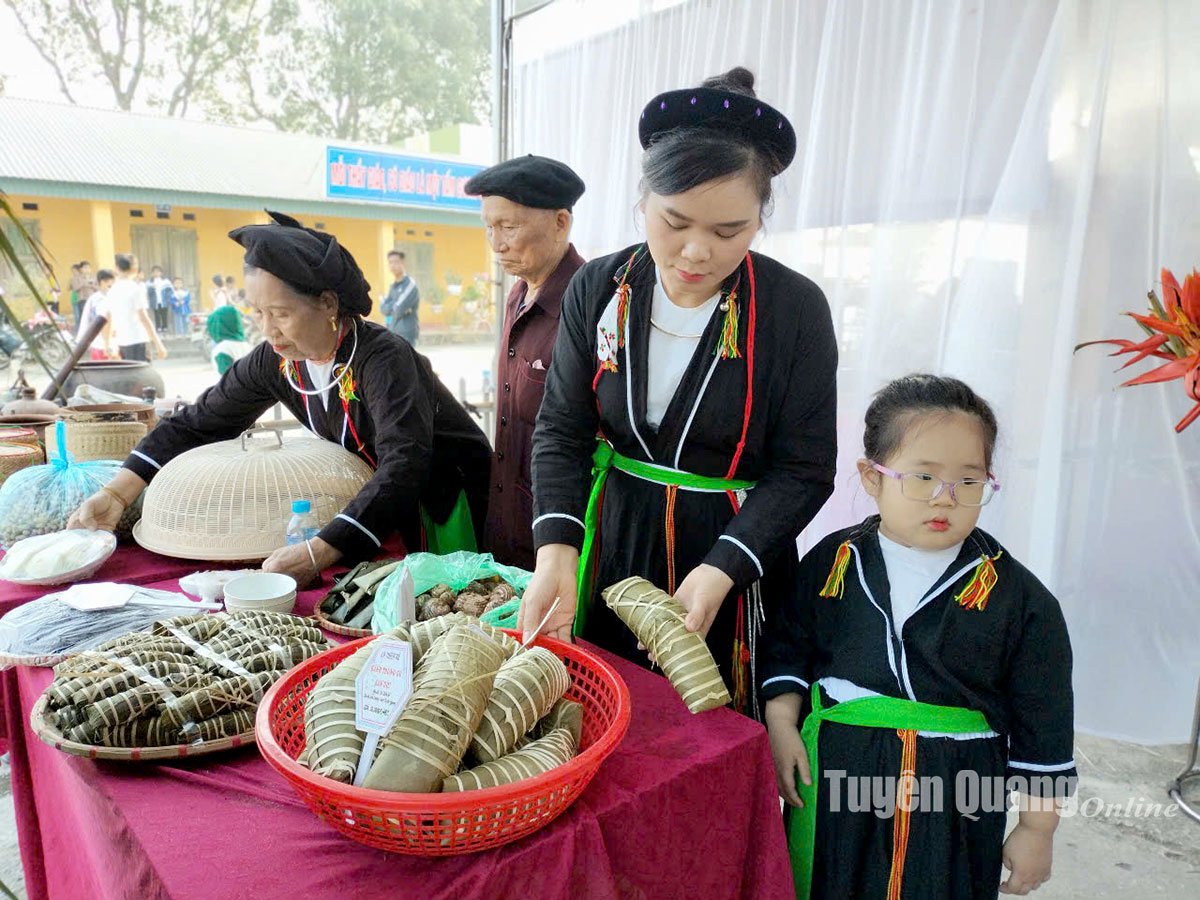
Humpback sticky rice cake (Bánh chưng gù) is an indispensable dish during holidays and Tet (Vietnamese Lunar New Year).
In the culture of the San Diu people, food is considered an appetizer, while folk songs and dances are like an intoxicating elixir, especially Soọng cô. Soọng cô, in the San Diu language, means call-and-response singing, with lyrics in the seven-syllable four-line quatrain style, recorded in ancient Chinese characters and passed down orally through folklore. A San Diu legend tells of a girl named Ly Tam Moi in a certain village who was very intelligent, beautiful, and skilled at call-and-response singing, a skill no one could ever surpass. Three talented young men came to her but could not out-compete with her, leaving her with sorrow and regret for not inviting them into the village. Therefore, day after day, she sang with a poignant, yearning voice, which gradually became the melody of Soọng cô.
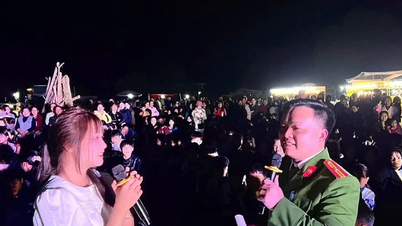
The themes of Soọng cô songs revolve around working life, production; family feelings; friendship, and romantic love... Mr. Ôn Văn Long, a member of the Sán Dìu Ethnic Culture Club, shared that the singing usually includes steps such as: singing to get acquainted, greeting, offering drinks and betel nuts, sharing feelings between the man and woman, singing at dawn, and singing farewell...
Singing Soọng cô is very difficult, especially to sing it well. This is because the rhythm in Soọng cô singing is stable in duration, the vocal range is not too large, the pitch ranges follow each other smoothly, with few sudden highs and lows, and few abrupt changes in embellishments. This is the inherent characteristic that distinguishes Soọng cô from other folk songs of other ethnic groups.
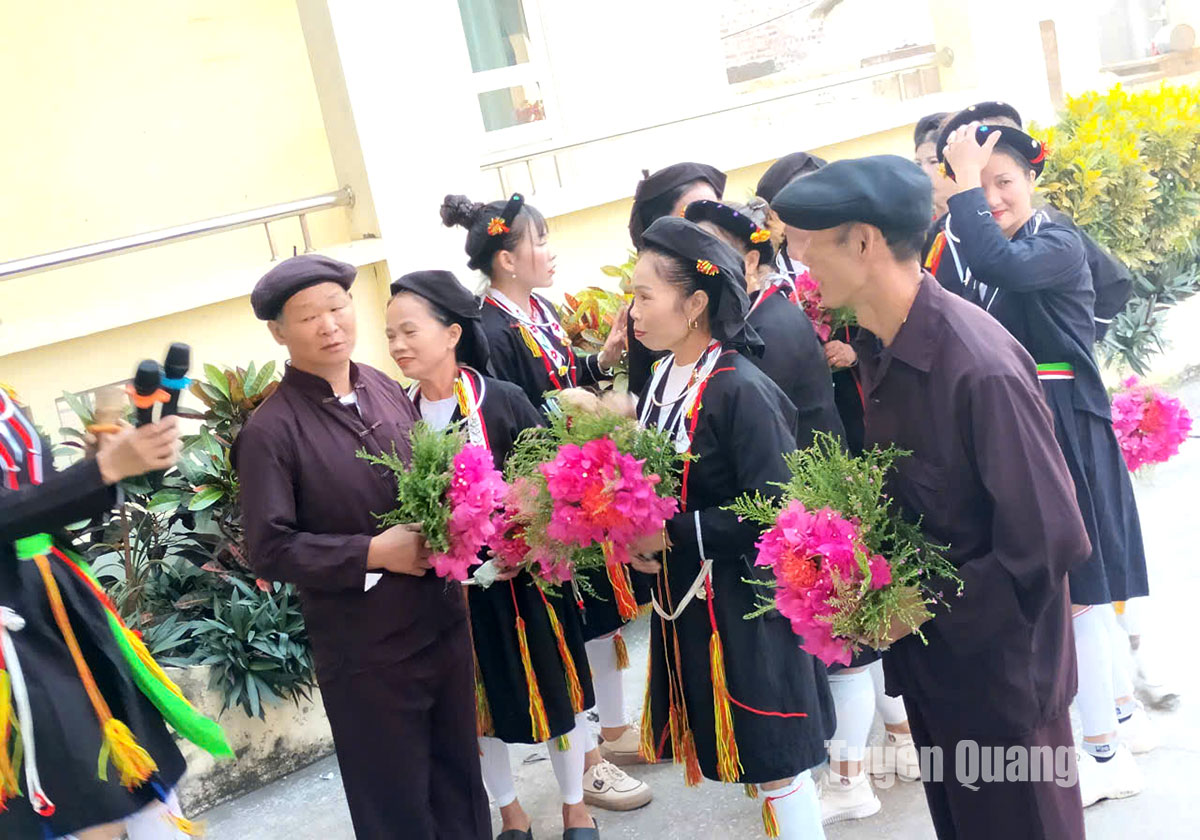
Members of the San Diu Ethnic Culture Club practice singing Soong Co.
He said that Soọng cô isn't flowery but stems from the genuine, simple thoughts and feelings of each person. From the age of 14, he and the village boys would sing all night and all day. If there was a wedding, they would sing all day, from around 8 a.m. to 11 or midnight. When the groom's family came to pick up the bride, they had to sing in a call-and-response style with the bride's family; only if they could win could they take the bride. Even during wedding preparations (whether there was too much or too little), they had to sing in a call-and-response style to ask for the bride's family's understanding... But singing was a lot of fun, and it strengthened the unity and closeness of the village. Small conflicts were resolved thanks to the genuine, heartfelt lyrics of Soọng cô.
Thien Ke commune currently has over 4,400 San Diu people living in the villages of Van Song, Tan Phu, Lang Sinh, and Thien Phong, accounting for approximately 54% of the commune's population. According to Comrade Truong Viet Hung, Secretary of the Party Committee of Thien Ke commune, the San Diu ethnic cultural space is extremely rich and diverse, and preserving the San Diu community's culture is the responsibility of everyone. The immediate solution is to maintain the effective operation of the San Diu Ethnic Culture Club. Club members will be the core in preserving the Soong Co cultural heritage, traditional dances, teaching embroidery skills, preserving rituals, language, traditional costumes, and folk games of the San Diu ethnic group.
The immediate steps taken in preserving the San Diu culture of Thien Ke commune open up a bright future for the San Diu cultural roots to spread and deeply permeate the community.
Source: https://baophutho.vn/men-say-van-hoa-san-diu-225728.htm


![[Photo] Solemn bathing ceremony and Buddha procession in Hue](https://vphoto.vietnam.vn/thumb/1200x675/vietnam/resource/IMAGE/2026/05/31/1780228263543_1-jpg.webp)
![[Photo] Admire the coral "masterpiece" amidst the million-year-old heritage of Dak Lak province.](https://vphoto.vietnam.vn/thumb/1200x675/vietnam/resource/IMAGE/2026/05/31/1780221235105_anh-man-hinh-2026-05-31-luc-16-53-27.png)
![[Photo] The General Secretary, President and his wife begin their state visit to the Philippines.](https://vphoto.vietnam.vn/thumb/1200x675/vietnam/resource/IMAGE/2026/05/31/1780230559452_anh-man-hinh-2026-05-31-luc-19-28-11.png)











![[Video] Sunset at Lap An Lagoon – Where the sun sets over the fishing nets](https://vphoto.vietnam.vn/thumb/340x192/vietnam/resource/IMAGE/2026/05/31/1780192137701_beach-landscape-sea-water-nature-grass-745871-pxhere-com.jpeg)




































![[Photo] Admire the coral "masterpiece" amidst the million-year-old heritage of Dak Lak province.](https://vphoto.vietnam.vn/thumb/402x226/vietnam/resource/IMAGE/2026/05/31/1780221235105_anh-man-hinh-2026-05-31-luc-16-53-27.png)


























Comment (0)