

The reason is the lack of reserve capacity, and although water levels in hydropower reservoirs have improved, they are increasing slowly. Therefore, these reservoirs are still limiting their use to prepare for the next heatwave and potential extreme situations.
"Adjusting the load and reducing electricity consumption is still necessary. We hope consumers will continue to reduce their power consumption to ensure sufficient electricity for daily life as well as for the production and business activities of factories and enterprises," EVN stated.
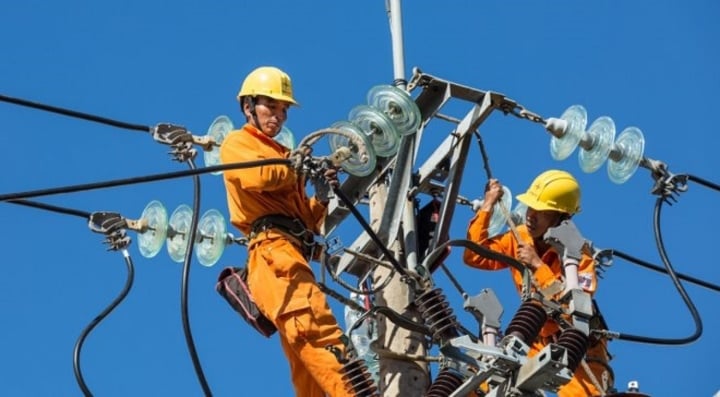
According to EVN, the power system in Northern Vietnam basically met demand from June 23rd. (Illustrative image: Internet)
Speaking to VTC News , Mr. Tran Viet Hoa, Director of the Electricity Regulatory Authority, said that in recent days, the water flow into hydropower reservoirs in the North has improved. The current water levels in Son La, Tuyen Quang, and Ban Chat reservoirs are all 5 to 9 meters higher than the dead water level, while Lai Chau, with its smaller reservoir, has a water level 19.7 meters higher than the dead water level.
"Currently, the North is in the early flood season. It is expected that in the coming period, the water flow into hydropower reservoirs will continue to increase and may be able to ensure electricity supply with an average calculated load of approximately 421-425 million kWh/day. In the extreme case of no flooding, the North can utilize the remaining water in the reservoirs, combined with natural water flow into the reservoirs, to meet the load demand; however, water storage capacity will be difficult," Mr. Hoa said.
According to data updated on the morning of June 24th by the National Power System Dispatch Center, the total electricity load on June 23rd reached 828.8 million kWh. Of this, the North accounted for approximately 384.2 million kWh, the Central region approximately 80.9 million kWh, and the South approximately 363.1 million kWh.
The peak power capacity (Pmax) of the electricity system at 3 PM reached 39,757.1 MW. Specifically, the peak power in the North reached 17,468.2 MW, in the Central region 4,152.8 MW, and in the South 18,319.8 MW.
"To ensure better electricity supply in the future, we hope customers will continue to use electricity economically, safely, and efficiently," Mr. Hoa emphasized.
Meanwhile, Mr. Tran Van Hoa, Deputy Director of Hoa Binh Hydropower Plant, reported that in recent days, Hoa Binh has experienced heavy rains, helping to quench the thirst of rivers and lakes. However, the water level in the hydropower reservoir has not increased significantly.
As of the afternoon of June 23rd, the water inflow into the Hoa Binh Hydropower Reservoir was approximately over 300 m3/s. Currently, the water level in the reservoir is 101.6m, 22m above the dead water level, a decrease of about 1m compared to previous days. This is due to the fact that over the past two days, the plant has increased its output to meet the electricity needs of people and businesses.
"Currently, water levels are stable, and the turbines of the Hoa Binh Hydropower Plant are operating well. If heavy rains and floods continue to occur over a wide area in the coming days, more water will flow into the reservoir, and power generation capacity will continue to increase, thus easing the electricity shortage. However, if the Hoa Binh hydropower plant still has to support the power output of other hydropower plants, we warn of the very real risk of electricity shortages. Therefore, consumers should also use electricity sparingly to avoid the worst-case scenario," Mr. Hoa advised.
Meanwhile, energy expert Dao Nhat Dinh stated that the electricity supply situation has improved significantly in recent days, with a noticeable reduction in rolling power cuts in the North. However, the hot weather is expected to continue. Therefore, the Ministry of Industry and Trade and the Vietnam Electricity Group need to continue directing, urging, and finding all possible solutions to enhance the flexible operation of power sources.
Simultaneously, monitor and direct thermal power plants to prioritize addressing unit malfunctions; ensure the supply of coal and gas for power generation; actively supplement renewable energy sources for the system; and enhance the safe operation of the Central-Northern transmission system. On the consumer side, it is necessary to continue implementing the Prime Minister 's directive on electricity conservation.
PHAM DUY
Beneficial
Emotion
Creative
Unique
Source



![[Image] Shipbuilders exposed to steel and record-breaking heat.](https://vphoto.vietnam.vn/thumb/1200x675/vietnam/resource/IMAGE/2026/06/04/1780545781745_ndo_br_img-5402-4683-jpg.webp)

























































![[Video] Sunset at Lap An Lagoon – Where the sun sets over the fishing nets](https://vphoto.vietnam.vn/thumb/1200x675/vietnam/resource/IMAGE/2026/05/31/1780192137701_beach-landscape-sea-water-nature-grass-745871-pxhere-com.jpeg)






































Comment (0)