|
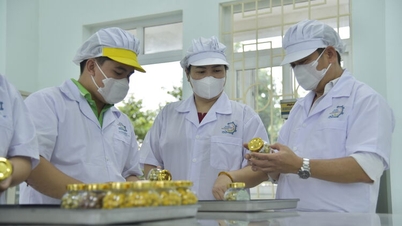
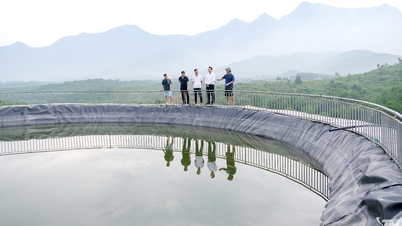
| The application of automated irrigation technology is becoming a trend in many tea-growing regions of Thai Nguyen . Modern production is a crucial foundation for building traceability data and enhancing product value. |
Data speaks louder than words.
The rapid development of e-commerce and online sales platforms has created more opportunities for businesses to expand their markets. However, this has also led to an increasing number of counterfeit, fake, and illegally sourced goods, with increasingly sophisticated methods being employed.
In just the first five months of 2026, market management forces in Thai Nguyen province inspected and handled hundreds of cases related to counterfeit goods and goods of unknown origin. Many items were found to be in violation, ranging from cosmetics and clothing to food. This highlights the urgent need for product information transparency and strict control of the supply chain.
In this trend, traceability is seen as a crucial solution for identifying the entire journey of a product from production, processing, transportation to consumption. Consumers can access information about origin, production process, quality standards, and relevant certifications before deciding to choose a product.
 |
| A team of Dutch experts is assisting Yen Duong Cooperative (Thuong Minh commune) in improving the quality of its green pumpkin growing area. |
Mr. Cao Minh Hai, Deputy Director of the Department of Science and Technology of Thai Nguyen province, said: "Traceability is a tool that helps to make the supply chain transparent, control product quality, build market trust, and contribute to sustainable development. It is also an important requirement for goods to participate more deeply in domestic and international markets."
In recent years, Thai Nguyen has gradually built a database to serve traceability; implemented the issuance of planting area codes; applied QR codes; and integrated traceability content into OCOP, VietGAP programs and safe food supply chains. Many key agricultural products have begun to form a system for identifying and storing production information in a digitized manner.
However, the implementation process still faces many difficulties. One of the major limitations currently is the uneven understanding of traceability. Many production facilities still consider simply attaching QR codes to products as sufficient for traceability requirements, while the core value lies in the updated, stored, and verified data system behind that code.
Ms. Le Thi Quynh Huong, Head of the Sub-Department of Agricultural, Forestry and Fisheries Product Quality Management (Department of Agriculture and Environment), assessed: Agricultural production in the province is still mainly on a small scale and scattered. The recording of production information is largely done manually and has not been digitized uniformly. When food safety incidents occur or product recalls are needed, determining the origin becomes difficult if data is incomplete or there is no interconnectedness between stages in the production chain.



In addition, authorities have also discovered several cases of exploiting the traceability system for commercial fraud. Some products use QR codes that have not been verified or provide only vague and inaccurate information. Even when scanning the code, consumers only see a few introductory images or information in a foreign language, insufficient to verify the product's true origin.
These shortcomings demonstrate that traceability is only effective when the data is comprehensive, accurate, and regularly updated. Technology is merely a supporting tool; the accuracy of the information is what ultimately determines the value of the traceability system.
Transparency of information to elevate the quality of agricultural products.
While traceability previously served primarily government management purposes, it has now become a crucial competitive advantage for businesses, cooperatives, and producers.
As a unit with a 5-star OCOP product, Huong Van Tea Cooperative in Tan Cuong commune is considered one of the pioneering models in applying traceability in Thai Nguyen. The entire raw material area of the cooperative has been assigned a planting area code, and all stages from cultivation, harvesting, processing to packaging are updated in the data system. Ms. Nguyen Thi Huong Van, Director of Huong Van Tea Cooperative, said: Customers can scan the QR code on the product to find out full information about the raw material area, production process, and related quality standards. Publicizing this information helps increase product credibility, facilitating access to markets with high demands for quality and food safety.
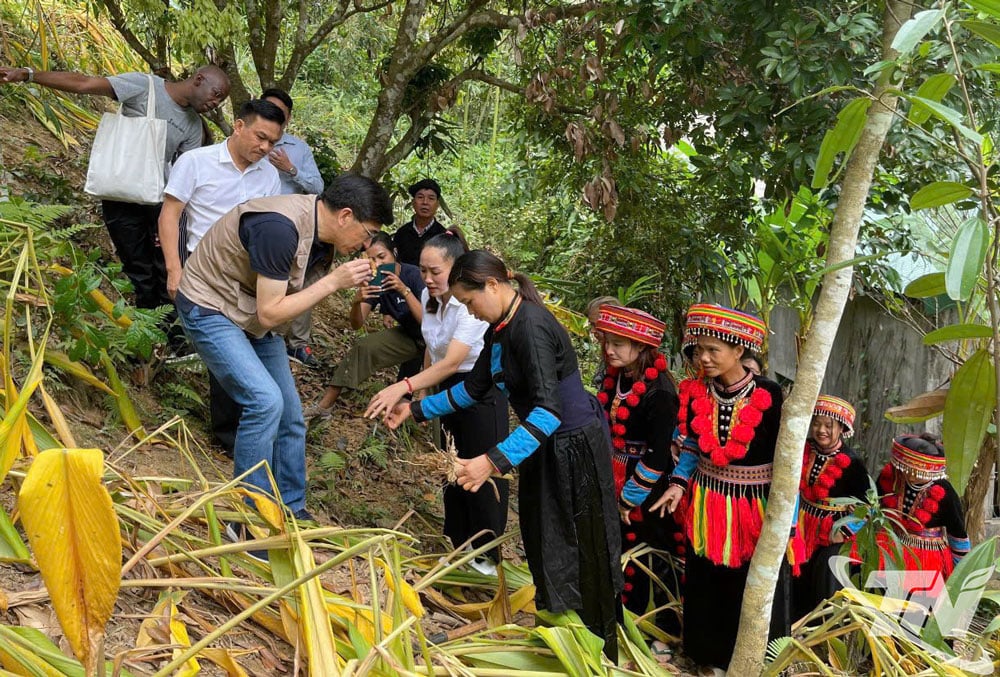 |
| Tan Thanh Cooperative (Bac Kan ward) applies a GIS system to manage information on growing areas and link up areas for growing glutinous turmeric. |
According to Ms. Van, information transparency has become an essential requirement of the market. Traceability helps protect legitimate producers, limits counterfeit goods, and contributes to enhancing the brand value of local agricultural products.
Nevertheless, the transition to digital management methods still poses many challenges for small-scale producers. Many farmers are accustomed to traditional farming practices, making it difficult for them to electronically record data, update information via smartphones, or use digital platforms.
From a consumer perspective, the need for transparent product information is growing. Ms. Nguyen Thu Ha, from Hanoi, said: "My family has been using Thai Nguyen tea for many years because of its distinctive flavor and consistent quality. However, there are many products on the market labeled as Thai Nguyen tea, making it difficult for buyers to distinguish them. I hope that products will be more transparent about their origin, growing region, and production process through QR codes or traceability platforms. Knowing where the product is grown and how it is processed will give me more confidence in my choices, and I will be willing to pay a higher price for truly high-quality products," Ms. Ha said.
Consumer feedback indicates that traceability is gradually becoming an important criterion in purchasing decisions. When information is publicly available and easily verifiable, trust in the product is strengthened. This is a key factor in increasing the value of goods and motivating producers to adhere to quality control processes. According to experts, the key to traceability lies not in the software or technology but in the quality of the data. A modern system will struggle to be effective if the input information is inaccurate or not regularly updated.



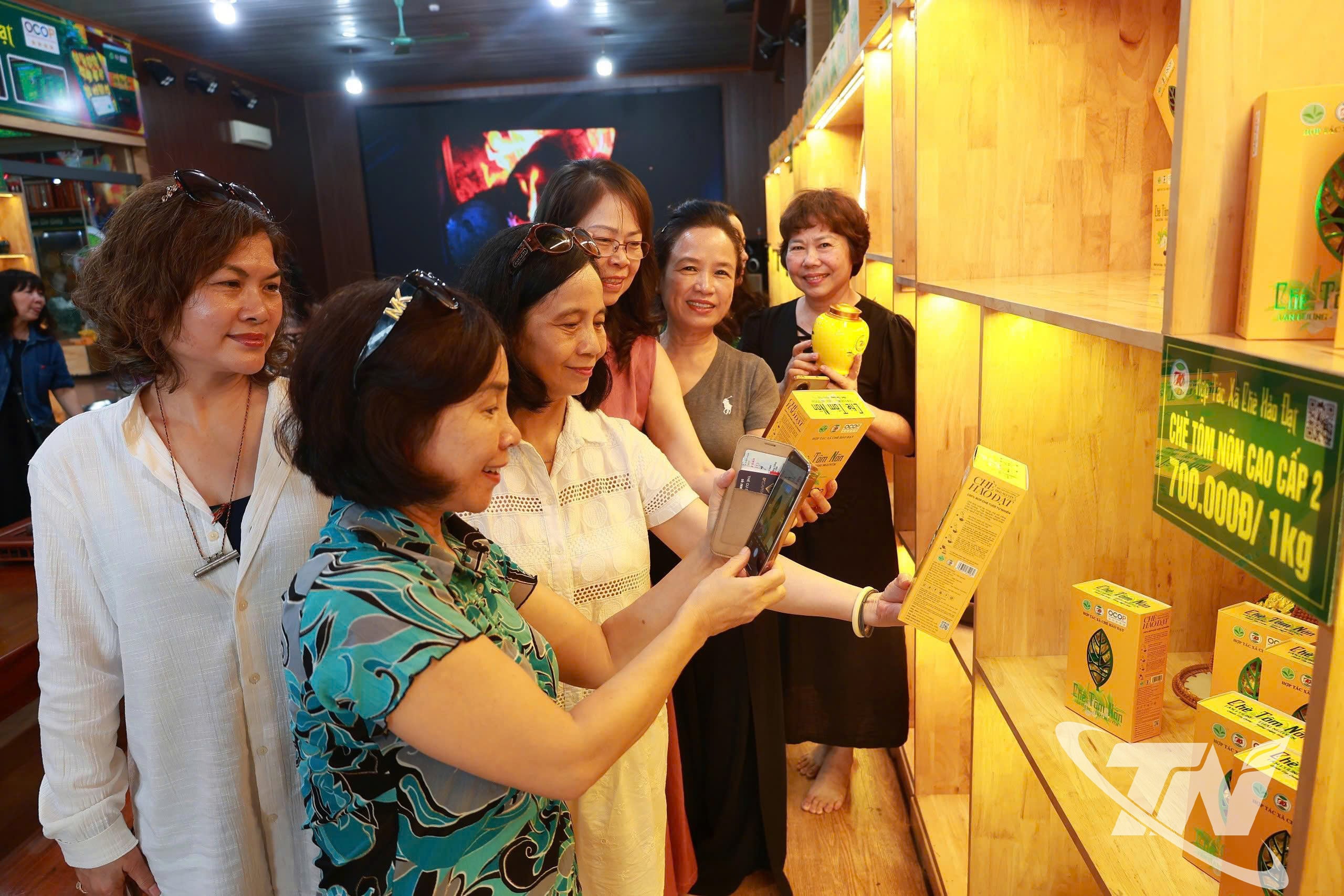 |
| Customers scan the QR code to find out information and the origin of the product before making a purchase. |
In the coming period, Thai Nguyen will pilot the Ministry of Agriculture and Environment's agricultural product traceability system for tea products. Several localities with strengths in tea production will participate in the model before expanding it to other product categories. Simultaneously, the province will continue to support businesses and cooperatives in applying science and technology, digital transformation, and building databases for traceability. Connecting data between production, processing, distribution, and consumption stages is also identified as a crucial task to improve management efficiency and increase product value.
In the digital economy, consumer trust is increasingly measured by verifiable information. For Thai Nguyen, traceability is not just a technical solution for product management, but is becoming a crucial foundation for protecting brands, enhancing the competitiveness of agricultural products, and expanding consumer markets. When each product has a clear, transparent, and reliable "data profile," the value of agricultural products is affirmed by concrete evidence, creating a solid foundation for sustainable development.
Source: https://baothainguyen.vn/kinh-te/202606/minh-bach-du-lieu-cho-nong-san-0904175/




























![[Photo] Thousands of people participate in a run to show their support for the campaign "Sharing a common determination to build drug-free communes, wards, and special zones".](https://vphoto.vietnam.vn/thumb/1200x675/vietnam/resource/IMAGE/2026/06/27/1782554475933_0673e2a3df7b5e25076a-8283-jpg.webp)