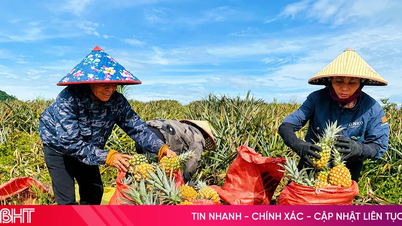
In order to increase income per unit area, the agricultural sector and localities in the province have created favorable conditions for organizations and individuals to consolidate land, shift the crop structure, and expand the area of intensively cultivated crops for high productivity and output.
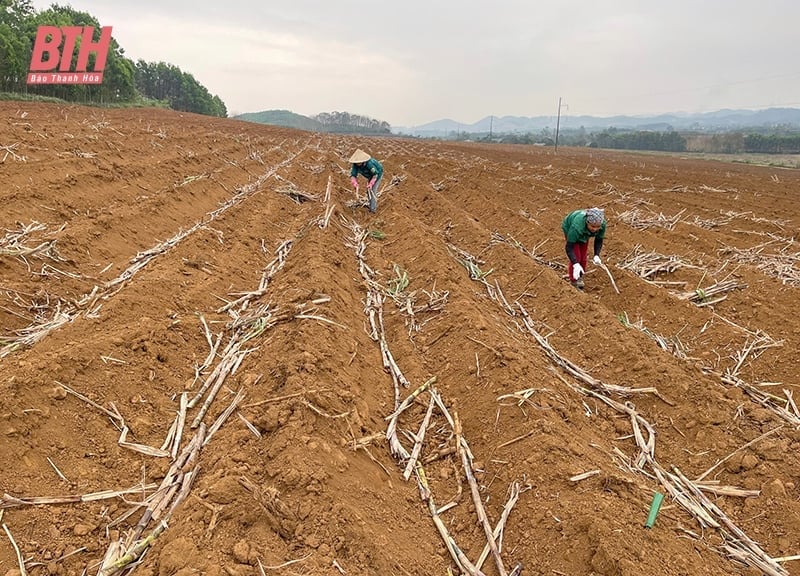
To expand the area of intensively cultivated crops, Thach Thanh district has been actively transforming its crop structure, focusing on land consolidation, high-tech production, and digital transformation in agriculture to form large-scale, concentrated agricultural production areas. Through this, the district has proactively planned large-scale concentrated fruit-growing areas to attract organizations and individuals to invest in development and apply high technology to production. To date, the entire district has developed 1,100 hectares of concentrated fruit trees, yielding 22,000 tons per year. Many intensive fruit-growing models in the district have proven highly economically effective, such as: oranges and pomelos in Thanh Cong commune and Van Du town; dragon fruit in Thanh Tien and Thanh Tam communes; and Taiwanese pear guava in Thanh Tam commune...
Along with developing fruit trees, the people of Thach Dong commune have linked production with Sao Khue Trading Joint Stock Company (Dong Son) and Luu Suong Trading Company Limited (Ha Trung) with an area of 200 hectares of glutinous rice per season, yielding 100 tons. Furthermore, through cooperatives acting as intermediaries, people in the district have signed contracts for the production and intensive cultivation of sugarcane on 3,000 hectares per year with Vietnam-Taiwan Sugarcane Company Limited... Mr. Tran Ba Son, Vice Chairman of the People's Committee of Thach Thanh district, said: “In order to leverage the advantages of natural conditions and key crops of the district to focus on developing production in the direction of applying high technology associated with the value chain, Thach Thanh district is currently focusing on mobilizing resources and attracting businesses and cooperatives to participate in completing the Project “Pilot project on restructuring crop patterns, associated with land consolidation and concentration, and digital transformation for high-tech agricultural production in Thach Thanh district until 2030”. Through this, the district is actively innovating forms of production organization, promoting the restructuring of crop patterns, land consolidation and concentration, applying science and technology and developing markets, building and forming large-scale, high-quality concentrated agricultural production areas.”



To date, the province is maintaining and developing intensive farming areas and concentrated production zones, such as: 150,000 hectares of high-yield, high-quality intensive rice cultivation, 20,000 hectares of intensive corn cultivation, 12,000 hectares of intensive sugarcane cultivation, 13,500 hectares of safe vegetables, 325 hectares of high-tech ornamental plants and flowers, 12,000 hectares of concentrated fruit tree cultivation, and 17,000 hectares of fodder crops. Many intensive farming models have yielded high economic efficiency, such as: the production of F1 hybrid rice seeds, purebred rice varieties, and commercial rice in Yen Dinh, Hoang Hoa, Thieu Hoa, Tho Xuan, and Nong Cong districts... which yield economic efficiency 1.2 to 1.5 times higher than conventional production; intensive fruit tree cultivation areas in Tho Xuan, Thach Thanh, and Nhu Xuan districts... which generate revenue of 500 million VND/ha and profit of 350 million VND/ha. Growing medicinal plants in Trieu Son district yields an income of 400 million VND/hectare/year...
To develop intensive crop cultivation, through the "Construction of an agricultural chemical map to serve intensive cultivation, restructuring of crop patterns, and sustainable management of agricultural land resources in Thanh Hoa province (Phase 1)", the agricultural sector is orienting the development of crops suitable to the climate and soil conditions, such as: developing citrus fruits and pineapples, dragon fruit, guava, seedless lychee, and early-ripening longan in Thach Thanh, Nhu Xuan, and Ngoc Lac districts... At the same time, it is transforming the crop structure from low-economic-efficiency crops to higher-economic-efficiency crops, developing raw material crops for processing, such as: sugarcane (8,100 ha), cassava (7,200 ha), rubber (5,400 ha), and animal feed crops (4,500 ha).
In the lowland districts, efforts are being intensified to consolidate and concentrate land for large-scale agricultural production using high technology. Alongside this, localities are focusing on developing large-scale, concentrated specialized production areas, such as: 101,500 hectares of high-yield, high-quality intensive rice cultivation areas; 4,000 hectares of concentrated fruit tree areas; over 8,000 hectares of vegetable and fruit production areas; and 325 hectares of concentrated ornamental plant and flower cultivation areas...
According to Cao Van Cuong, Director of the Department of Agriculture and Rural Development, in recent years, the trend of intensive crop cultivation using high technology has attracted investment from localities, businesses, and cooperatives. This form of production yields the highest value and best quality agricultural products. In the coming time, to develop intensive crop production in the province, the agricultural sector will review and re-identify concentrated production areas for the application of high technology. The province needs to issue strong policies and mechanisms to attract people, businesses, and cooperatives to focus on developing intensive crop cultivation using high technology. Along with that, the agricultural sector will actively apply and transfer science and technology into production, making high-tech agriculture a key sector.



Text and photos: Le Hoi
Source: https://baothanhhoa.vn/mo-rong-dien-tich-cay-trong-tham-canh-237674.htm