

(BLC) - Taking advantage of the numerous streams and cool climate, in recent years the people of Sin Suoi Ho commune (Phong Tho district) have been raising cold-water fish and rapidly expanding the area over the years.
Sin Suoi Ho commune is widely known as a leading locality in the province's community tourism development. Every year, the commune attracts a large number of tourists who come to visit, experience, and explore. Furthermore, it is a locality rich in the cultural identity of the Mong ethnic group; has great potential for developing temperate fruit trees; and can increase income from tea and cardamom cultivation, forest protection and care, and more recently, cold-water fish farming.
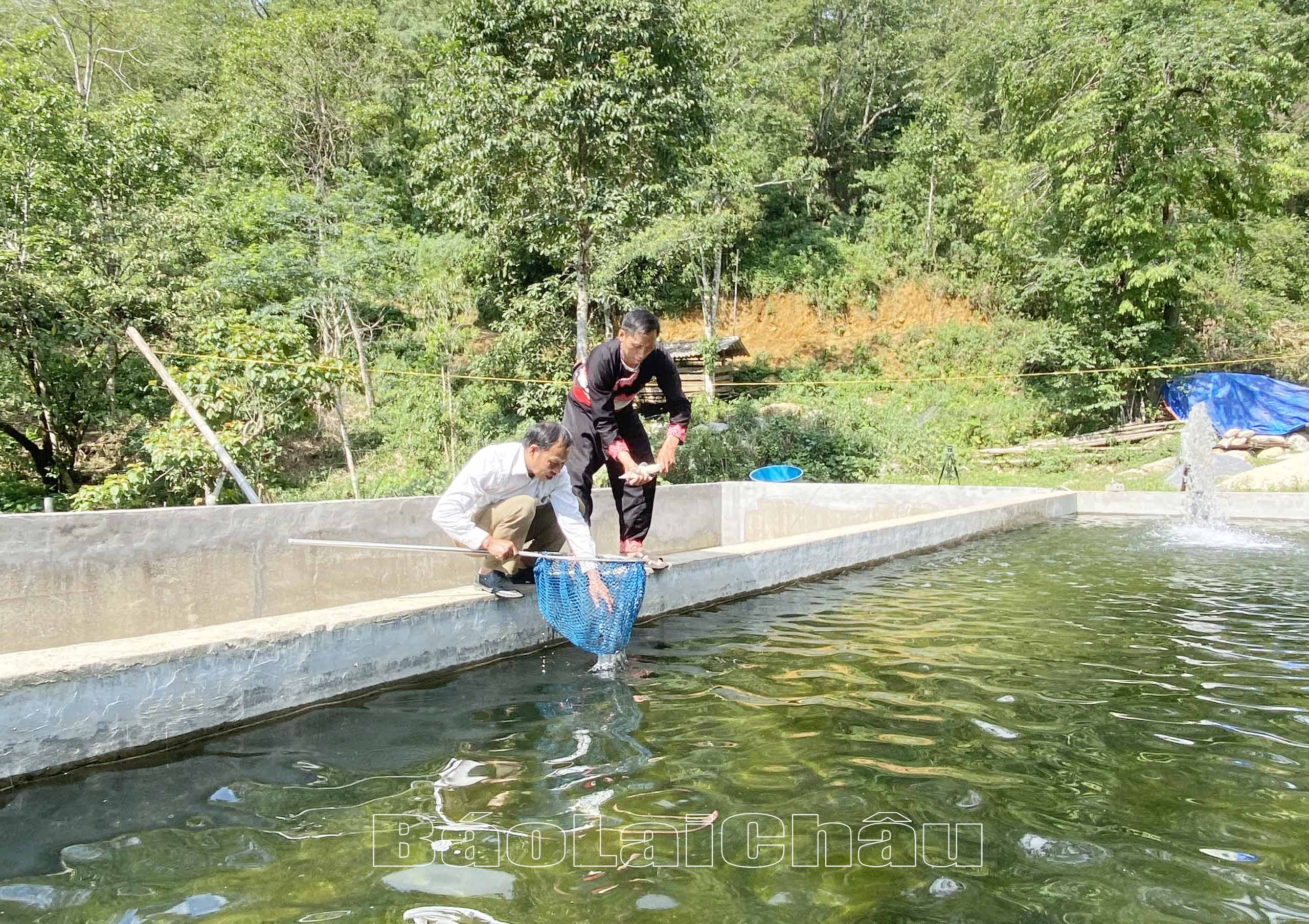
Raising cold-water fish brings high income to the family of Mr. Sung A Phong (on the left) in Sin Suoi Ho village.
The family of Mr. Sung A Phong in Sin Suoi Ho village used to make a living by growing orchids, but when many villagers started growing them, finding a market became more difficult. Recently, the orchids have been affected by disease, reducing economic efficiency. Therefore, he decided to switch to raising cold-water fish. He researched the market for cold-water fish, finding it easy to sell, with high economic value and quick return on investment. Furthermore, the village's natural conditions and climate are very suitable for fish farming; many tourists visiting the village want to eat sturgeon or salmon, but there isn't enough fish available to serve them.
To start the business, his family invested nearly 200 million VND to buy land and build two tanks with a volume of 160m3 each. They then invested another 150 million VND to buy 900 sturgeon and feed for breeding. Fortunately, under his care, the fish thrived. With retail prices of 250,000 VND/kg for sturgeon and 180,000 VND/kg for salmon, after deducting expenses in the first breeding cycle, his family earned a profit of 250 million VND. Currently, his family has 3,000 salmon and sturgeon ready for sale in the tanks, and 1,000 young sturgeon. In his plan, from now until the end of 2024, he intends to continue investing in expanding the scale of cold-water fish farming.
As a hardworking and resourceful farmer who dared to change, recognizing the potential of cold-water fish farming, Mr. Sung A Phenh, also from Sin Suoi Ho village, decided to shift his focus. In early 2023, he sold five of his family's buffaloes and borrowed 50 million VND from the Phong Tho District Branch of the Social Policy Bank to invest in building three fish ponds with a volume of 200m³ each. In May 2023, he purchased 2,000 sturgeon for breeding. Currently, his family's fish stock is thriving. They plan to raise an additional 6,000 sturgeon in 2024.
We learned that the cold-water fish farming in Sin Suoi Ho commune has been practiced since 2019 and has developed strongly from 2022 to the present. It is mainly concentrated in the villages of Sin Suoi Ho, Den Sung, Chang Phang, and Sang Ma Pho. Cold-water fish farming requires significant investment and strict care techniques. Therefore, to facilitate the development of cold-water fish farming, the commune has encouraged and guided people to visit and learn from experienced cold-water fish farming facilities both within and outside the province. Experienced farmers are encouraged to share their knowledge with younger farmers.
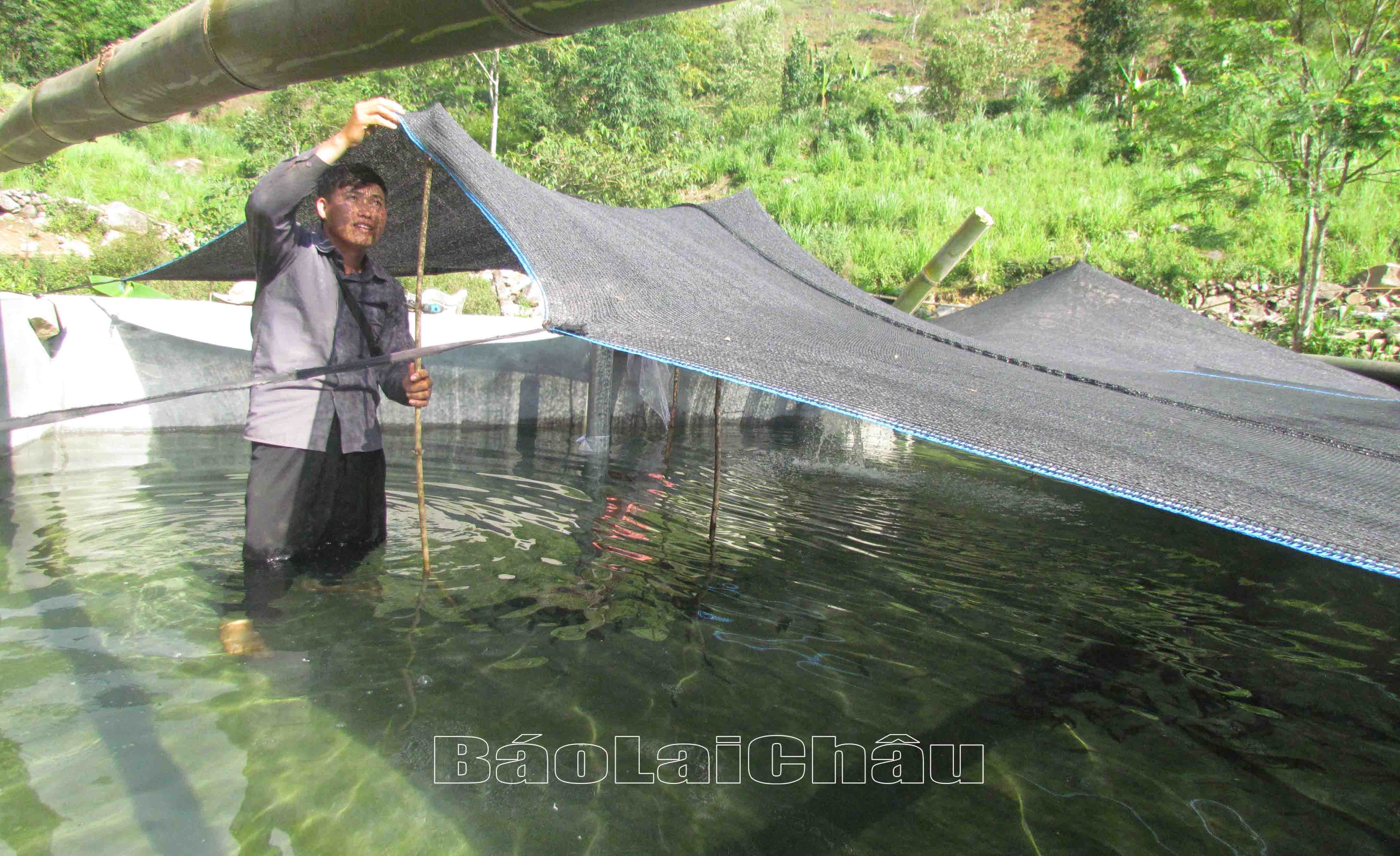
The family of Mr. Sung A Phenh in Sin Suoi Ho village uses nets to cover the ponds to limit the impact of the heat on their newly raised sturgeon.
In the villages, people have also proactively established cold-water fish farming cooperatives to create a bridge for connection and mutual support in economic activities. On the part of the commune's organizations and associations, they have signed entrustment agreements with the Phong Tho District Branch of the Social Policy Bank to provide loans to members, resolving initial difficulties. As a result, the number of households raising cold-water fish in the commune has increased significantly.
In the coming period, Sin Suoi Ho commune will continue to encourage people to expand the scale of cold-water fish farming at the headwaters of streams to serve the needs of tourists and supply the market. The goal is to make cold-water fish farming a new and effective direction, helping people increase their income, improve their lives, and contributing to the socio-economic development of this border region.
Source link

![[Photo] Prime Minister Pham Minh Chinh receives the Chinese Ambassador to Vietnam](https://vphoto.vietnam.vn/thumb/1200x675/vietnam/resource/IMAGE/2026/04/05/1775397481797_ndo_br_dsc-5512-jpg.webp)
































































Comment (0)