

In the 1980s, in my hometown, dwarf corn and fatty corn (local varieties, now extinct) were harvested, dried, and piled up in baskets (woven bamboo containers).
Every few weeks, after helping Grandma with some chores, we kids would pester her: "Grandma, make some corn porridge, we're craving it!" Grandma would playfully scold us: "You kids, always playing and not studying, and you're already asking for corn porridge?" Without waiting for her reply (because that scolding was taken as a tacit agreement), we'd all pitch in to turn over the stone mortar, wash it clean, and dry it.
In the rural areas of Quang Nam province, stone mortars are indispensable in every household. My maternal grandparents' house had a rather large mortar, called a "great mortar," weighing over a hundred kilograms, carved from a single block of green stone. I don't know how old the stone mortar was, but its insides were worn smooth.
Everything required it: pounding rice, pounding corn, pounding bananas for pigs to eat (at that time, bran was scarce, so the pigs' main food was bananas, usually plantains, thinly sliced with a knife and then pounded in a stone mortar)... But the most unforgettable experience for me was pounding large ears of corn!
Back then, in my village, we didn't use aluminum pots but earthenware pots to roast corn (I only later learned that my village was so poor that few families owned aluminum pots). Sand was poured into the pot and heated, then the corn was added and stirred well with bamboo chopsticks. When there was a crackling sound in the pot, the lid was covered to prevent the corn from scattering, and then stirred repeatedly. Roasting continued until the corn kernels puffed up slightly, turned golden brown, and fragrant. Over-roasting would burn the corn.
The roasted corn was left to cool for a while before being put into a stone mortar. We took turns, each pounding it with about five or ten wooden pestles until the corn was crushed.
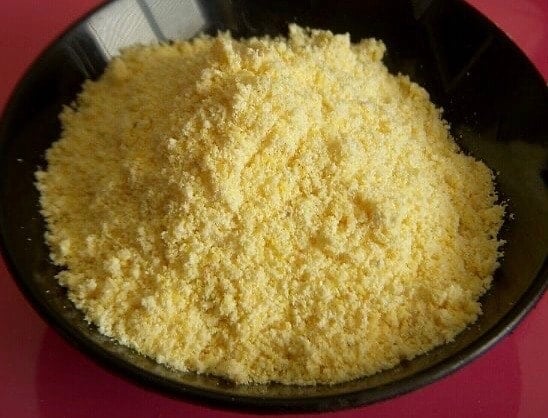
Just then, Grandma took a knife and chopped the palm sugar (also known as block sugar) into many small pieces, mixing them thoroughly into the mortar with the corn, and adding a few grains of salt. The wooden pestle "worked" for another ten strokes, and the corn-sugar mixture became a yellow powder that looked quite appealing and had an indescribable aroma, so much so that some of the children couldn't resist secretly scooping up handfuls of the powder and putting them in their mouths.
The process of making puffed corn doesn't stop there. My grandmother takes a mortar and pestle, puts in the cornstarch, and rotates it so that the fine powder falls into the sieve. The lumpy, hard powder remaining in the mortar and pestle is put into a mortar and pounded again, then put back into the mortar and pestle (the mortar and pestle are woven bamboo utensils)... All the fine powder is put into a large bowl.
We enjoyed eating the corn on the cob without using plastic or aluminum spoons, but with... jackfruit leaves. We went to the garden, picked jackfruit leaves, rolled them up, and used bamboo toothpicks to thread one end shut, making a "spoon" to scoop it up.
Unlike other rustic dishes, eating corn on the cob requires a certain "skill": The eater tilts their head back to receive the "spoon" of corn on their tongue, then closes their mouth to allow saliva to slowly dissolve the corn powder, without chewing.
Eating popcorn requires a gentle approach, meaning you should only scoop up a moderate amount of cornstarch at a time; too much will cause you to choke. When eating, avoid looking directly at other people's faces so that if you choke or spit it out, it won't cause discomfort.
Now that my hair is streaked with gray, I still cherish the indescribable feeling of eating roasted corn: the sweet taste of sugar, the salty taste of salt, the nutty flavor of the corn, and the subtle aroma of jackfruit leaves all blend together to create a delicious and unforgettable treat!
This afternoon, returning to my grandmother's old garden, I couldn't help but feel nostalgic upon seeing... the old stone mill – a witness to a difficult time closely associated with growing corn in the past.
Recalling the corn dishes of my childhood, I still hear my grandmother's words echoing in my ears: That if you want to eat, you have to get into the kitchen. That you must cherish simple, rustic dishes, the culmination of hard work and the soul of the countryside, not necessarily gourmet delicacies. That you must learn to eat with grace...
Those early life lessons are never outdated!
Source: https://baodanang.vn/mon-bap-lo-cua-ngoai-3311944.html






































































Comment (0)