



Gia Mieu Temple - a magnificent architectural masterpiece with many elaborate carvings and decorations.
It was an early winter morning. The sky was a silvery mist, and I was shivering, occasionally exhaling warm breath from my throat. Greeting us was Mr. Nguyen Dinh Luan, the caretaker of Trieu Tuong temple in Ha Long commune, dressed in his weather-defying attire. He raised his wrinkled, calloused hand and cheerfully said: "It's only a little cold early in the morning; the sun will be out soon."
Perhaps many people are familiar with Gia Mieu, the ancestral land of the Nguyen dynasty. This place has witnessed countless families and individuals who migrated south to expand their territory... partly due to historical changes, and partly out of a sense of responsibility to the nation. The Trieu Tuong temple, the Gia Mieu communal house, the Truong Nguyen mausoleum, the Quan Hoang Trieu Tuong shrine... all are tinged with the silver of time, but the stories of the Nguyen family remain ever-present.
Mr. Nguyen Dinh Luan is like a tour guide. He is very knowledgeable about the history of the Nguyen dynasty, the lives of the Nguyen lords, and the genealogical records of the Nguyen Dinh, Nguyen Huu, and Nguyen Van branches here. “I am a descendant of the royal family; not knowing my roots is like a tree with unstable roots, ready to tilt at any moment,” he proudly said, introducing the site. He explained: “Just one year after King Nguyen Anh ascended the throne (1802-1820), taking the regnal name Gia Long, he ordered the construction of a temple to worship the ancestors of the Nguyen dynasty. After several conferences, the Trieu Tuong mausoleum complex was recognized as a national historical site in 2007. In 2009, relevant authorities conducted archaeological excavations of the ancient foundations. From 2011 to December 25, 2018, the temple was constructed and officially inaugurated.”
The temple complex consists of two structures: the main temple, dedicated to Emperor Trieu To Tinh Hoang (Nguyen Kim) in the central chamber, and Emperor Thai To Gia Du (Nguyen Hoang) in the left chamber. To the east of the main temple is the shrine dedicated to Duke Truong Quoc Nguyen Van Luu (Nguyen Kim's father) and Nguyen Han (Nguyen Hoang's son). The entire complex faces south. Annually, on the five festivals and other festivals as prescribed by the court, officials of Thanh Hoa province, following orders, perform rituals as in temples in the imperial capital of Hue. At the same time, many Nguyen dynasty emperors such as Gia Long, Minh Menh, Thieu Tri, Thanh Thai, and Khai Dinh, after ascending the throne, came to offer incense and pay respects to their ancestors.
Many people still think Trieu Tuong is the name of a place. “Trieu means 'open,' Tuong means 'beautiful.' The full meaning is 'opening a beautiful dynasty.' That's why I disagree with the view that Trieu Tuong Temple is a 'miniature Hue Imperial City.' It would be more accurate to say that Hue Imperial City is nothing more than an 'expanded Trieu Tuong Temple.' In terms of time, Trieu Tuong Temple was built three years earlier. It's not just Mr. Luan; anyone from Gia Mieu village/hamlet will proudly say they were born here, are descendants of the ancestors, and belong to the royal lineage.”
Following National Highway 217B, we visited Gia Mieu communal house, dedicated to the village's tutelary deity Nguyen Cong Duan – a founding hero of the Later Le Dynasty, who was bestowed the title of Thai Bao Hoanh Quoc Cong by King Le Thai To. The communal house was built by King Gia Long in 1804, at the same time as the Trieu Tuong temple. Gia Mieu communal house is a magnificent architectural masterpiece with many elaborate carvings and decorations. These carvings are evident on the roof trusses, the ends of the beams, the purlins, and the cornices. In addition, mythical creatures such as dragons, unicorns, and turtles are also meticulously and delicately decorated, while deer, sparrows, and geckos are also featured on the brackets and purlins. However, the soul and customs of the village are embodied in the village charter that originated hundreds of years ago, when Gia Mieu was still a hamlet: Gia Mieu Ngoai Trang.
The village charter of Gia Mieu contained a clause stipulating that all young men of the village, regardless of social standing, wealth, or occupation, must return annually during Tet (Lunar New Year) to offer incense and participate in the ceremony honoring the village's tutelary deity. Anyone who neglected this duty would be punished by the village according to the charter's provisions. The village charter was so strict that, according to the elders, in the 9th year of the reign of Emperor Thieu Tri, for some unknown reason, the Emperor did not return to the village to offer incense and worship the tutelary deity and ancestral shrine. Based on the provisions of the charter, the village sent a delegation of sixty elders on foot from Gia Mieu to Hue to present the charter to the Emperor. The Emperor personally visited the guesthouse to apologize to the elders, admitting that due to his busy schedule with state affairs, he had neglected his responsibilities as a young man of the village. After apologizing, the king hired someone to go to Gia Mieu to be the village crier for six months to atone for his mistake due to... negligence.
To this day, Gia Mieu communal house remains a gathering place for villagers on important occasions, a sacred place for descendants living far away to admire and remember.
About 1km from Gia Mieu communal house, we arrived at Truong Nguyen mausoleum. The story of the mausoleum's construction and the relocation of Nguyen Kim's remains to Thien Ton mountain alone is incredibly mysterious. Mr. Nguyen Dinh Luan told us: In the year of the Snake (1545), Nguyen Kim, then 78 years old, was poisoned to death by Duong Chap Nhat, a general of the Mac dynasty. King Le, grieving, posthumously bestowed upon him the title of Chieu Huan Tinh Cong. His remains were brought back and buried on Trieu Tuong mountain. Legend says that as soon as the soldiers placed Nguyen Kim's coffin into the grave, a sudden thunderstorm erupted, with heavy rain and strong winds, and the grave slowly closed, causing everyone to flee down the mountain in fear. A short while later, the sky cleared, and the soldiers returned to find only the coffin placed on a rocky, undulating mountain, covered in lush vegetation; they couldn't tell where the burial was. Feng Shui masters considered it an auspicious sign, that heaven had "buried" him. Later, his descendants said that he had been "heavenly buried." And the mountain has been named Thien Ton ever since. Later, whenever they paid homage to the ancestral kings, the Nguyen dynasty kings could only look up at Thien Ton Mountain and bow in reverence.

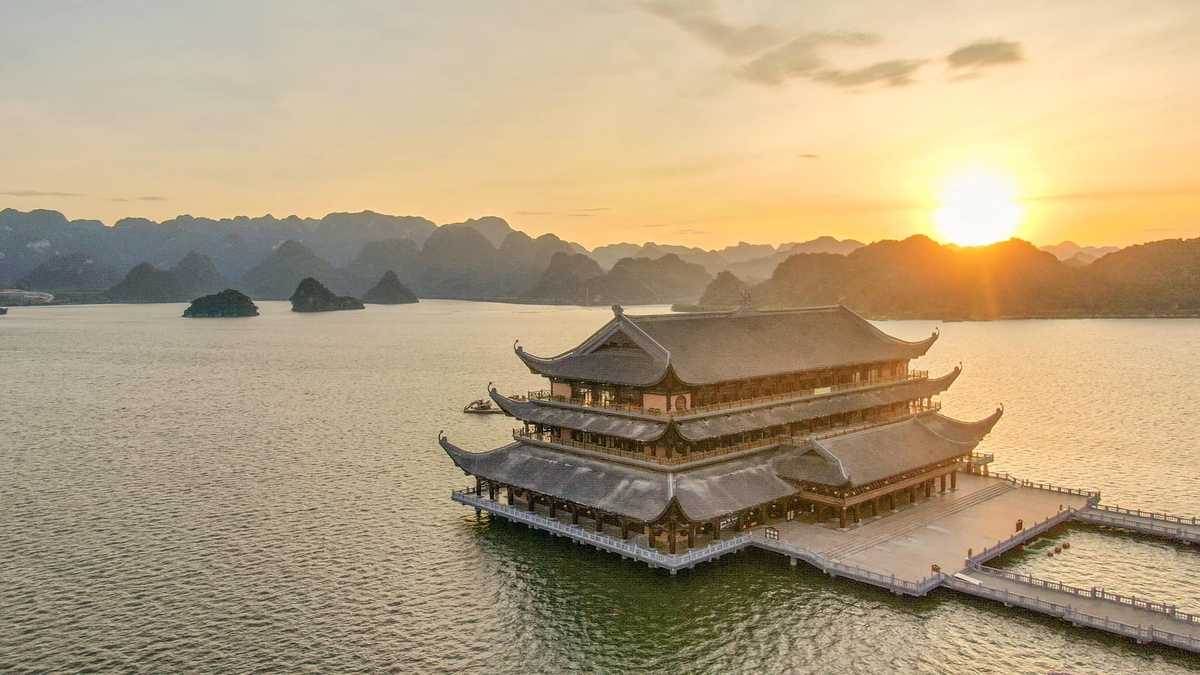
Trieu Tuong Temple - the "place of blessings" for the Nguyen royal family.
From a scientific perspective, it was due to heavy rain, strong winds, and landslides, but from a spiritual perspective, the predictions later proved true. And the descendants of the ancestor maintained nine generations of lords and thirteen generations of kings, one of the longest-lasting dynasties in Vietnamese history.
Standing in the space of Truong Nguyen Mausoleum, gazing at the wall inscribed with the translation of Emperor Minh Mang's poem in Chinese characters: "The great land, blessed by the sacred lord, gave birth to Trieu To / Cultivating moral principles, upholding sacred martial prowess," one further understands that it is only natural that a sacred land produces outstanding individuals.
A single day in Gia Mieu certainly cannot encompass the entirety of the homeland of the 9 lords and 13 kings of the Nguyen Dynasty: beginning in 1558 and ending in 1945, spanning 387 years. Like us, I forgot the chill of the weather and listened intently to the many stories, both fact and fiction, recounted by the descendants of the Nguyen family in Gia Mieu. The achievements of the Nguyen lords remain, enduring through time and need to be preserved and promoted by future generations with reverence for the ancestors who expanded the territory and shaped the nation as it is today. Leaving Gia Mieu village, I continued to ponder this land of spiritual significance and outstanding people, hoping that soon, after the second phase of the Trieu Tuong Temple's restoration is completed, there will be a tour through this cultural and historical region, the birthplace of the Nguyen Dynasty.
This article uses the following books as source material: Nearly 400 Years of the Nguyen Dynasty (Luong Kim Thanh, Thuan Hoa Publishing House, 2011); Nine Lords and Thirteen Nguyen Kings (Nguyen Dac Xuan, Thuan Hoa Publishing House, 2015); Following the Nguyen Dynasty (Ton That Tho, Ho Chi Minh City General Publishing House, 2020) and some other documents.
Text and photos: Kieu Huyen
Source: https://baothanhhoa.vn/mot-ngay-o-gia-mieu-275691.htm

















































Comment (0)