


The Chairman of the People's Committee of Dan Hoa commune, Dinh Minh Thao, called me and said, "Come and visit the fields with me, the villagers are harvesting rice. This season is a good harvest, everyone is very happy!" Accepting the invitation, I traveled over 170km to this border commune.
Our first stop was Ba Looc village. This is considered the "rice granary" of Dan Hoa commune, with an area of about 30 hectares, mainly planted with red and black glutinous rice. The villagers start planting rice in June. Thanks to good care and favorable weather, the rice grows well and yields high productivity.
Welcoming us into his sturdy stilt house, the village head of Ba Loóc, Hồ Vách, excitedly said: "This year, the upland rice crop is excellent! Every household has a lot of rice, with many families getting 7-8 quintals."
According to the villagers of Ba Loóc, in the past, besides growing upland rice, they also cultivated cassava and corn. However, in years with unfavorable weather and poor harvests, many households still lacked rice. In recent years, the commune leaders have directed the villagers to focus on planting and caring for upland rice to ensure food security.
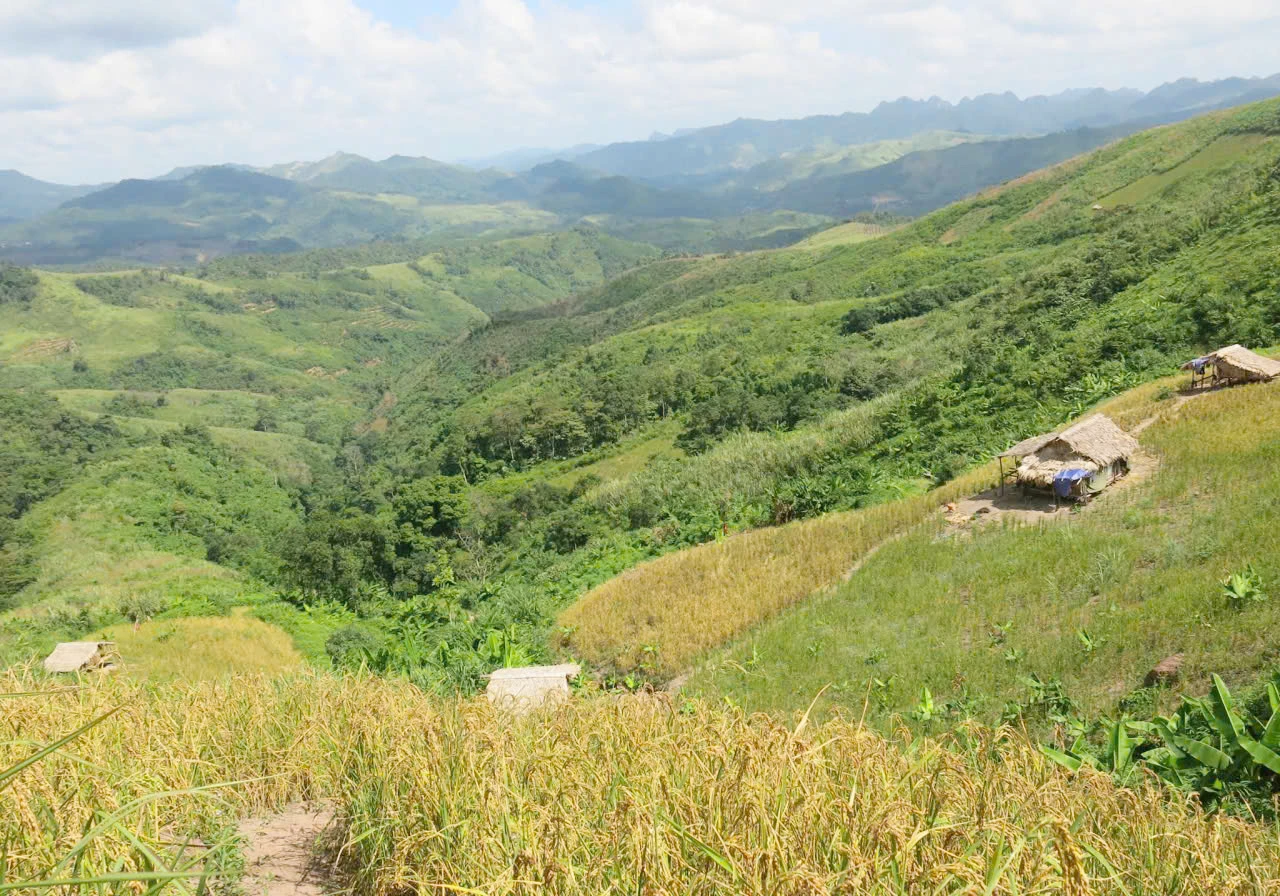 |
| The golden ripe rice fields of the May and Khua people - Photo: XV |
Elder Ho Nham, from Ba Looc village, shared: "Thanks to upland rice cultivation, my family has enough rice for my son's wedding. For the past few years, the upland rice harvest has been bountiful, so no one in the village has gone hungry." His family cultivates two rice fields, yielding 600 kg of rice. With this amount of rice, along with the subsidized rice supply, his family is basically self-sufficient in food.
From Ba Looc village, we followed the locals, walking for about 30 minutes along the Ka Cham slope, cutting through the forest. The first sight that caught our eye was a vast expanse of rice paddies laden with ripe, golden grains.
Mr. Ho Mao, a resident of Ba Looc village, said: "My family cultivates two rice fields, and if we harvest them all, we'll get about 8 quintals of rice. I've already harvested one field and brought home 4 quintals. The remaining rice in the field is also ripe, and my family is asking people to come to the field to thresh it and bring it home (ethnic minorities here don't harvest rice by hand; they thresh each rice stalk by hand and put it into baskets or sacks to carry home)."
Leaving Ba Looc village, we arrived at Cha Cap village. This village is located on the road to Lom village, about 20km from the commune's office. The distance from the village to the rice paddies is about 1km as the crow flies, but it took us more than 30 minutes of walking to reach it. In the distance, we saw endless stretches of golden ripe rice paddies, beautiful like a watercolor painting amidst the Truong Son mountain range.
Here, dozens of households in Cha Cap village are harvesting their upland rice crop. This year, the harvest is bountiful, and the villagers can't hide their joy.
Village head Cha Cap Ho Xon said: "Previously, people who grew upland rice relied entirely on... the weather. When the weather was unfavorable, the crops were poor, and many households still lacked rice. In recent years, the commune has directed people to focus on planting rice at the right time, weeding, and fertilizing, so the rice yield has been high. This year, the weather has been favorable, so the rice crop is abundant and the price is good, making the people extremely happy. My family harvested nearly 8 quintals of rice this year."
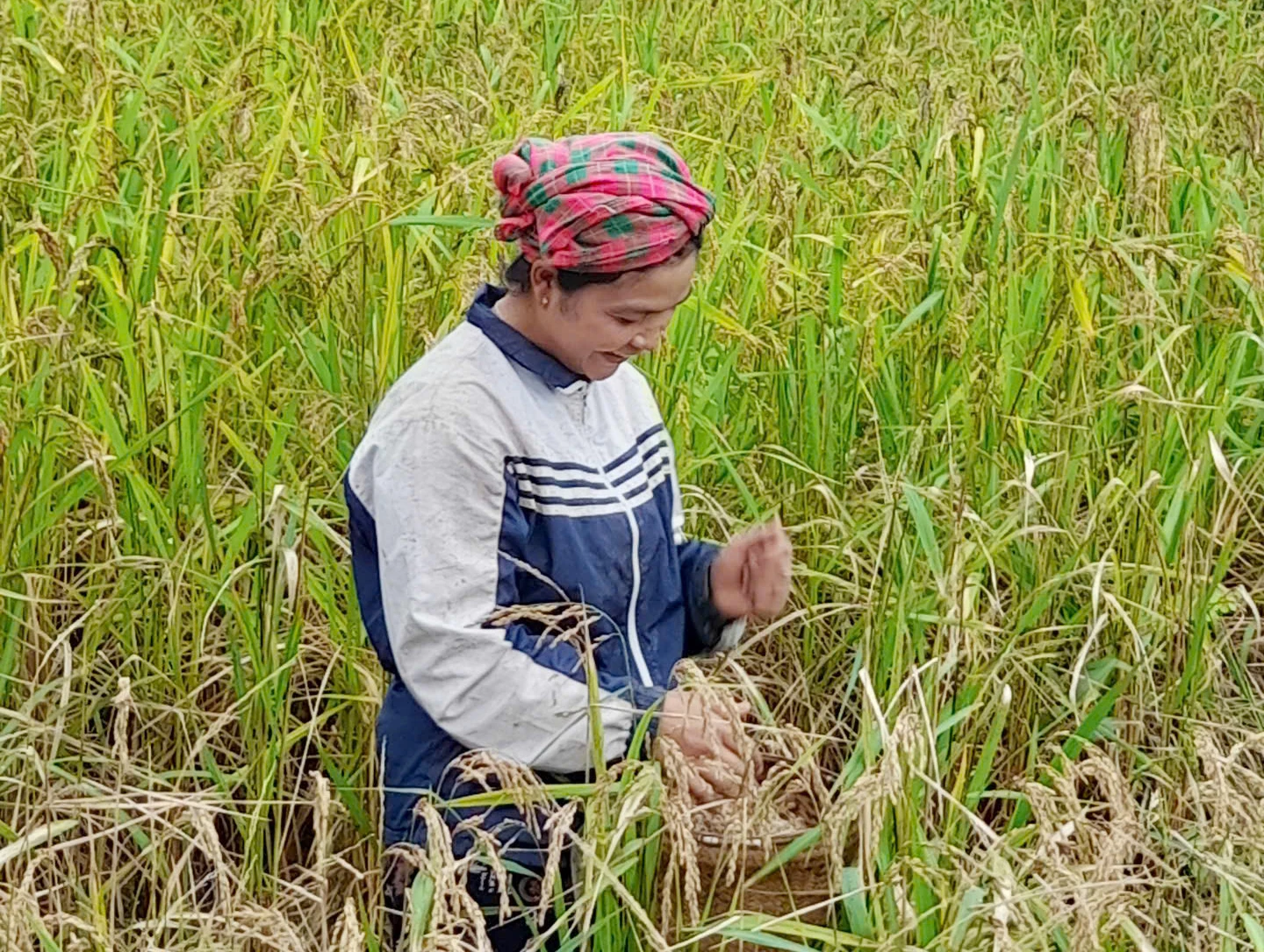 |
| People in Dan Hoa commune harvesting upland rice - Photo: XV |
In the entire Cha Cap village, there are about 20 hectares of land where the villagers cultivate upland rice. Despite the long distance and difficult travel, the villagers still come here to farm. According to the locals, this is a large, fertile area with many reeds and bushes, allowing them to alternate rice cultivation with cassava or corn to prevent soil depletion.
This year, most people in Cha Cap village are planting upland rice. Some households plant as much as 80kg of seeds, while others plant at least a few dozen kilograms.
Mr. Ho Mot, a resident of Cha Cap village, shared: "For generations, my family has cultivated upland rice at the foot of Giang Man mountain. Although it's hard work, the rice here consistently yields good harvests, ensuring our family always has enough food. When Tet (Lunar New Year) comes, I have sticky rice to make banh chung (traditional Vietnamese rice cakes) for the whole family and the entire village to share."
This season, Ho Mot cultivated three rice paddies. After five months of care, he harvested over 800 kg of rice. "This year, my family won't have to worry about food shortages anymore. The good harvest of upland rice, along with the government 's rice support, will be enough to eat for the whole year," Ho Mot said.
In the village, besides Ho Mot, there are also the families of Ho Ninh, Ho Ka, etc., who all harvested about 6-8 quintals of upland rice this season. Currently, 10 quintals of black glutinous upland rice costs from 600,000 to 800,000 VND, while yellow glutinous rice costs 300,000 to 500,000 VND, so many villagers selling rice have a decent income. Upland rice from the May and Khua ethnic groups in Dan Hoa commune has long been famous for its fragrant and sticky texture, so many people buy it as gifts, to make banh chung (traditional Vietnamese rice cakes) for Tet (Lunar New Year), or to roast into puffed rice, which is very delicious...
According to Dinh Minh Thao, Chairman of the People's Committee of Dan Hoa commune: "The entire Dan Hoa commune has 135 hectares of upland rice fields, with an estimated yield of 18 quintals/hectare this year. In the near future, the commune will research and develop OCOP (One Commune One Product) products from upland rice; restore and preserve the rituals of worshipping the land and offering new rice in the villages to contribute to the preservation and promotion of traditional cultural values and tourism development among ethnic minorities in the area."
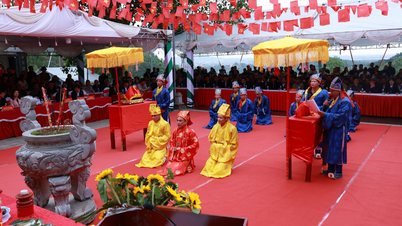
As the sun set behind the Giang Man mountain range, we returned to the home of Ho Xuan Ba, the Party Secretary of Ba Looc village, to attend the traditional harvest festival of the May people. After everything was prepared, Ba and his family offered roasted rice, sticky rice, chicken, pork, wine, and other offerings to the ancestral altar.
Then, Mr. Ho Bon, the head of the clan, lit a bundle of fragrant incense sticks and placed them on each tray of food. He clasped his hands in a respectful bow and invited his ancestors to partake in the new meal with their descendants. First, this was to express the descendants' gratitude for their parents' upbringing, and second, to hope that the ancestors would continue to bless them with favorable weather, a bountiful harvest, and a better harvest next year than this one.
After the ceremony, Ho Xuan Ba and his relatives invited villagers, teachers, and commune officials to share a meal of the new year, drinking rice wine in a joyful, warm, and united atmosphere.
Xuan Vuong
Source: https://baoquangtri.vn/xa-hoi/202512/mua-lua-ray-ben-day-giang-man-5ed7faf/






















































Comment (0)