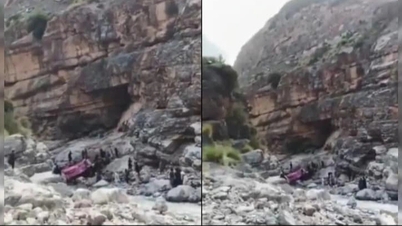
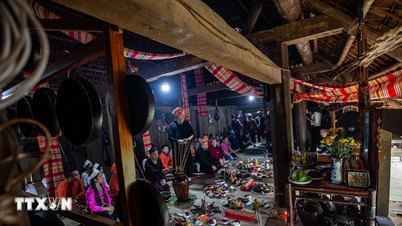
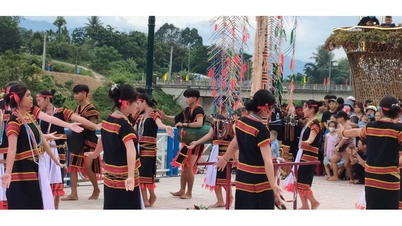
The Co Tu people have a custom of giving firewood as a gift – a unique cultural feature, deeply rooted in humanistic values and community spirit. Photo: PL-PL
Firewood arrives one step ahead of winter, like a silent message between people. There's no need to say "I'll help you," nor is there any need to say "I'm short of money." The firewood simply travels from the forest to the village, from one house to another, silently measuring the living space of the community and the length of cultural time.
The Co Tu people call this the "Dáo oóih" season, which means giving firewood – one of the many unique, humane, and communal cultural traditions of the highlanders in the green Truong Son Mountains.
From the forest to the kitchen, from person to person.
Early in the morning, the Tay Giang forest was still half-asleep. Tall trees stood still, mist clinging to them like a faded brocade blanket. Co Tu men went into the forest to pray to the forest spirit for some dry branches and fallen trees... to take home as firewood. They searched for fallen dry branches and naturally dead tree trunks. Whatever the forest gave them, the Co Tu men asked the forest spirit for.
The firewood is not chosen randomly. It must be dry, have a mild scent, and burn smoothly. Wet wood is the wood of haste, broken pieces are the wood of carelessness. The Co Tu people believe that firewood reflects the heart of the person who gathers it. A peaceful heart produces beautiful wood. A restless heart produces a fierce fire.
The journey from the forest to the village is a spatial one. The firewood travels over mountain slopes, along familiar inclines, past the edge of the village where the sounds of gongs and drums echo. But the journey doesn't end there. The firewood doesn't stay at the house of the person who collects it. It continues on to the house of the village elder, the village hall (gươl) during village festivals, to the house of the lonely and vulnerable, to newly built houses, to houses with young children, or to houses where people are sick.
Firewood is placed on the porch, no knocking is needed. The recipient understands. No one asks "who brought it?", because that question is unnecessary. In Katu culture, firewood speaks for itself.
You may also like
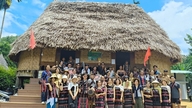
Bhơ Hôồng - a fairy tale amidst the Trường Sơn mountain rangeVHO - Nestled amidst the Trường Sơn mountain range, the village of Bhơ Hôồng (Sông Kôn commune, Da Nang city) appears as beautiful as something out of a fairy tale. It still preserves many unique cultural features of the Cơ Tu people; the houses nestled against the mountainside, the echoing sound of gongs in the night, and the peaceful rhythm of village life have become a special attraction for visitors from afar. Elder Pơloong Nấp (Agrồng village, Tây Giang commune, Da Nang city) sat thoughtfully by the fire, where the ashes had accumulated into memories. He spoke slowly, each word falling like glowing embers: "This is an ancient cultural tradition of the Cơ Tu people, reflecting the spirit of solidarity, mutual support, and helping each other, especially in times of difficulty, hardship, or when the village has a joyful festival."
But beyond the meaning of firewood – the hearth – it is the living soul of the villagers. Fire shares love, fire illuminates the path, fire is the source of culture. Therefore, the stilt houses, longhouses, or communal houses of the Co Tu people always have a hearth; fire protects the village, protects the country.”
That saying opens up another dimension: the spiritual dimension. There, the hearth is not just in the house, but in the community. The firewood thus becomes a measure of distance between people. The more firewood donated, the shorter the distance. The more hearths burn evenly, the warmer and more affectionate the village becomes.

Katu women have the deepest understanding of firewood. Photo: PL-PL
Memories, the present, and a promise for the future.
The tradition of giving firewood as a gift has been preserved through generations. Many pieces of firewood are given by the bride's family to the groom's family, or to elderly, lonely, or vulnerable people, and are kept by the host as sacred mementos on the "Rơ-pang" kitchen hearth throughout their lives.
The elderly recall a bygone winter, when the village was sparsely populated, the paths wild and desolate, and firewood was as precious as rice. Back then, whoever had dry firewood could survive the cold and hunger. The custom of giving firewood arose from the need for survival, but it has endured through moral principles.
Every winter, children grow up by the fireplace, listening to stories about protecting the village, the country, and the forest; folk tales about their origins, lineage, and ancestors; stories teaching them how to live righteously, avoiding wrongdoings and harmful actions that could endanger the villagers, the mountains, the forests, and the rivers.
Time is layered like firewood on a stove: the bottom layer is memory, the top layer is the present, and the burning fire is the future.
Old Man Pơloong Nấp added, his voice becoming softer but warmer: "Without a kitchen, there is no village. Without firewood, the kitchen dies. And when the kitchen dies, the culture dies."

Strengthening the friendship between Vietnam and the United States.On July 3rd, as part of the Pacific Partnership - Friends of the Pacific 2026 program, the U.S. Army Pacific delegation, led by Lieutenant General Joel Vowell, Deputy Commander of the U.S. Army Pacific, paid a courtesy visit to the Quang Tri Provincial Military Command. Therefore, preserving firewood is also preserving time. The Co Tu people do not allow themselves to cut down forests indiscriminately, because they know that if they take firewood today and lose the forest tomorrow, their descendants will be cold not only because of the winter, but also because they will lose their roots.
The old man added that firewood is not only given to the living, but when someone in the village dies, firewood is an indispensable offering, so that the soul of the deceased will not be cold and lost.
The tradition of giving firewood as a gift among the Co Tu people in particular, and the highlands west of Da Nang city in general, is not just a custom, but a unique and humane cultural feature during the cold winter months.
It is also a philosophy of life: to live close together, to live with just enough, to live with gratitude, and to live responsibly towards the forest, the village, and the future.
Source: https://baodanang.vn/mua-tang-cui-cua-nguoi-co-tu-3321559.html