

Artistic time in Quang Tri's Tet poetry is often perceived through the intertwining of landscape and life. In "The Last Day of the Year," Bach Diep constructs time as a journey through two contrasting regions, from the humble hillside villages to the bustling city, and finally stopping at "the warm corner of my home's kitchen." It is a place where memory and the present meet in the moment of seasonal transition: "The last afternoon of the year, mist falls like rain / The sound of the season's bells fades away / Who sets off firecrackers across the sky? / The road home is bumpy with hurried footsteps / Just a little further down the slope / And the warm corner of my home's kitchen is filled with emotion!"
 |
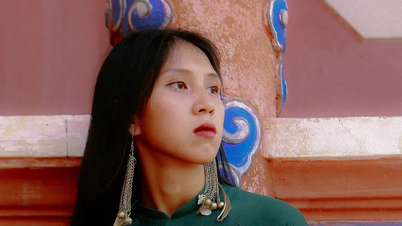
| Spring - Photo: TA |
In "Listening," Van Loi leads the reader into a tranquil space, where even the sound of a falling yellow leaf is enough to evoke a sense of harmony between heaven and earth and the depths of human emotion: "Listen to the sound of falling yellow leaves / Only then will we understand the interplay of heaven and earth."
The late poet Hai Ky, in his poem "Green Grass," placed the Tet holiday within the context of nature's resurgence: "Bombs and bullets ravaged the shores/After the rain, unexpectedly, grass sprouts." Grass growing on land once ravaged by bombs and bullets is considered a green memory of Quang Tri, evoking the resilient spirit of the people who always rise again after years of hardship.
Reading and experiencing the New Year's Eve moment in Quang Tri poetry, we seem to hear the silent rhythm of the universe. Time is a constant movement and shift; only through the existence and transformation of all things does time become visible and recognizable. If all things stand still, the flow of time becomes meaningless. Therefore, there is always a parallel interaction between time and all things: time changes all things, while all things are the tangible measure of time.
Time, once gone, never returns. Even if it's the same hour, day, month, and season, its attributes have changed, and everything has taken on a different appearance in its flow. In Quang Tri poetry, the awareness of time is often awakened by the very small shifts in life.
Hong The confronts the passage of time as he observes the cyclical nature of days in "Alas, Alas": "Eight more years until the thirtieth day of the twelfth lunar month / The Lunar New Year arrives one day early / Wholesalers miss one market day / Will the young banana bunches grow big enough for offerings?" The small shift of a single day disrupts the rhythm of life, leading him to a simple yet decisive realization: "A day is twenty-four hours / What is meant to be will be."
Hoang Vu Thuat uses the leaf to express the cycle of rebirth after the wear and tear of the old season: "When the leaf bids farewell to the branch/the wound remains there (...)/the soft green leaf/gradually appears this afternoon" (Leaves and Branches). Le Minh Thang captures the fragile appearance of youth: "Youth overflows in the storm/Faith like a dewdrop sows on a leaf/A drop of water falls on your cheek/Leaving behind the years" (Shadow of Youth).
Knowing it's impossible, Do Thanh Dong still tries to hold onto time because "I fear that in spring, you will be thin and frail / Your green eyes will follow the shadows of the passing days" (Regretting Spring). Vo Van Luyen in "Greeting Spring" reflects on old age through a familiar, bittersweet greeting: "Goodbye, yellow flower in your green eyes / A little bit of beauty left behind for wandering / I pour out all my regrets / Dreaming of youth settling between smiling lips."
These poetic voices all share a common sentiment of self-reflection on the passage of time, listening to the flow of life through subtle movements. Spring in Quang Tri poetry is therefore a reminder of awakening, a life that needs to be contemplated to recognize that in its delicate movement, the lifeblood still silently rises and flourishes.
The sense of time in Quang Tri's spring poetry is formed from familiar images of life, elevated into haunting metaphors. Humans are placed between the vast universe and their finite existence, so that the cycle of days and months becomes an object of contemplation. Looking at a leaf, Hoang Vu Thuat reflects on fate and separation, offering a philosophical self-questioning: "Oh heart - please don't cry / The branch reveals itself / To live means separation / Who knows the reason?" (Leaf and Branch). Le Minh Thang recognizes the fading of youth through the fragile material of "faith like a dewdrop sown on a leaf."
Do Thanh Dong continues with a tangible sense of anguish: "My hand caresses the child's fingers / Touching each breath of spring worn away by my hand" (Regretting Spring). Vo Van Luyen reflects on age with a seasoned gaze to recognize the limits of life: "Goodbye, spring is now so far away / Your hair is white, and mine is no longer green" (Greeting Spring).
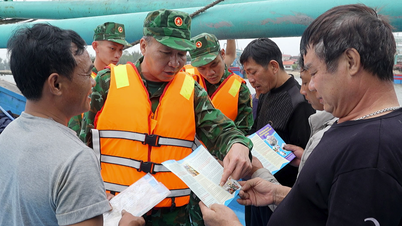
Tet in Quang Tri poetry encompasses everything from mountain hamlets and villages to borderlands and distant islands. In the outlying waters, spring in Vo Van Hoa's poetry emerges with vibrant life and unwavering faith: “Strong faces / Guarding the desolate landscape to welcome the surging waves / Taking joy as a spring gift to send to mother and sister (…) / The island's heart overflows with happiness” (Sending to a Distant Island). The Tet atmosphere is felt through the clouds and wind, the salty taste, and the moonlight hanging over the waves. Eyes awake with the island, faces silently guarding against the wind and waves so that spring arrives early in joy amidst the vast expanse of the sea and sky.
Returning to the mainland, Hai Ky conveys the feeling of spring through the image of lush green grass, a symbol of the vitality of a land that had endured countless months of bombing and shelling. "Many times blood stained the fields red / The earth buried the enemy's corpses in circles of thorny grass" presents a contrast between destruction and rebirth, from which new life sprouts: "After the rain, unexpectedly, grass grows" (The poem "Lush Green Grass").
Narrowing the space to the rooftop, Van Loi's poetry brings spring back to the lives of women in the poem "Silence." "Spring is like the silence of all four seasons within me" is how the poet identifies spring through diligence, patience, and quiet nurturing. Nguyen Huu Quy also views the feeling of family spring through the lens of childhood with innocent joy: "Nothing is more joyful than the first day of Tet / Waking up to receive lucky money / Mother and Father - Fairy Godmother and Fairy Godmother / Giving us magical stories" (Tet Makes Us Young Again). Tet, therefore, is a place that anchors pure, peaceful, and lasting memories.
Thus, whether on a remote island, the mainland, or a rooftop, all spatial layers in Quang Tri's spring poetry are connected by the spring inspiration. Spring encapsulates the spirit of preservation, the power of rebirth, and the humanistic values that are continuously nurtured over time.
In the vibrant atmosphere of spring, reading the spring poems of Quang Tri, we encounter profound insights and philosophies, imbued with images of arduous labor, the philosophy of life, great sacrifice, and the resilient spirit of rebirth of the land and its people. Images of mothers in mountain villages, soldiers guarding distant islands, the elderly reflecting on their lives, the young catching glimpses of youth, and even the resilient green grass sprouting from the fiery earth... all give Quang Tri's spring poetry a unique character, profound yet radiant. And so, each time Tet (Lunar New Year) arrives and spring returns, reading these poems overflowing with springtime sentiment and imbued with the essence of human life, we cherish even more the people who were born, raised, and silently shaped the indomitable spirit of this land.
Hoang Thuy Anh
Source: https://baoquangtri.vn/van-hoa/202602/mua-xuan-trong-tho-quang-tri-8917764/
![[Image] National Assembly discusses the implementation of the socio-economic development plan.](https://vphoto.vietnam.vn/thumb/1200x675/vietnam/resource/IMAGE/2026/04/20/1776696707422_ndo_br_img-20260420-185419-jpg.webp)
![[Photo] General Secretary and President To Lam meets with National Assembly delegates from ethnic minorities.](https://vphoto.vietnam.vn/thumb/1200x675/vietnam/resource/IMAGE/2026/04/20/1776696701056_a1-bnd-8331-3342-jpg.webp)

















































Comment (0)