

 |
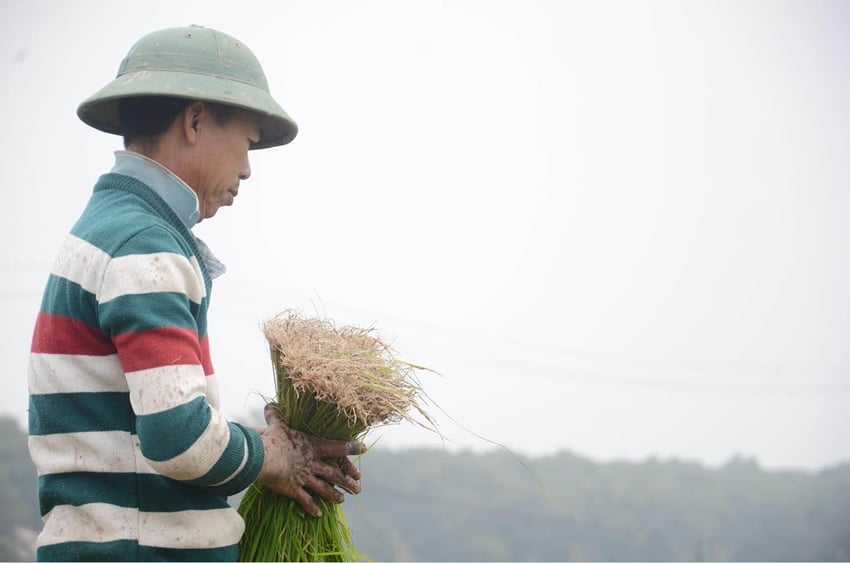
| Mr. Nguyen Manh Hung, from Thuan An ward, Thuan Hoa district, bundles rice seedlings before transplanting them. |
1. At the end of the year, when the reeds along both sides of the road from Dien Truong Bridge to Thao Long Dam (Duong No Ward, Thuan Hoa District) bloom profusely, it is also the time when farmers along National Highway 49B, stretching from Thuan An Ward, Thuan Hoa District to Ngu Dien area, Phong Dien town, are bustling with activity for the new winter-spring crop season. The unique topography of the countryside at the foot of Tam Giang Lagoon makes rice cultivation here somewhat more arduous.
During the rainy season, the area planted with winter-spring rice in this region is often deeply flooded. Rice planting can only begin when the water recedes towards the end of the lunar year. To ensure timely planting, farmers sow seedlings in higher fields, and only prepare the land for transplanting after the water in the lower fields has been successfully drained.
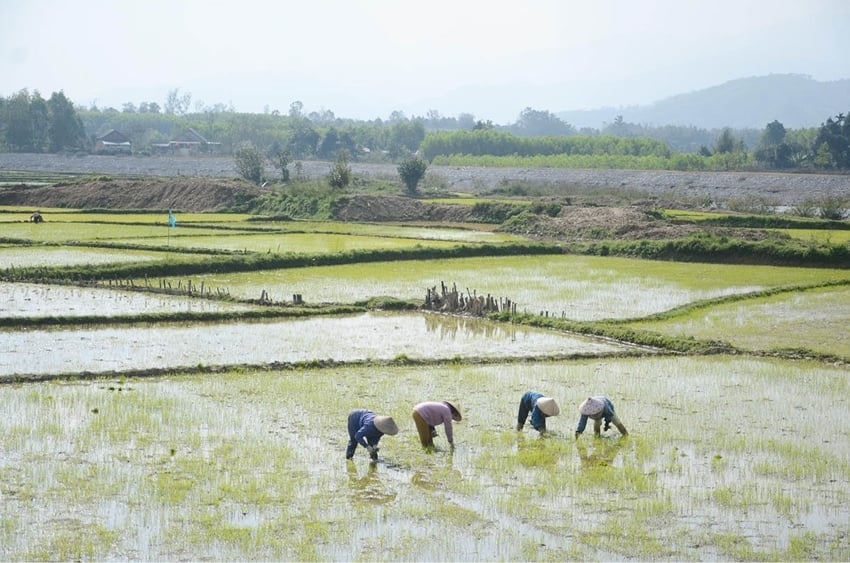 |
| Farmers in A Lưới are replanting seedlings in areas where the sown rice has died. |
Mr. Le Dinh Tuan, from Quang Cong commune, Quang Dien district, said that it takes about a month to grow rice seedlings, from soaking the rice seeds, waiting for them to germinate, and then sowing them. The seedlings are sown in rows with a high density. After about a month, when the seedlings are almost a handspan tall, farmers begin to pull them up to transplant them into the deeper fields. In years with favorable weather, rice transplanting is completed before the Lunar New Year. In years with prolonged cold and rainy weather, many areas have to wait until after the Lunar New Year to be transplanted.
2. According to the locals, the rice planting is partly due to the deep fields, requiring simultaneous drainage and planting; and partly due to the cold, rainy weather, forcing them to take advantage of dry days to plant rice. Therefore, during this time, every household is bustling, with everyone in the family mobilized to help in the fields. Young and old alike pull up and bundle seedlings; those who cannot plant help prepare the land and transport seedlings from higher fields to deeper fields.
With nimble hands, Mrs. Nguyen Thi Vui, from Thuan An ward, Thuan Hoa district, planted rows of rice seedlings in straight lines. She explained that in her household, most of the rice planters are women. On average, each person plants more than half a sao (approximately 1000 square meters) per day. Each person is responsible for a row, with about 12-13 clumps of seedlings planted, depending on the length of each person's arm. Each clump contains about 10 seedlings. The number of seedlings per clump varies depending on the depth of the water in the field. If the field is deep and the weather is cold, 1-2 extra seedlings are added to prevent the young seedlings from dying.
Locals say that the eastern part of the lagoon doesn't have much agricultural land. Even so, each household needs 4-5 acres of land to complete the planting. Therefore, the people have a very clever method: they exchange labor with each other. Depending on the area, they calculate the number of people needed to complete the planting in a day. When one household finishes planting, they move on to another, and so on until all households have finished. This is also how the people living near the Tam Giang lagoon have built close relationships in their daily lives for generations.
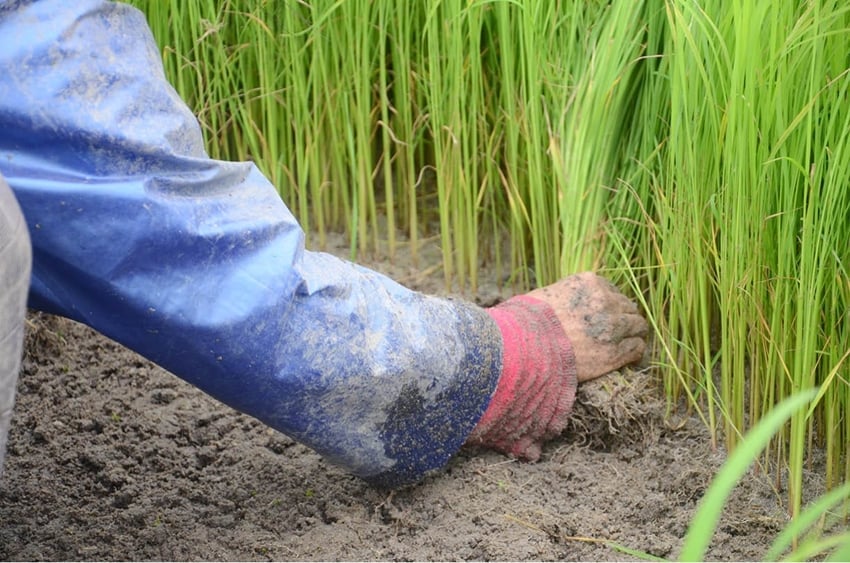 |
| Pulling up rice seedlings requires sufficient force; otherwise, the seedlings will break. |
Due to the large area of rice cultivation in the past, many localities on both sides of the lagoon had a profession of hired rice transplanting. In the past, during the planting season, many people from villages on the other side of the Tam Giang lagoon would wake up at dawn to catch the first ferry across to villages on the eastern bank of the lagoon to work as hired rice transplanters. At noon, they would only have time to eat and rest for about 30 minutes before continuing to transplant rice, only to catch the last ferry back home around 4 pm.
Ms. Nguyen Thi Vui shared that currently, there are still some people who work as hired rice planters, but very few. Rice planting is hard work; you have to bend over all day, your back becomes numb. In cold weather, your hands and feet are constantly submerged in water. Despite all this hard work, the current wage is only 400,000 VND per day. Compared to some other jobs, it's not as good, so no one in the younger generation wants to do it anymore.
Taking advantage of the midday break, Mr. Nguyen Manh Hung, from Thuan An ward, Thuan Hoa district, was pulling up rice seedlings so that he and his wife could plant them in the deep fields in the afternoon. While pulling up the seedlings, Mr. Hung smiled and said that pulling up seedlings also requires technique. The hands must use just the right amount of force, otherwise the young seedlings will break. The seedlings are rinsed with water to remove the soil and then bundled together evenly.
“In Hai Duong commune, Hue City, now Thuan An ward, many areas are affected by saltwater intrusion, so farmers mainly cultivate salt-resistant rice varieties. With salt-tolerant rice varieties, the care is simpler compared to regular varieties. Farmers only need to plant the seedlings; the rice will grow naturally without the need for fertilizer or pesticides. The yield of salt-resistant rice is only half that of other varieties, but the cost is double. The amount of seed needed for transplanting is also much less. For regular rice varieties, 7 kg of seed is needed to transplant one sao (approximately 1000 square meters), while for salt-resistant rice, only 2 kg of seed is required,” Mr. Nguyen Manh Hung further informed.
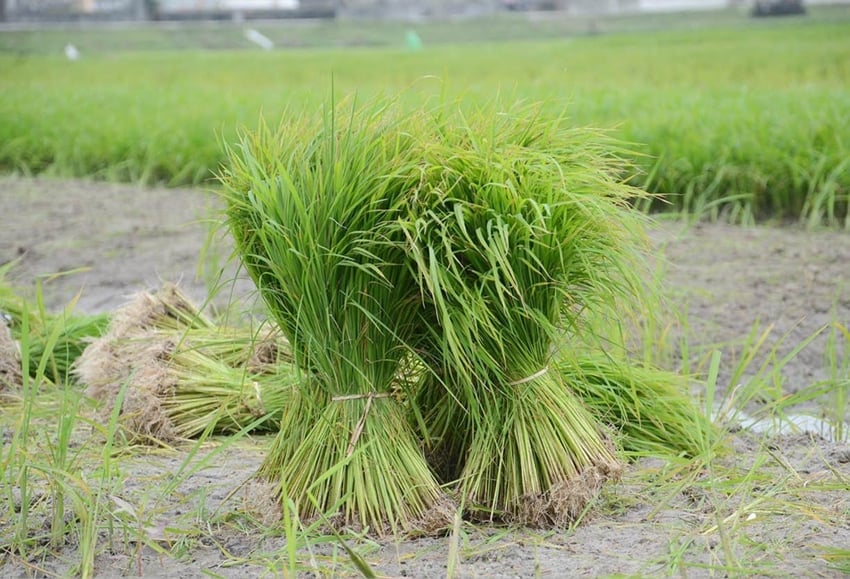 |
| The bundles of rice seedlings are pulled up and transferred to be transplanted in the deeper fields. |
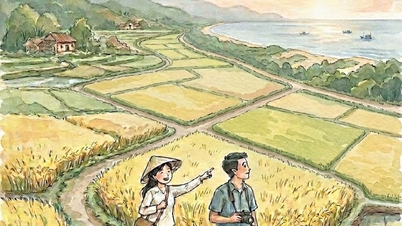
3. Anyone who lives in the delta region will find it hard to forget their childhood days. I'm no different; I was born and raised surrounded by the smell of rice. Even after so many years away from home, I can never forget the fragrant smell of rice, especially the smell of young rice seedlings, when harvest time came and we had to go down to the fields to help pull them up. It's the scent of undissolved rice grains, the faint fragrance of young seedlings, the fresh air each morning in the fields… All of it creates the scent of my homeland.
Each planting season brings immense hardship, but for the farmers living by the lagoon, it carries with it the hope of opening up a new future for their families, especially for their children and grandchildren. From the bundles of rice seedlings to the rows of rice plants, each fragrant grain nurtures the dreams of countless people to grow up, study, and become useful members of society.
After a long time away, returning to my hometown after many years of wandering, I found that many low-lying rice paddies had been converted to aquaculture. Upon inquiry, I learned that many people had abandoned farming in recent times. Faced with this situation, the local authorities boldly switched to aquaculture, which yields higher economic returns. To ensure food security, the higher-lying fields previously used for growing peanuts and sweet potatoes have now been converted to rice cultivation using direct seeding instead of transplanting.
According to Mr. Ho Dinh, Head of the Department of Crop Production and Plant Protection of Hue City, the area of rice cultivation using the transplanting method is decreasing. The application of scientific and technical advancements and the increasingly dry weather towards the end of the year have led to many areas switching to direct seeding. Farmers' gradual shift to direct seeding increases economic efficiency by significantly reducing the cost of transplanting labor.
Machinery is gradually replacing manual labor. Now, seeing the deep rice fields no longer being transplanted but instead sown directly, I feel happy for the farmers that rice cultivation has become less stressful. The image of mothers and sisters bending over to plant rice; the elderly and children calling out to each other as they pull up seedlings… is becoming less common, but it will forever remain a beautiful memory for everyone born and raised in the countryside by the lagoon.
Source: https://huengaynay.vn/kinh-te/mui-ma-non-150860.html
![[Image] Close-up view of the interchange connecting the two expressways and Long Thanh Airport.](https://vphoto.vietnam.vn/thumb/1200x675/vietnam/resource/IMAGE/2026/05/25/1779703378210_ndo_br_z7863716673926-224453a31600126cce10622af6290afd-4549-jpg.webp)
![[Image] Hanoi's urban life under the challenge of a "scorching hot" environment](https://vphoto.vietnam.vn/thumb/1200x675/vietnam/resource/IMAGE/2026/05/25/1779706979265_nang-nong-t5-2026-minh-duy-7-4636-jpg.webp)



























































Comment (0)