

 |
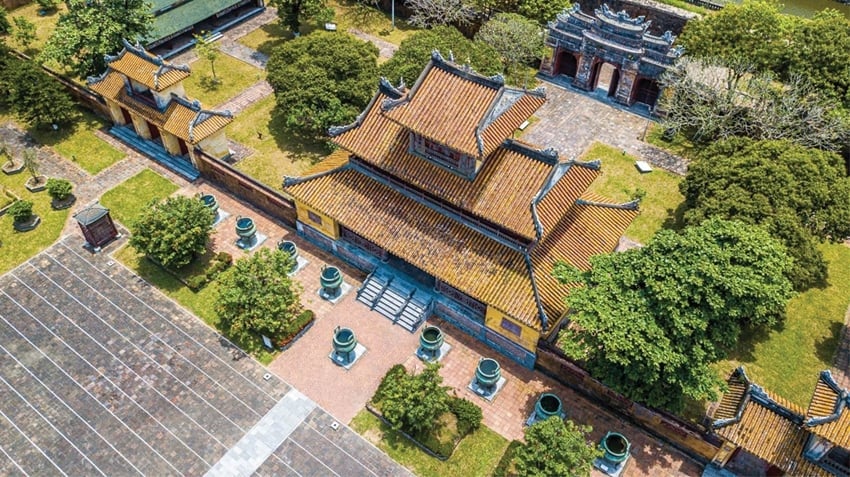
| Nine Cauldrons |
With its exceptional cultural and historical value, the Nine Dynastic Urns were recognized as a National Treasure by the Prime Minister in 2012, and the relief castings on them were inscribed by UNESCO as a Documentary Heritage of the Asia-Pacific region in 2024.
From historical records. According to the Dai Nam Thuc Luc, in 1835, when authorizing the casting of the Nine Tripods, Emperor Minh Mang explained the reason for casting them in relatively detail: “The tripods are to show that the position is rightfully held, and the destiny has been established (...) I respectfully continue the legacy of my predecessors, following the clear path. Now I wish to emulate the ancients; to cast nine tripods to be placed in the The Mieu temple (...) This is to express my hope that they will endure for millennia...”.
 |
| The poem by Emperor Minh Mạng related to the casting of the Nine Dynastic Urns is printed in the "Five Collections of Imperial Poems". |
In December 1835, the casting of the Nine Bronze Tripods began. By January 1837, the Nine Tripods were completed. The Nine Tripods are named Cao Tripod, Nhan Tripod, Chuong Tripod, Anh Tripod, Nghi Tripod, Thuan Tripod, Tuyen Tripod, Du Tripod, and Huyen Tripod. All nine tripods are cast in bronze, with a rounded body. Two lines of Chinese characters are engraved on the rim of each tripod. The first line, on the left, records the casting date, identically: Minh Mang sixteenth year, Ất Mùi year. Note: Cast in the year Ất Mùi (1835), the 16th year of Minh Mang. The second line records the specific weight of each tripod (the heaviest weighing approximately 2,600 kg; the lightest approximately 1,900 kg).
Upon completion, the Imperial Observatory chose an auspicious day for the inauguration: "On the day of Quy Mao, place the nine cauldrons in front of the The Mieu temple." To commemorate this important event, Emperor Minh Mang composed a seven-word, eight-line poem, and interspersed within the introductory, descriptive, argumentative, and concluding lines of this Tang Dynasty-style poem are very detailed annotations related to the casting of the Nine Cauldrons, such as their meaning, names, specific placement, carved motifs, dimensions, and weight. However, this poem is little known, especially in scholarly works on the Nine Cauldrons published by various authors.
This poem is printed in the Five Collections of Imperial Poems, with the opening line roughly stating, "Following the ancient style, the Nine Tripods were cast and placed in front of the Ancestral Temple, to welcome and offer sacrifices; after the ceremony, a poem was written to record it." The poem's content is transcribed as follows: "The offering is made in the style of ancient times / Cast into the Nine Tripods and placed before the temple / The three great treasures are all depicted / All things are fully represented / The method of the Xia Emperor expands / The method of the Song Emperor is used to create the true essence / Majestic and auspicious, it is erected and placed on the altar / Descendants and descendants will forever preserve and pass it down."
Using copper coins as tribute, following the example of our ancestors.
After casting the Nine Tripods, they were placed in front of the courtyard.
The earth and sky, big and small, become symbols.
The forms of all things are manifested around us.
Following the example of the Lower Emperor, they increased their power even further.
To receive the Song King would be a waste of effort.
Standing firm and unwavering like a great mountain,
His name will be passed down through generations.
This poem is a useful document when studying the Nine Tripods, and the poem itself contributes to increasing the historical and artistic value of this particularly important National Treasure.
The symbolic images cast on the Nine Tripods are considered a living "geographical record" of many fields. Each tripod is cast in relief and then finely carved with images including celestial phenomena, mythical creatures, territorial waters, rivers and mountains, architecture, officials, animals, insects, plants, palanquins, boats, weapons, and two Chinese characters indicating the tripod's name. Regarding the carving of these images, in the book Dai Nam Thuc Luc, Emperor Minh Mang also stated to the Ministry of Public Works: "Now, when casting tripods and carving images of rivers, mountains, and all things, it is not necessary to carve everything; only the name, title, and place must be clearly carved for easy identification. That is the intention of the ancients in depicting all things." The relief images on each tripod are arranged in three rows around the body of the tripod and each has a Chinese character name attached to identify the carved image.
 |
| Nine Cauldrons in front of Hien Lam Pavilion |
In the poem about the Nine Tripods, the king also noted the meaning behind the images cast on them, which included the sun, moon, stars, clouds, wind, thunder, rainbows, rain; famous mountains, wide rivers, large rivers, and vast seas; and all the flora and fauna belonging to our country; even various types of vehicles, boats, and large cannons were selected to be cast on the tripods. These Nine Tripods were all cast in one go; only the intricate and skillful carving required time.
The Nine Tripods bear witness to the nation's protection of its maritime sovereignty . These ancient artifacts hold special significance; beyond their technical and artistic value, they possess immense cultural and historical significance, affirming a national spirit and becoming timeless symbols.
Historically, besides numerous ancient texts clearly demonstrating Vietnam's sovereignty over its maritime territories, such as the Châu bản and Mộc bản texts, the images of the East Sea (East Sea, South Sea, West Sea), strategically important ports (Thuận An port, Cần Giờ port, Đà Nẵng port), as well as various types of seafaring vessels, patrol boats, and warships (Ô thuyền, Đa tác thuyền, Lâu thuyền, Mông đồng thuyền, Hải đạo, Lê thuyền...) carved on the Nine Dynastic Urns all show that in the past, people were very concerned with demonstrating their awareness of protecting sovereignty at sea. This phenomenon reflects the nature of the viewpoints and policies regarding maritime territories, clearly showing a consistent viewpoint and policy in managing the territorial waters of that era.
The Nine Bronze Tripods are a masterpiece of Vietnamese bronze artifact, arguably the pinnacle of bronze casting art during the Nguyen Dynasty. The entire casting process required a large workforce of skilled artisans and, above all, seamless and coordinated teamwork to ensure a smooth operation.
Today, since no historical documents describing the technical process, the design of the molds, the shaping of the reliefs, the casting techniques, etc., have been found, looking at the final product, the Nine Tripods, it is difficult for us to imagine the hardship and toil of the countless drops of sweat that were poured into this cultural artifact to create a treasure that will be remembered for generations to come.
Source: https://huengaynay.vn/van-hoa-nghe-thuat/muon-doi-con-chau-mai-truyen-danh-150044.html



















































Comment (0)