

The US government has just approved $825 million in funding to build a research and development center for extreme ultraviolet (EUV) lithography equipment in the country, aiming to break ASML's monopoly.
The new center, called EUV Accelerator, located in the Albany NanoTech Complex in New York, is the first research and development (R&D) facility established under the auspices of the CHIPS Act.
With the goal of boosting the US semiconductor industry, the EUV Accelerator will be equipped with state-of-the-art chip manufacturing machinery, enabling industry researchers to collaborate with university training partners.
"When advanced research is conducted in the United States, we will be able to create the world's most advanced chips, giving our military an advantage," Senator Schumer said. "Of course, it also ensures that the American economy and businesses have an advantage in advanced semiconductors."
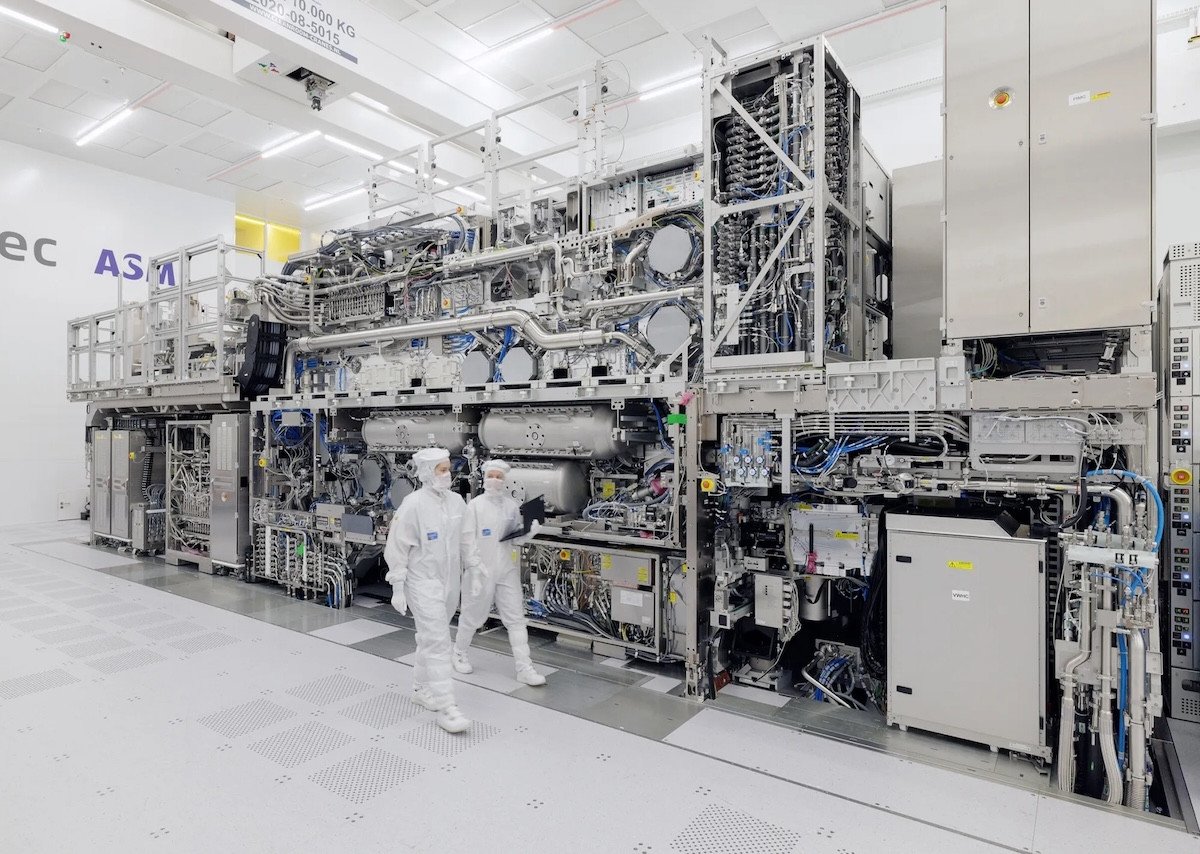
Meanwhile, the US government considers EUV a crucial technology in the production of advanced chips and aims to master it.
Washington also argues that access to, research, and development of EUVs is essential to expanding America's leading position, reducing prototyping time and costs, and building and maintaining a semiconductor workforce ecosystem.
When operational, the EUV Accelerator is expected to focus on developing advanced high-aperture digital EUVs as well as researching other EUV-based technologies.
The center is expected to provide access to standard EUV NA next year and EUV High-NA in 2026 to members of the US National Semiconductor Technology Center (NTSC) and Natcast.
"The launch of the center marks a significant milestone in ensuring that the United States remains a global leader in semiconductor innovation," said Gina Raimondo, U.S. Commerce Secretary, in a statement.
In February, the Biden administration announced funding for chipmaker GlobalFoundries to boost production expansion in northern Albany and Vermont. In April, the U.S. further announced a $6.1 billion package for Micron to manufacture advanced memory chips.
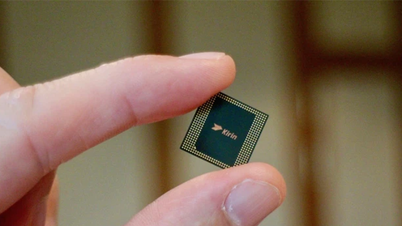
Photolithography is the process of printing circuit diagrams onto the photosensitive surface of a silicon wafer by shining a beam of light onto the silicon wafer through a glass disc pre-drawn with the circuit diagram.
The smaller the circuit, the more it requires light sources with shorter wavelengths, with extreme ultraviolet (EUV) being the most advanced development currently available.
Over the years, ASML has held a "monopoly" on the supply of lithography machines, turning the Dutch company into a "bottleneck" in the semiconductor supply chain.
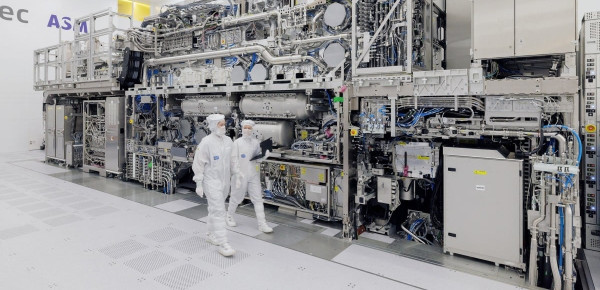
These chip foundries are also a hotbed of contention between Washington and Beijing. ASML currently sells its most advanced EUV High-NA machine for $380 million, having delivered the first unit to Intel earlier this year and the second to an "unidentified customer".
Not only the US, but other links in the global semiconductor supply chain are also striving to produce EUVs domestically.
In early August, Japanese researchers (OIST) announced the successful development of a simpler and cheaper EUV lithography machine. Furthermore, this device has a simpler design than the conventional ASML system, for example, reducing the number of optical illuminating mirrors to just two, instead of the standard six.
With its simpler design and lower cost compared to ASML's equipment, the new EUV machine, if mass-produced, could reshape the chip foundry industry, thereby impacting the entire semiconductor industry.
Furthermore, one of the machine's advantages is increased reliability and reduced maintenance complexity. Significantly reduced power consumption is also a strong point of the new system.
Thanks to optimized light path, the system operates with an EUV light source of only 20 W, resulting in total power consumption below 100 kW. In contrast, traditional EUV systems typically require more than 1 MW of power.
OIST has filed a patent application for the technology and stated that it will continue to develop the EUV lithography machine for practical applications. The global EUV machine market is expected to grow from $8.9 billion in 2024 to $17.4 billion in 2030.
(According to Fortune and Bloomberg)
Source: https://vietnamnet.vn/my-tim-cach-pha-the-doc-quyen-cua-asml-2338672.html
![[Photo] General Secretary and President To Lam and the President of the Philippines hold talks.](https://vphoto.vietnam.vn/thumb/1200x675/vietnam/resource/IMAGE/2026/06/01/1780286997787_anh-man-hinh-2026-06-01-luc-11-09-43.png)


![[Photo] Reception to welcome General Secretary and President To Lam and his wife on their State visit to the Philippines](https://vphoto.vietnam.vn/thumb/1200x675/vietnam/resource/IMAGE/2026/06/01/1780295488620_vna-potal-chieu-dai-chao-mung-tong-bi-thu-chu-tich-nuoc-to-lam-va-phu-nhan-tham-cap-nha-nuoc-toi-philippines-8798060-7855-jpg.webp)



































































































Comment (0)