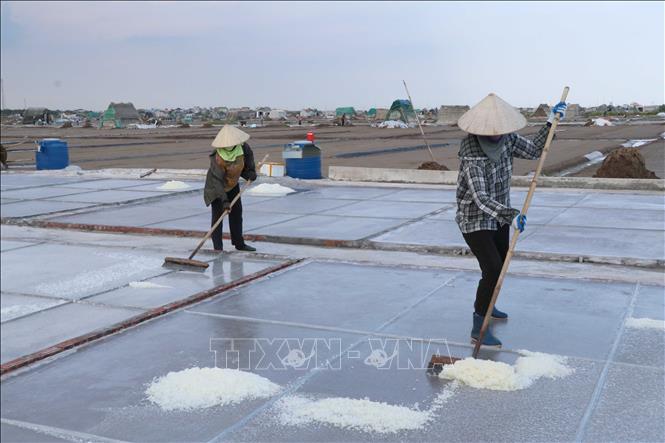
People in Giao Binh commune, Ninh Binh province, harvest salt. Photo: Cong Luat/TTXVN
Preserving traditional crafts
The harsh winter sun is enough to cause the seawater to evaporate quickly, leaving behind sparkling white salt crystals on each concrete slab. Taking advantage of the strong sunshine, salt farmers in Giao Binh commune, Ninh Binh province, have gathered at the Bach Long salt fields to produce salt.
With nimble hands spreading sand on the ground, Mr. Lai Van Tien from Giao Binh commune shared his experience, explaining that salt farmers go through many different stages to produce salt. First, seawater is channeled onto the sand to allow it to permeate, then the sand is placed in troughs to settle. The water flows into small baskets and then into larger baskets. Once the water is clear, it is transferred to raised platforms to dry in the sun for crystallization. On sunny days, salt can be harvested from morning to afternoon. However, just one sudden rain shower can wash away the farmers' hard work of 2-3 days into the river or sea.
Crystallized from the saltiness of the sea and the sweat and hard work of the people, Bach Long salt is salty but not harsh, naturally pure. Therefore, many traders flock here to buy salt. Due to unfavorable weather this year, with less sunshine and more rain, salt production is not high, but in return, the price is higher than in previous years. Currently, people are selling salt at an average price of about 3,000 VND/kg.
Mr. Tien calculated that, in the hot summer months , each 360 square meters of salt ponds (1 Northern Vietnamese acre) would yield 2 measures of salt (equivalent to about 50 kg), while in winter, each acre would yield about 1 measure of salt. Thus, after deducting expenses, the daily wage for salt farmers ranges from 50,000 to 100,000 VND per day per acre. Not only is the work arduous, but the price of salt also fluctuates erratically, making the villagers less enthusiastic about the profession. Most young people have gone to work in factories in industrial zones, leaving only older people to continue salt production.
Consequently, the area dedicated to salt production in the commune is steadily decreasing. Previously, Giao Binh commune was known as the largest salt-producing area in the region, with an area of approximately 230 hectares, but now, the actual area still in production is only about 57 hectares.
To preserve the traditional salt-making profession and enhance the production value for salt farmers, since 2022, the Bach Long Salt, Fisheries and Environment Service Cooperative in Giao Binh commune has partnered with Nam Dinh Salt Joint Stock Company to produce high-quality clean salt.
Accordingly, on 1 hectare of salt production, 12 households have received training on the technical process of producing clean salt that meets export standards; they have also received support for investment in equipment and materials to renovate and upgrade the salt fields, applying the clean salt drying model such as: moving the filtration tanks to the middle of the field; renovating the crystallization ponds with M200 salt-resistant concrete, composite water storage pits, water pumps, etc.
The company committed to purchasing clean salt from local people at a price approximately 30% higher than the price of regular salt. Over the past three years, the company has purchased over 100 tons of clean salt from the local population.
Ms. Trinh Thi Huong, from Long Thanh hamlet, Giao Binh commune, said that her family has 3 sao (approximately 0.3 hectares) of land for salt production under a partnership with the company. They have received guidance on clean salt production techniques from the company's staff, support with supplies, and the company buys all their products at a high price. As a result, their income has increased significantly, motivating people to stay committed to this traditional profession...
Boosting processing, aiming for export.
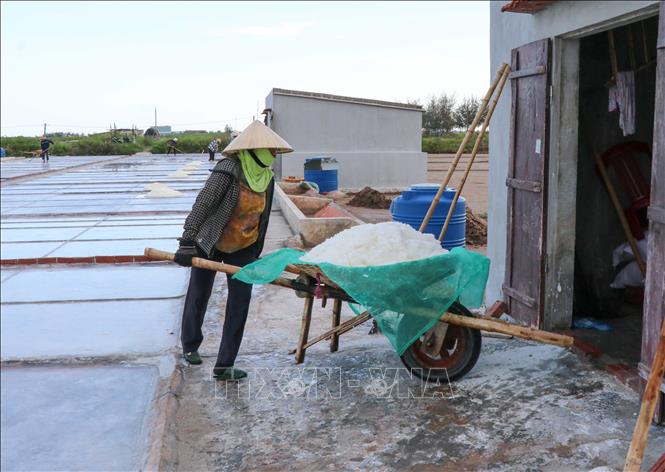
Pushing carts of salt into the storage warehouse to await sale to traders. Photo: Cong Luat/TTXVN.
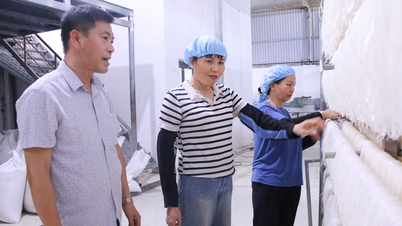
Ninh Binh is considered one of the centers for processing salt products in Northern Vietnam. Using clean, sun-dried salt as raw material, many companies have successfully produced products with high nutritional value, beauty products, and health-supporting products for the community, which have been highly appreciated by consumers.
Starting as a business that purchased raw salt, over the years, Nam Dinh Salt and Trade Joint Stock Company has applied advanced technologies and transformed itself towards producing clean salt according to international standards.
To ensure a stable supply of raw materials, the company has partnered with over 100 households in Giao Binh and Hai Quang communes (Ninh Binh province) and Thai Thuy commune ( Hung Yen province) to produce clean salt on an area of 7 hectares. In addition to the partnered area, the company purchases approximately 10,000 tons of raw salt annually to produce refined salt products.
The company focuses on building a brand of clean Nam Dinh salt based on local origin, developing a diverse range of refined salt, iodized salt, and clean granulated salt products, and investing in international standard packaging. Currently, the company has 5 products that have achieved OCOP 4-star certification (One Commune One Product Program).
In 2015, the company successfully researched and produced Royal low-sodium sea salt. This type of salt has a sodium content 27-30% lower than regular salt, and is rich in potassium, which helps support cardiovascular health and improve overall well-being. The company has exported this product to the US market. In addition, the company's NADISALT clean salt product has also been successfully exported to the Japanese market.
According to Ms. Tran Thi Binh, Director of the company, the refined salt products are currently receiving very positive feedback from the market. Thanks to the application of modern technology and strict quality control processes, the finished salt products ensure high purity, meeting even the stringent standards of export markets. This is the key factor that helps the product gain more trust and be chosen by more people.
According to Ms. Binh, the biggest challenge currently lies in maintaining a stable supply of raw materials. Salt production is still heavily dependent on the weather, while climate change is becoming increasingly unpredictable, and the labor force is scarce, leading to a shrinking production area.
Furthermore, the investment cost for modern refining technology is quite high, posing a significant challenge for businesses. "To meet the requirements of export markets, we are forced to continuously upgrade our production lines, improve processes, and strengthen quality control. This requires substantial capital, while the profit margin of the traditional salt industry is not high," Ms. Binh shared.

Vietnam encourages US businesses to expand investment in high technology.On the morning of June 26th, at the Government Headquarters, Deputy Prime Minister Ho Quoc Dung received Mr. Jeff Place, Supply Chain Director of Coherent Group (USA). During the meeting, the Deputy Prime Minister affirmed that Vietnam encourages US businesses to expand investment, especially in high-tech, innovation, and semiconductor industries. Ninh Binh province currently has approximately 105 hectares of salt production area. The province has 15 processing enterprises built in concentrated salt-producing areas of Giao Binh, Hai Quang, Hai Tien, and Rang Dong communes, with a processing capacity of up to 100,000 tons per year; however, the province's domestic salt production only meets 20% of the demand (20,000 tons per year).
In recent years, the province has focused on and promoted the development of value chains for salt production, processing, and consumption. To date, the province has established three value chains in the production and consumption of salt products, helping to better control product quality and enhance product value and brand. Notably, these value chains have successfully produced clean salt that meets export standards for the Japanese market, with an average export volume of 50 tons per year.
To diversify salt products, promote and connect consumption, and enhance competitiveness, the province has guided and supported establishments in developing and publishing quality standards for 40 salt products. Currently, 14 products from 6 establishments have been certified as OCOP products; of which 5 products have achieved 4 stars and 9 products have achieved 3 stars.
In order to maintain the area of land used for effective salt production, create conditions to promote land consolidation and concentration for organizations and individuals engaged in concentrated salt production, and invest in the application of science and technology in production, Ninh Binh province encourages individuals and businesses to propose projects and research topics on the application of science and technology to diversify salt products to meet the needs of the people, provide raw materials for industries, and gradually export sea salt products with competitive advantages.
In addition, the proposal suggests implementing policies on land, investment, credit, and science and technology related to the salt industry; while also opening up, encouraging, and prioritizing investment from various economic sectors in the production, processing, and consumption of salt.
Source: https://baotintuc.vn/kinh-te/nang-cao-gia-tri-hat-muoi-phoi-cat-20251201164702200.htm











![[Photo] Strengthening character and expertise: Intense training for artillery soldiers.](https://vphoto.vietnam.vn/thumb/1200x675/vietnam/resource/IMAGE/2026/06/30/1782815602541_lu-368-1875-4571-jpg.webp)