

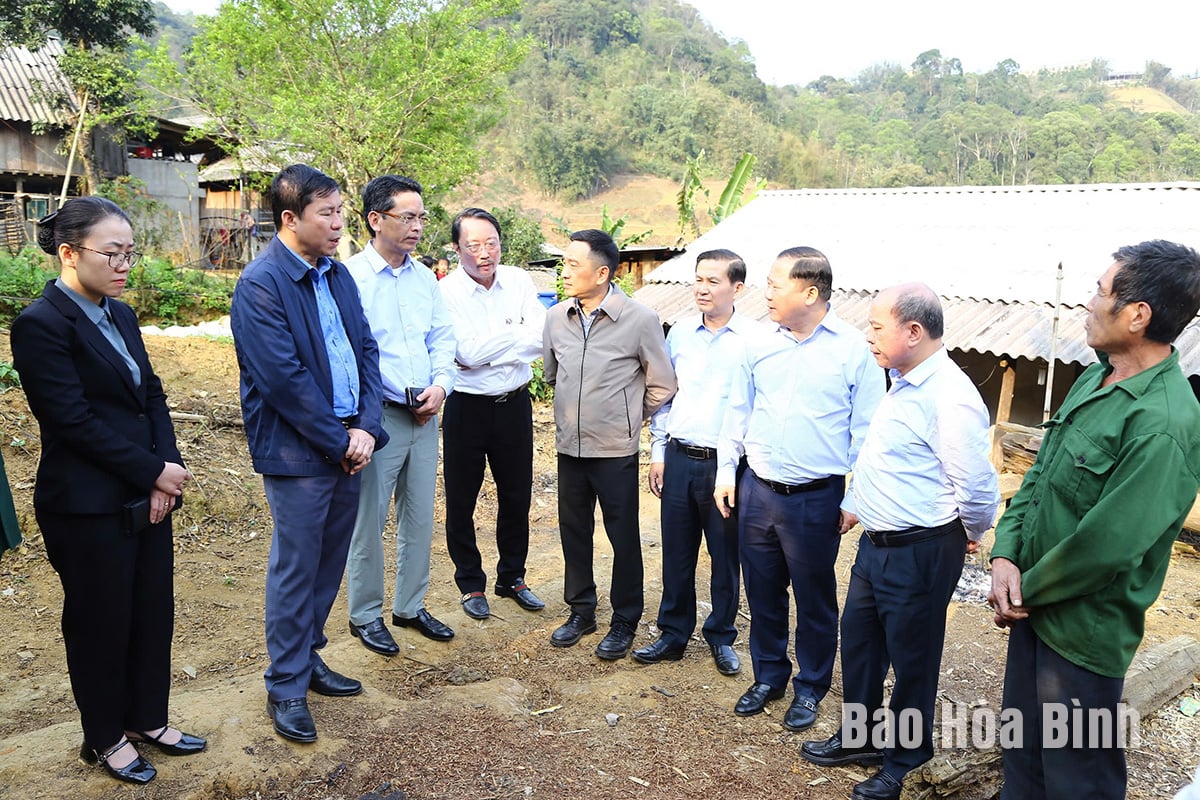
Comrade Nguyen Phi Long, Alternate Member of the Central Committee of the Party, Secretary of the Provincial Party Committee, and the delegation exchanged views on solutions for socio-economic development and sustainable poverty reduction in Thanh Son commune, Mai Chau district.
Over the years, the Party committees and authorities of Hoa Binh province have focused on leading and directing the implementation of the National Target Program on Sustainable Poverty Reduction and have achieved significant results. Awareness among Party committees, authorities, and the people has been raised. Poverty reduction projects and policies have been implemented synchronously, tailored to each target group, and integrated with the National Target Program on New Rural Development and the National Target Program on socio -economic development in ethnic minority and mountainous areas. Many programs supporting production development and improving livelihoods for the poor have achieved positive results, creating a ripple effect and gaining the consensus and positive response of all segments of the population. In the period 2021-2024, the poverty rate in the province decreased from 15.49% to 6.59%, an average reduction of 2.55% per year. Hoa Binh province has achieved and exceeded the set poverty reduction target, making a significant contribution to the province's overall development goals and indicators, and improving the lives of its people.
However, the province's poverty reduction results are not sustainable. The lives of the people, especially in remote areas and areas with large ethnic minority populations, still face many difficulties. There are still newly emerging poor households and households that fall back into poverty. The income of poor households currently only meets the minimum living needs; it is insufficient for savings to prepare for accidents, illness, job loss, and always carries the risk of falling back into poverty.
On April 3, 2025, the Executive Committee of the Hoa Binh Provincial Party Committee issued Conclusion No. 1109-KL/TU on the five-year review of the implementation of Conclusion No. 580-KL/TU, dated September 30, 2020, of the XVI Provincial Party Committee on continuing to implement Resolution No. 16-NQ/TU, dated August 11, 2017, of the Provincial Party Committee on strengthening leadership in implementing the National Target Program on Sustainable Poverty Reduction. The Conclusion clearly states that, after eight years of implementing Resolution No. 16-NQ/TU and five years of implementing Conclusion No. 580-KL/TU, the awareness of Party committees, government agencies at all levels, cadres, Party members, and the entire population regarding the policy and their roles and responsibilities in implementing the National Target Program on Sustainable Poverty Reduction in the province has been enhanced; some targets have been met or exceeded compared to the targets set in the Resolution.
To continue implementing poverty reduction efforts according to multidimensional standards with an average growth rate of 2-2.5% per year, the province has proposed specific solutions to effectively achieve poverty reduction goals such as: Strengthening propaganda work, raising awareness and responsibility of Party committees, authorities from the provincial to the grassroots level, the community, and the poor themselves in implementing the National Target Program on Poverty Reduction. Prioritizing the allocation of additional funds from the local budget to ensure sufficient matching funds as stipulated by the program. Developing additional specific poverty reduction policies to support the poor and ethnic minorities living in particularly difficult communes, villages, and hamlets. Implementing poverty reduction mechanisms and policies and the National Target Program on Poverty Reduction in a coordinated manner; promoting activities to support the poor, near-poor, newly escaped from poverty, and ethnic minorities in the province. Regularly reviewing, evaluating, and strengthening the Steering Committee for National Target Programs; Strengthening decentralization linked to authority and responsibility, improving the effectiveness and efficiency of state management for each agency; emphasizing and promoting the responsibility of the head of each agency. Assigning responsibility to the head of each agency in charge of a specific field in the implementation of poverty reduction policies and the annual review of poor and near-poor households at the local level. Strengthening inspection, supervision, and evaluation of implementation results...
In the process of achieving poverty reduction goals, the role of self-reliance is crucial. In reality, many poor households, despite receiving support in terms of capital, land, vocational training, or housing, will only receive temporary assistance if they lack the determination to change their lives. Self-reliance and self-improvement are key factors that help people proactively seize opportunities, learn skills, change their mindset, and take practical actions to overcome difficulties. Conversely, relying solely on subsidies can easily lead to a vicious cycle of poverty, resulting in re-poverty or the inability to escape poverty sustainably.
Therefore, to seriously implement the directives of the Provincial Party Committee, Party committees, government agencies, and mass organizations at all levels need to strengthen propaganda about successful poverty alleviation examples, helping people understand that escaping poverty is entirely possible with determination and the right actions. Support for the poor needs clear conditions, requiring households to commit to participating in labor, vocational training, or production and business activities. This creates motivation and responsibility for people in their efforts to improve their lives. Focusing on encouraging entrepreneurship and livelihood development; providing technical support, preferential loans, and specific guidance on how to do business and develop household economic models is a practical way for people to proactively generate income and escape poverty through their own labor. Creating conditions for the poor to learn vocational skills and improve their expertise will give them better job opportunities, especially for young people and young workers in rural and mountainous areas. Local authorities need to effectively monitor and evaluate the effectiveness of poverty reduction programs, while also providing moral support and encouragement to poor households to continuously strive for improvement.
When the poor realize that escaping poverty is both their responsibility and their right, they will proactively take action, gradually breaking free from dependence and moving towards a better life. Therefore, raising awareness of the need to improve one's life is the key to sustainable poverty reduction.
Le Chung
Source: https://baohoabinh.com.vn/12/200104/Nang-cao-y-thuc-vuon-len-thoat-ngheo.htm



![[Photo] General Secretary and President To Lam meets with National Assembly delegates from ethnic minorities.](https://vphoto.vietnam.vn/thumb/1200x675/vietnam/resource/IMAGE/2026/04/20/1776696701056_a1-bnd-8331-3342-jpg.webp)

![[Image] National Assembly discusses the implementation of the socio-economic development plan.](https://vphoto.vietnam.vn/thumb/1200x675/vietnam/resource/IMAGE/2026/04/20/1776696707422_ndo_br_img-20260420-185419-jpg.webp)


















































































Comment (0)