At seventy years old, with more than half her hair gray, she walks slowly, yet every morning she wakes up at dawn, while the dew still clings to the branches and leaves. Meticulously selecting each bunch of vegetables and each tomato harvested the day before, she puts them into her old, faded plastic basket, then calls her son to take her to the market three kilometers from her house.
Her garden, nearly thirty acres in size, was overflowing with lush green vegetables; she couldn't eat them all, so she sold the surplus. Mrs. Hai lived with her son Ba and his wife in a spacious, well-built house with all the modern conveniences. Yet, every morning, she would choose a corner of Ben Ba market, under an old oil tree next to a milk shop, and sit hunched over with her fresh vegetables, a habit she couldn't break.
Many neighbors, seeing her plight, felt sorry for her and advised her to rest: "Good heavens, at this age, why are you still going to the market, Auntie Hai! Stay home and play with your grandchildren, drink tea, and watch traditional Vietnamese opera to stay healthy." Auntie Hai just smiled, a gentle, kind, and vibrant smile. "It's not because I'm poor that I'm selling, children. It would be a waste not to pick the vegetables from my garden, and I'm selling them to teach my children and grandchildren to value money and to live frugally." Some understood, some didn't. Some sympathized, others disapproved. Some even shook their heads: "This old woman must be just putting on a show." But she wasn't bothered by that. Because she understood that saving wasn't about being stingy, but about the principles of being a good person. Earning a lot or a little wasn't important; what mattered was appreciating and preserving every drop of sweat that went into producing it.
She experienced wartime, hunger, and even went without a bowl of porridge so her children could have enough to eat. She meticulously mended her husband's faded shirt while he worked in the fields, and cut a small cake in half so her children could have something to eat, leaving her own stomach empty. These hardships are not meant to be complained about, but to be remembered, preserved, and passed on to future generations.
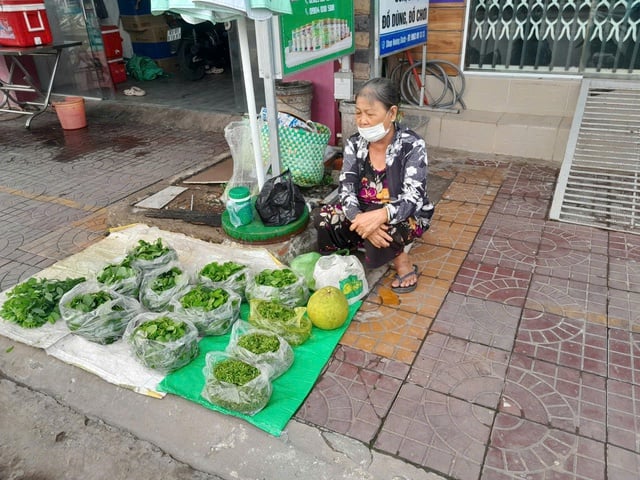
Mrs. Hai chose a corner of Ben Ba market, hunched over with her pile of fresh vegetables, a habit she couldn't break.
PHOTO: PROVIDED BY THE AUTHOR
Once, Mrs. Hai sat quietly in the market, her gaze fixed on the convenience store next door. A young woman stepped off a gleaming SH scooter, high-heeled shoes on her feet, one hand on her phone, the other holding a cup of milk tea. She handed the store owner a 500,000 dong note to buy just two small items. She hastily tossed the change into her bag without looking, then left. Mrs. Hai watched her go, shaking her head slightly, a sigh filled with unspoken sorrow. She had witnessed countless similar scenes. Children eating only half a loaf of bread for breakfast before discarding it. Bottles of water being drunk only a few sips before thrown away, as if money were something to be easily thrown away.
There was even an instance when a group of young people sitting near her vegetable stall were chatting animatedly when one of them burst out laughing loudly: "Oh my God, my mom always tells me to save money! I said: Mom, I'm going to school, not to become a monk!" The whole group burst into laughter, their innocent laughter unintentionally cutting into Mrs. Hai's heart. Not because of the disrespectful remark, but because of the way they didn't understand the true value of labor and money. For her, every penny from selling vegetables represented a drop of sweat, a season of drought, a torrential rain. Yet, some of them treated it like worthless paper, something to be thrown away at any time. She only hoped that when they grew up, they wouldn't forget the hardships of those who came before them to build every house and every road.
She didn't spend the money from selling vegetables on herself. She carefully wrapped it in a paper bag, put it in a small drawer, and locked it. She saved it for her grandchildren's university tuition. That drawer contained not only money, but also a strong belief. She believed that someday, her grandchildren would study hard, become successful, and achieve great things in life. And most importantly, she believed they would understand that every penny earned carried the scent of the earth, the sun, and the sweat of their grandparents and parents.
Dat, her eldest grandson, was in his second year of university. During one summer break, he drove all the way to the market to pick her up. Standing beside her vegetable stall, he spoke softly but with determination: "Grandma, when I make a lot of money, I'll support you. You can rest now; I won't let you suffer anymore!" Grandma Hai looked up, her eyes filled with joy and radiant happiness. She smiled, a gentle, warm smile like the fairies in fairy tales: "Yes, I'm happy that you love me. But remember, son, no matter how rich you become, you must be thrifty. Don't think that just because you have millions you can spend whatever you want. Every penny has its own value; you must respect it. Saving is knowing how to live for tomorrow, son!"
The market breeze carries the refreshing scent of fresh vegetables, mingled with the early morning sun, creating a unique flavor of the countryside. Little birds hop on the branches of the oil palm trees, as if listening together to the silent yet meaningful lesson of the old woman. This corner of the Ben Ba - Cu Lao Dung rural market, seemingly the most ordinary place, actually holds a profound philosophy of life. People may pass by without buying vegetables, but everyone must turn back to look at the familiar figure and the gentle yet resolute gaze of Mrs. Hai.
There, you'll find not only fresh green vegetables and plump, ripe tomatoes, but also a vivid lesson in frugality and morality. No blackboard, no chalk, no formal sermons, just a white-haired old woman sitting quietly in the morning sun, carefully saving every penny to sow a seed in the hearts of future generations: to appreciate the value of hard work, to live frugally so that they may live more decently and usefully.
The 5th "Living Beautifully" writing contest was organized to encourage people to write about noble acts that have helped individuals or communities. This year, the contest focuses on praising individuals or groups who have performed acts of kindness, bringing hope to those in difficult circumstances.
A highlight is the new environmental award category, which honors works that inspire and encourage action for a green and clean living environment. Through this, the organizers hope to raise community awareness in protecting the planet for future generations.
The competition features diverse categories and prize structures, including:


Article categories: Essays, reports, notes, or short stories, not exceeding 1,600 words for essays and 2,500 words for short stories.
Feature articles, reports, and notes:
- 1st Prize: 30,000,000 VND
- 2 Second Prizes: 15,000,000 VND
- 3 Third Prizes: 10,000,000 VND
- 5 Consolation Prizes: 3,000,000 VND
Short story:
- 1st Prize: 30,000,000 VND
- 1 Second Prize: 20,000,000 VND
- 2 Third Prizes: 10,000,000 VND
- 4 Consolation Prizes: 5,000,000 VND
Photo category: Submit a set of at least 5 photos related to volunteer work or environmental protection, along with the title of the photo set and a short description.
- 1st Prize: 10,000,000 VND
- 1 Second Prize: 5,000,000 VND
- 1 Third Prize: 3,000,000 VND
- 5 Consolation Prizes: 2,000,000 VND
Prize for the Most Popular Song: 5,000,000 VND

Prize for an outstanding essay on the topic of the environment: 5,000,000 VND
Honored Person Award: 30,000,000 VND
The deadline for submitting entries is October 16, 2025. Entries will be judged in a preliminary and final round by a panel of renowned judges. The organizers will announce the winners on the "Living Beautifully" website. See the detailed rules here. thanhnien.vn.
Organizing Committee

Source: https://thanhnien.vn/nang-doi-o-goc-cho-que-185250827101441778.htm