

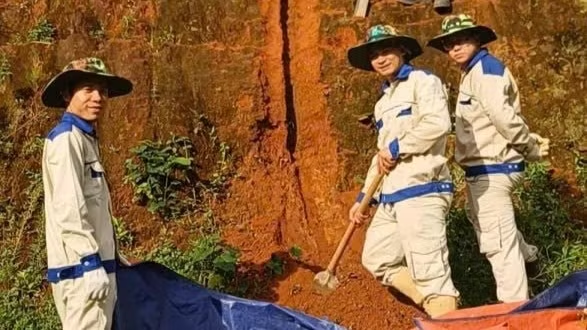
Possessing rare earth potential ranked second in the world , Vietnam is facing a "golden opportunity" to participate deeply in the global high-tech supply chain.
However, in a market where supply and technology are becoming the focus of global attention, the key to protecting national interests lies not in mining and selling raw ore, but in the capacity for technological self-reliance in deep processing and refining, mastering the value chain.
"Vitamin" of the economy
Rare earth elements comprise 17 chemical elements (15 lanthanide elements along with yttrium and scandium). They are called "rare" not only because they are scarce in the Earth's crust, but also because of their dispersion and the extreme complexity and high cost of extraction and purification technologies.
In the modern industrial era, rare earth elements are dubbed the "vitamins" of the economy by scientists – fundamental materials in many high-tech industries. Technological devices use only small amounts of rare earth elements, measured in grams or kilograms, but these are core materials that determine the performance, durability, and miniaturization of the equipment. In the current green energy transition, the role of rare earth elements is specifically allocated to three main application groups:
Firstly, the electric vehicle (EV) and renewable energy industry: This is the largest consumer of rare earth elements and is experiencing phenomenal growth. Light group elements such as neodymium and praseodymium are crucial components for manufacturing super-strong permanent magnets (NdFeB). Unlike conventional magnets, NdFeB magnets generate extremely strong magnetic fields in very small sizes. An electric car requires approximately one to three kilograms (kg) of these magnets for its motor assembly. For wind turbines, especially offshore wind turbines with enormous capacities of 10 MW to 15 MW, the direct-drive generator sets require tons of permanent magnets.
In particular, to ensure these motors operate stably at high temperatures without losing their magnetism, it is necessary to add valuable heavy rare earth elements such as Dysprosium and Terbium.
Secondly, energy-saving technology: Elements such as Yttrium, Europium, and Terbium play an indispensable role as luminescent materials in the production of LED lighting, liquid crystal displays, and mobile devices. Thanks to rare earth elements, LED bulbs can emit high-intensity light while consuming only one-tenth the electricity of traditional incandescent bulbs, making a significant contribution to reducing the burden on the global power grid.
Thirdly, the defense and aerospace industry: Although rare earth elements account for a small proportion of total production, they are vital to the national security of major powers. They are used in laser guidance systems, radar, cruise missile control systems, night vision devices, and stealth aircraft fuselage alloys.
The economic value of rare earth elements depends heavily on the supply chain. Structurally, the processing of rare earth elements is divided into many complex and closed stages: ore mining, ore beneficiation (ore enrichment), hydrometallurgy (breaking down the ore structure to convert it into a solution), separation and purification (extracting individual elements from a mixture), metallurgy (manufacturing metals and alloys), and materials manufacturing (producing magnets, fluorescent powders, catalytic materials, ceramics).
Significantly, the majority of environmental pollution (chemicals, radioactive waste) is concentrated in the upstream stages (mining, mineral processing, hydrometallurgy). Meanwhile, 80% to 90% of the profit margin and added value lies in the downstream stages, namely the technology for separating and refining minerals to achieve high purity (over 99.9%) and the technology for metallurgy and magnet production.
Vietnam's process of accessing and mastering technology.
The opportunities are immense, but the consistent and unwavering direction of the Party, State, and Government is: resolutely not to export raw ore; mineral exploitation must go hand in hand with environmental protection, and be closely linked to deep processing to create maximum added value for the national economy.
To achieve this goal, the role of scientific research is fundamental. The Institute of Rare Earth Technology (under the Vietnam Atomic Energy Institute - Ministry of Science and Technology) is one of the leading research units, having spent nearly 40 years researching and implementing projects on rare earth processing procedures.
Firstly, mastering hydrometallurgical technology is crucial: Rare earth ores in Vietnam have unique characteristics, primarily consisting of light rare earth elements; bastnasite ore from the Dong Pao and Nam Xe mines (Lai Chau province), and monazite ore found in placer deposits. Scientists have successfully researched advanced hydrometallurgical processes (high-temperature decomposition using acid/alkali) to break down the ore concentrate structure, remove impurities, treat radioactive waste, and recover commercially viable total rare earth oxides on a semi-industrial scale.
Secondly, research on separation and purification technology: As analyzed, separation technology is the core technology of the rare earth value chain. Separating identical elements requires a process called "multi-stage solvent extraction." This technological scheme may require hundreds of consecutive extraction stages with extremely sophisticated control of physicochemical parameters to separate each rare earth element from one another. The Institute's team of experts has developed software to calculate, simulate, and successfully operate a solvent extraction system capable of successfully separating strategic elements such as Neodymium, Praseodymium, Samarium, and Dysprosium with a purity of over 99%. This is a mandatory standard for use as input materials in the production of wind turbine magnets and electric vehicles.
Thirdly, controlling and safely handling radioactive environments: Most rare earth mines in the world and in Vietnam contain naturally occurring radioactive elements. If the processing of rare earths is not controlled, these radioactive substances will be released into water sources and soil, causing long-term ecological disasters. In fact, many developed countries have had to close rare earth mines because they could not solve this environmental problem.
As the nation's leading research institution in atomic energy and radiation safety, the Institute of Rare Earth Technology has successfully established technological processes for the safe recovery, isolation, and treatment of radioactive isotopes associated with rare earth ores. Complete control of radioactive waste from the hydrometallurgical process helps realize the concept of "green mining and processing"—a prerequisite for high-tech foreign direct investment (FDI) enterprises (from the US, Japan, and Europe) to invest in Vietnam without violating stringent international environmental, social, and governance (ESG) standards.
Creating an industrial ecosystem
Vietnam has a great opportunity to leverage the value of its mineral resources for economic development. However, resource exploitation will not be sustainable if it only focuses on exporting raw materials at the expense of the environment.
In fact, the technology for separating and refining rare earth elements and the metallurgical production of magnets are considered core technological secrets by the countries that possess them. It is highly unlikely that foreign partners will be willing to transfer all of this sensitive technology. Therefore, the challenge for Vietnam is to promote self-reliance and self-sufficiency, and to invest heavily in domestic technology research as soon as possible.
Vietnam's rare earth industry development strategy must be built on a foundation of science and technology. The extensive research achievements over the years are vivid proof that Vietnam is fully capable of absorbing, mastering, and jointly developing the refining technologies for this most complex mineral in the world.
The in-depth research participation of the Institute of Rare Earth Technology and other domestic scientific institutions will provide crucial data to help management agencies assess foreign investment projects and select advanced, environmentally friendly technologies.
Once Vietnam gradually achieves self-sufficiency in advanced processing technology to produce rare earth oxide raw materials that meet international standards, instead of just selling raw materials, we can use these materials as a competitive advantage. For example, we can invite global high-tech corporations to Vietnam, thereby directing FDI capital towards establishing factories producing electronic components, electric vehicle motors, renewable energy equipment, etc., forming a closed-loop high-tech industrial ecosystem right in the country.
Mastering the technology of deep processing of rare earth elements is not only a solution to economic problems, but also a strategic step to protect national energy security, elevating Vietnam to a higher level in the global technology value chain, and making a worthy contribution to the journey of creating a green and sustainable future.
Source: https://nhandan.vn/nen-tang-cua-cong-nghiep-xanh-post959320.html










































































Comment (0)