


Russia develops mobile UAV 'launch platform'.
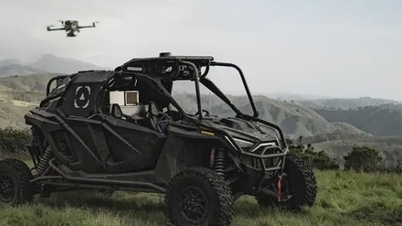
Russian experts are working on a new version of the Muravei remotely operated vehicle, to be used as a 'platform' for unmanned aerial vehicles (UAVs). This information was announced by an official representative of the Kaisant Scientific and Production Association.
Specifically, the new UAV transport vehicles, produced in small batches with various variants, have been delivered to the Russian Army. The manufacturer is currently receiving feedback from the units that ordered these platforms for specific missions.
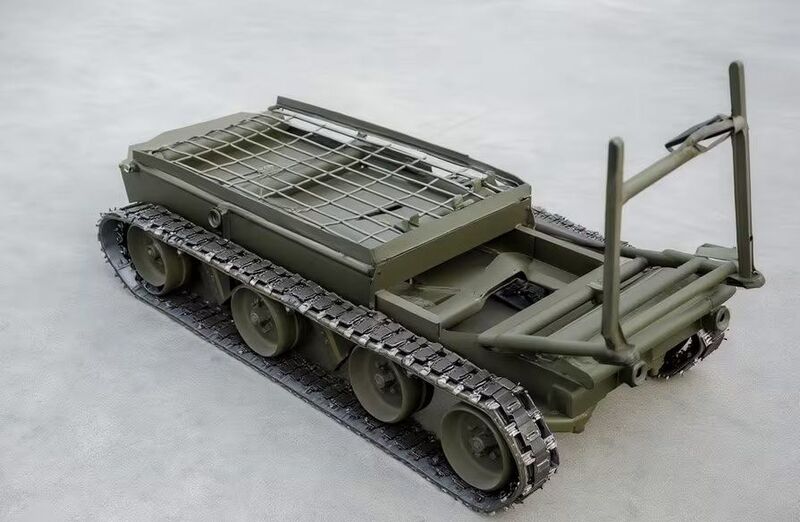
Muravei UAV transport platform. Photo: Lenta
"After receiving feedback from the military, we will accept large-scale orders for certain types of Muravei vehicles, and then we can proceed with mass production. Currently, we are also researching the production of tracked Muravei vehicles, and a prototype has already been built," Kaisant announced.
Kaisant added that different versions of the Muravei platform use different engines and control systems. This makes the vehicle harder to predict on the battlefield.
He participated in the bidding process to supply a new destroyer to the Swedish Navy.
British company Babcock and Swedish company Saab are jointly bidding for Arrowhead 120-class destroyers to supply the Swedish Navy with four new-generation Luleå-class frigates. According to Navy Recognition, this consortium is competing with France's Naval Group with its FDI-class destroyer design and Spain's Navantia with its F110 design.
In an interview with Dagens Nyheter, Babcock's Commercial Director, Ilgi Kim, confirmed that this is a joint proposal with Saab and that the British company did not submit a separate bid to the Swedish Defence Supplies Agency. A final decision on the supplier is expected in the first half of 2026, and delivery of the first two frigates is scheduled for 2030. Full delivery is expected by 2035. The value of the future contract is estimated at 60 billion kronor (approximately US$6 billion).
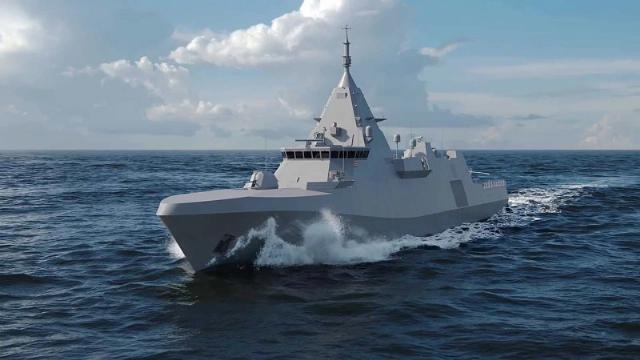
Arrowhead-class destroyer design. Photo: Saab
According to Navy Recognition, this program is considered Sweden's largest purchase of surface warships since the early 1980s and is directly related to the growing naval needs in the Baltic Sea and Arctic regions.
The Luleå-class program was created after the second-generation Visby-class frigate project, launched in January 2021, was canceled in 2023.
If built, the Swedish version would have a displacement of approximately 4,650 tons, a 124-meter-long steel hull, and a lightweight composite superstructure. The stated top speed would be 24 knots, with a range of 6,000 nautical miles at 15 knots.
The Krasnopol-M2 precision-guided artillery shell has been "tested in combat".
The improved Krasnopol-M2 precision-guided artillery shell requires less preparation time before firing. A soldier from the 238th Artillery Brigade of the Southern Forces Group outlined the main advantages of this highly accurate guided artillery shell to RIA Novosti.
Unlike standard ammunition, the Krasnopol-M2 is a monolithic projectile. It is manufactured to the dimensions of a standard 152mm artillery shell. This allows it to be installed and assembled inside a standard artillery shell compartment.
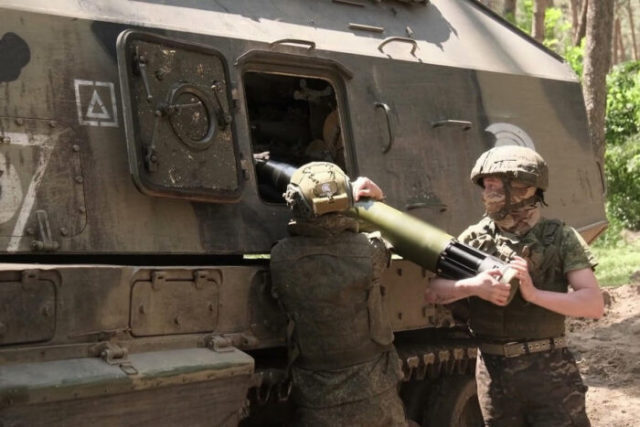
Loading Krasnopol-M guided artillery rounds into the Msta-S self-propelled howitzer. Photo: invoen.ru
"The crew inputs data from the control panel into the cockpit, and everything is calculated when the flaps will open… Previously, this was adjusted mechanically," said the commander of the 2nd Artillery Platoon, codenamed Angara.
The Krasnopol guided artillery shell is equipped with a laser seeker, which guides it to the target using a laser beam. Its trajectory is adjusted by six guide fins concealed within the shell's body.
In early 2026, High-Precision Systems JSC completed contracts to supply missiles for the Iskander-M system and Krasnopol-M2 artillery shells as ordered by the Russian military.
Source: https://congthuong.vn/nga-phat-develop-co-dong-uav-protection-be-phong-443857.html





























![[Photo] National Assembly Chairman Tran Thanh Man working with the National Assembly Committees](https://vphoto.vietnam.vn/thumb/1200x675/vietnam/resource/IMAGE/2026/02/24/1771915679930_bnd-7209-2157-jpg.webp)
















































Comment (0)