

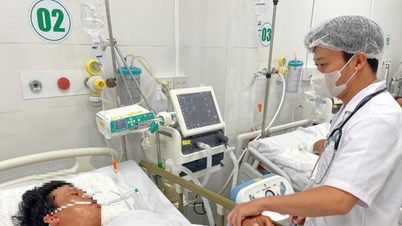
According to Dr. Nguyen Duc Loc, from the Department of Internal Medicine and Toxicology, Intensive Care Center, Military Central Hospital 108, the department recently received two patients from Son Dong district, Bac Giang province, who suffered from gas asphyxiation after descending into deep wells to clean them.
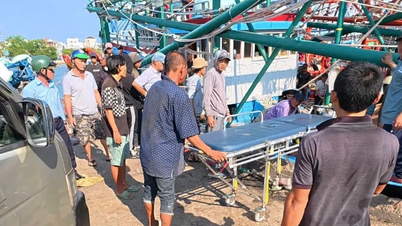
Accordingly, on May 4th, Mr. A went down a nearly 10-meter-deep well to clean it and did not resurface after a long time. Mr. X, 36 years old, and Mr. N, 45 years old, climbed down to rescue him but discovered that Mr. A had already died.

When someone is suffocating in a deep well, everyone needs to remain calm and provide first aid to prevent death (photo source: 108 Hospital).
At that time, both Mr. X and Mr. N experienced shortness of breath and dizziness. They were pulled to the surface and local residents performed cardiopulmonary resuscitation on the spot. They received further first aid at a local medical facility before being transferred to the Internal Medicine and Toxicology Intensive Care Unit.
According to Dr. Le Lan Phuong, Director of the Intensive Care Unit, "In deep well environments, especially wells that have been covered for a long time and are rarely used, the metabolic products of the decomposition of organic matter are toxic gases such as methane (CH4), carbon dioxide (CO2), carbon monoxide (CO), and hydrogen sulfide (H2S)... which are heavier than oxygen, and the deeper you are, the more concentrated they become."
The victims died from lack of oxygen (O2) and inhalation of toxic gases. Additionally, in areas with many coal mines, oil fields, or landfills and agricultural waste dumps, deep wells often contain high levels of methane gas.
This is a toxic gas that can cause rapid death if it reaches high concentrations. Therefore, people need to be cautious when intending to descend into deep wells in these areas.”
To prevent asphyxiation accidents in deep wells, doctors at the Poison Control Center advise people to follow these guidelines: Ensure you have all necessary equipment before descending into the well, such as protective gear and a gas mask.

Most people don't usually have these items, but these problems can be overcome with the following simple methods:
Cut a large, leafy branch, tie a long string to it, lower it to the bottom of the well, and repeatedly raise and lower it to aerate the well.
A better method is to use a pure oxygen aeration machine to pump air down the well.
A rubber tube should be prepared to both conduct air from the ground for breathing and to signal people above in case of an emergency.
People can light a candle or lamp and slowly lower it to the water surface at the bottom of the well. If the candle continues to burn brightly, it means there is enough oxygen at the bottom of the well for breathing; otherwise, if the candle only flickers and then goes out, it is not advisable to go down into the well.
Alternatively, you can drop a chicken or a bird close to the surface of the well water; if the animal suffocates, it indicates a high concentration of toxic gases in the well.
If you encounter a scene where someone is suspected of suffocating in a well, you absolutely must not go down the well immediately to rescue them. The rescuer should immediately call the Fire and Rescue Police (telephone number 114) for assistance.
If the victim is still conscious, lower a rope down the well to pull them up. If the victim is unconscious, prepare and check for safety before deciding to descend into the well.
The rescuer uses one hand to pinch both sides of the victim's nose shut, and the other hand to push down the chin to open the victim's mouth. Then, the rescuer takes a deep breath, places their mouth tightly against the victim's mouth, and blows forcefully, repeating two breaths for adults and one breath for children under 8 years old. Observe the victim's chest rising to ensure the procedure is correct. Then, allow the victim's chest to deflate naturally before blowing again.

Perform the above actions repeatedly at the following pace: adults and children over 8 years old should perform approximately 15-20 breaths per minute, while children under 8 years old should perform 20-30 breaths per minute. Mouth-covering and nose-blowing can also be done in a similar manner.
The best first aid for a victim after they reach the surface is to perform artificial respiration immediately, and then transport the victim to the nearest medical facility.
Gas poisoning in deep wells not only endangers the lives of the victims themselves but also poses a potential risk to those involved in the rescue. In fact, preventing this problem using simple manual methods is quite possible.
However, not everyone knows these methods, as well as how to provide first aid to victims of gas asphyxiation in deep wells.
Source

























































![[Video] Sunset at Lap An Lagoon – Where the sun sets over the fishing nets](https://vphoto.vietnam.vn/thumb/1200x675/vietnam/resource/IMAGE/2026/05/31/1780192137701_beach-landscape-sea-water-nature-grass-745871-pxhere-com.jpeg)




































Comment (0)