


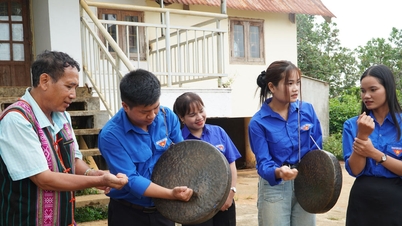
The Thung Muong village performing arts group has been equipped with a new set of gongs, spreading the cultural space of Muong gong music in community activities and festivals in Muong Dong.
New rhythm of life
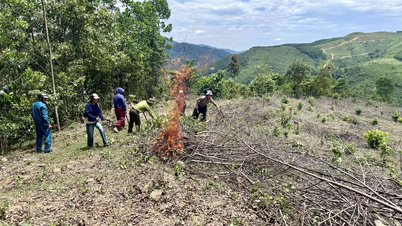
In the early days of the year, walking through the villages of Muong Dong, one can clearly feel the familiar yet new rhythm of life. In the fields, furrows are plowed to prepare the land for the spring crop; on the hillsides, people take advantage of the favorable weather to care for their crops, preparing seeds and fertilizers. Agriculture and forestry remain the pillars of the locality, but the methods have changed. By 2025, the commune's food crop production is expected to reach over 10,000 tons, with stable rice and corn yields; forests are replanted promptly after logging; and many models of sugarcane, ramie, and fruit tree cultivation bring considerable income to the people. Most significantly, there has been a change in production mindset: from producing just enough to eat to producing for sale, from small-scale farming to a commodity-based production system, linking products to the market and quality standards.
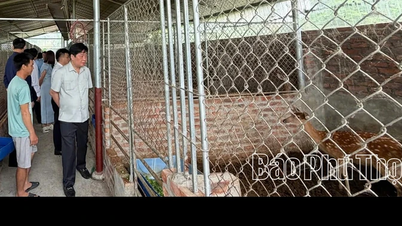
However, the spring production landscape still has some downsides. Livestock farming continues to be affected by disease outbreaks, input costs are rising; agricultural output is not yet truly stable, and the situation of bumper harvests but low prices still makes many farmers cautious. Sharing his thoughts on this, Comrade Nguyen Hoang Thu, Secretary of the Party Committee of Muong Dong commune, said: “We cannot rely solely on traditional production. The commune is gradually orienting towards clean agriculture, increasing production-consumption linkages, and linking agriculture with ecotourism to reduce risks and create more livelihoods for the people.” According to him, the most important goal is to help people feel secure in doing business right on their homeland, instead of having to seek precarious livelihoods elsewhere.
Alongside production, the appearance of rural Muong Dong has changed significantly in recent years. The transportation system has been invested in more comprehensively, with 100% of the main commune roads now paved, and many inter-village roads widened, shortening the distance from villages to the center. Electricity, water, and telecommunications are gradually meeting the needs of daily life and production; schools and health stations have received attention for upgrading. The average per capita income is estimated to reach over 46 million VND in 2025; the poverty rate will decrease to about 7.5%. Notably, the implementation of online public services and community digital technology groups has made many administrative procedures faster and more transparent, creating a sense of closeness and convenience for people in the mountainous region.
These changes are enough to allow the people of Muong Dong to enter the new spring with a more steadfast mindset. On familiar land, a new rhythm of life is taking shape - slow, steady, and enduring, in the way of the Muong region.
Preserving the spirit of the Muong people to pave the way for further progress.
While production and infrastructure provide a steady rhythm for daily life, culture and landscape are where spring in Muong Dong most clearly radiates. In this land, indigenous values do not remain dormant in the past, but are still present in daily life: in the Muong language echoing around the hearth, in the stilt houses still preserved in the villages, in the New Year's festival that calls people back to the land and to each other.
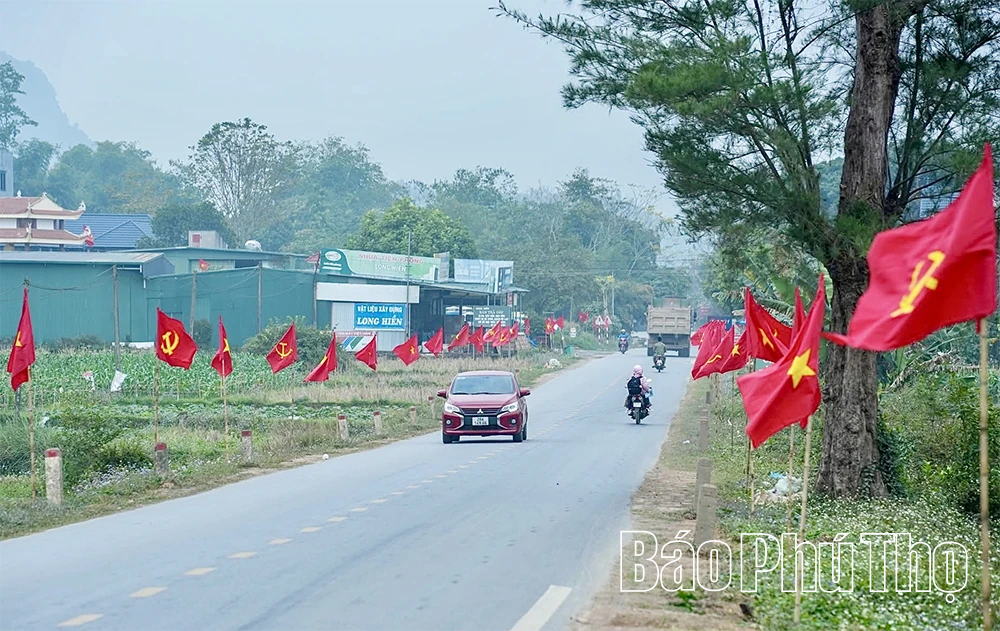
The road through Muong Dong is ablaze with flags in the early days of spring.
Muong Dong possesses a unique advantage: Muong culture remains a vibrant part of the community. Muong shamanism, courtship singing, and traditional festivals—including the Sim Pagoda Festival in Sim Ngoai hamlet—are not merely "performances" for tourists, but rather community cultural activities maintained by the people for generations. Muong cultural clubs in the villages and hamlets continue to operate regularly, both to preserve customs and to create spaces for community bonding. This natural continuity makes the local culture a strong foundation for community tourism, rather than just a decorative facade.
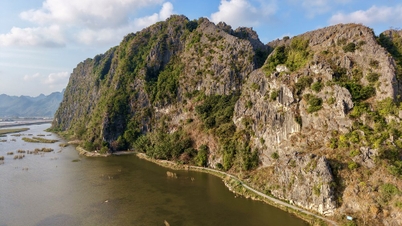
Along with its culture, the landscape and mineral springs are the elements that create the unique "geographical advantage" of Muong Dong. Thung Rech, Thuong Tien, Cuu Thac Tu Son... still retain the pristine beauty of forests, streams, waterfalls, and hills. In particular, the valuable hot mineral springs open up the potential for developing nature-based wellness and health tourism. Currently, some ecotourism destinations have been established, but their scale is still small, and accommodation and culinary services are not yet fully developed. However, this very "incompleteness" shows that there is still vast room for development, requiring approaches that are appropriate to local conditions.
It's noteworthy that in the stories of tourism in Muong Dong, the local people are not left out. Community tourism is seen not only as welcoming guests, but also as creating additional livelihoods right in the villages: from homestays, Muong cuisine, festival experiences, traditional crafts to OCOP products associated with culture and mineral water. Each village is expected to have its own unique product, just enough to preserve its identity and generate income, instead of chasing large-scale models beyond its capabilities.
Alongside this are the quiet but necessary preparations: perfecting essential infrastructure, training local people in community-based tourism skills, and gradually applying digital transformation in promotion and connecting tours. These efforts may not produce immediate results, but they help Muong Dong tourism have the opportunity to go further and avoid repeating the pitfalls of rapid, uncontrolled development.
Spring in Muong Dong, therefore, is not only reflected in festivals or scenery, but also in the way the local community looks to the future. When the land, culture, and people are placed in their rightful positions, the path of tourism development here can follow its own unique direction: slow enough not to lose its identity, clear enough to open up new avenues for the Muong village in future springs.
Nguyen Yen
Source: https://baophutho.vn/ngay-moi-o-muong-dong-246926.htm
![[Photo] General Secretary and President To Lam presides over a working session with the Central Policy and Strategy Committee on the development of the materials industry.](https://vphoto.vietnam.vn/thumb/1200x675/vietnam/resource/IMAGE/2026/05/21/1779359935432_a3-bnd-3129-1412-jpg.webp)
![[Photo] National Assembly Chairman Tran Thanh Man working with the Standing Committee of the Law and Justice Committee](https://vphoto.vietnam.vn/thumb/1200x675/vietnam/resource/IMAGE/2026/05/21/1779378929214_ndo_br_1-4610-jpg.webp)























































Comment (0)