

A drop of gold...
"I just crave a little bit of chili peppers mixed in a bowl of fish sauce to pour over cold rice. I miss the smell of home so much!" These words from my sister, who lives far away in Europe, made me realize that, just like homeland, traditional products don't need declarations; people naturally feel attached to them and fall in love with them.
Following a recommendation from some acquaintances, I drove to Ho Tram commune to find Mr. Nguyen Cao Thien, the owner of Thien Loc fish sauce factory, who has inherited the traditional fish sauce making craft for three generations. From the entrance of the alley, the rich aroma of fish sauce permeated the familiar atmosphere of the old fishing village. Despite societal changes and advanced processing technology, Mr. Thien's family still maintains the recipe passed down through generations.
This is a quintessential traditional craft, drawing bounty from the sea to produce its finest products. To create a batch of fragrant, rich, and beautiful fish sauce, besides experience, one must possess the dedication of the maker. It's a rigorous process, beginning with the selection of fresh fish. Each fishing ground provides different raw materials, and the finished product therefore carries a distinctive sea flavor – although made from anchovies, the anchovy fish sauce from the coastal villages of Ho Chi Minh City is absolutely distinct from the fish sauce of Nha Trang (Khanh Hoa province) or Phu Quoc ( An Giang province)…
Each year, the eastern sea area of Ho Chi Minh City typically experiences three "golden seasons." Fishing boats laden with fish usually begin their voyages from March to May, July to September, and the last two months of the year. Each time, Thien Loc's facility purchases approximately 500 tons of anchovies, from which they produce 30,000-40,000 liters of fish sauce for export worldwide. "It's hard work, but the fish sauce making profession has been passed down through generations. Each drop of fish sauce is like a drop of gold from the sea, containing the sweat of fishermen and the dedication of those who make it, becoming the livelihood of the fishing villages in the East," Mr. Thien said. As evening fell, I left Ho Tram amidst the melodious singing echoing from the Thien Loc fish sauce village: "The fish makes the fish sauce / The old couple loves each other so much, my dear!"
While the songs of the fishing village were still echoing, I walked along the eastern coastline, admiring the abundance that the sea had bestowed upon the land and its people.
Drip… drip… drip… the golden, smooth drops of fish sauce gently fall into the pristine white porcelain bowl, awakening the entire atmosphere of the Hon Cau fish sauce production facility (80 Bach Dang Street, Vung Tau Ward). Fish sauce has become the "soul" of the fishing village, the essence of the sea.
Mr. Nguyen Trong Duc, owner of the Hon Cau fish sauce production facility, has been involved in the traditional fish sauce making profession for over 30 years, to the point that even his clothes are imbued with the strong scent of the sea. He says that making industrial fish sauce is easy, but making traditional fish sauce is like "salting one's heart" for the sea, a process of slow fermentation over the years. Each place has its own secret recipe, but to make the best traditional fish sauce, you absolutely need very fresh anchovies and very salty sea salt.
Hundreds of wooden barrels filled with fermented fish fill the entire 4,000m2 facility, but Mr. Duc remembers the "origin" of each barrel, from the fermentation date, the draining date, to the flavoring date… Stopping by the extraction area, raising a cup of fish sauce, Mr. Duc remarked: "Truly the essence of the sea."
Gathering the essence of the sea.
Making fish sauce is a generational trade with its own secrets. Some fish sauces have a high protein content and beautiful color but are extremely salty, due to salt that wasn't aged enough before being used for fermentation. This profession seems difficult; everything has to be just right. "Salt is like a person; it needs to 'breathe' enough to be good. To have good fish sauce, you have to make it when the fish is at its best and fattest, the salt grains are at their oldest, and the weather isn't harsh," Mr. Duc said.
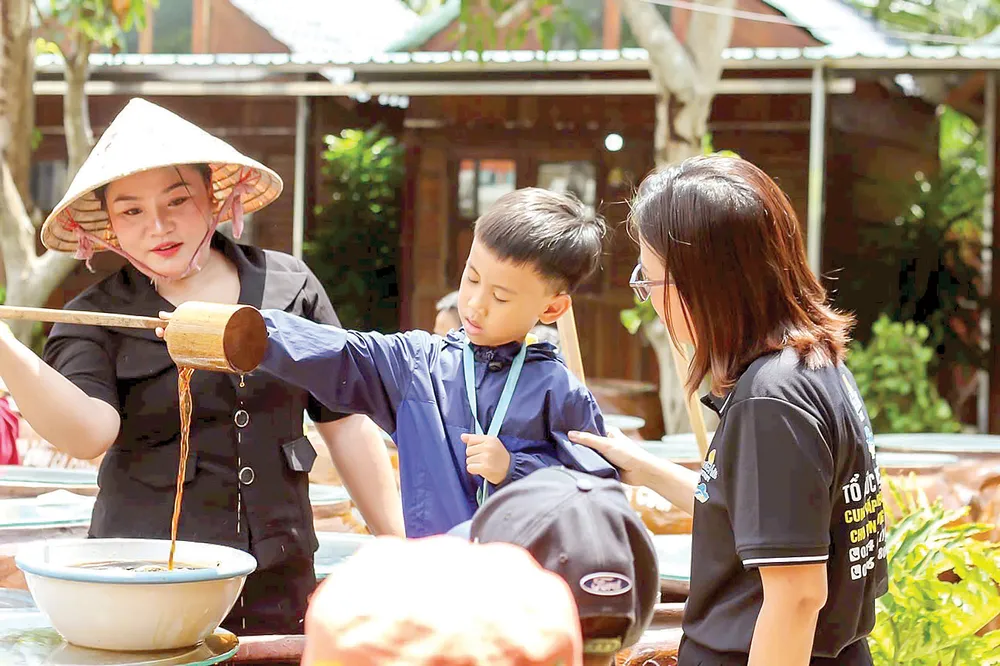
Traditional fish sauce is a family tradition. This mindset is carefully nurtured and embodied by Ms. Nguyen Thi Chien, Director of Hati Production, Trading and Service Co., Ltd., in every barrel of traditional fish sauce bearing the Long Hai anchovy fish sauce brand.
Around 5 a.m., as the sun rises from the sea, hundreds of tons of anchovies are brought ashore by fishermen's boats and immediately transported to fish sauce production facilities in Long Hai. The earthenware jars containing the fish sauce are spread out in the grounds of the Long Hai anchovy fish sauce production facility (Phuoc Hai commune, Ho Chi Minh City).
Ms. Chien stirs slowly and evenly in batches, the fish sauce foam rising like bubbly beer before sinking back down. Each time this happens, the aroma of the fish sauce rises, making fish sauce enthusiasts exclaim in delight. "The recipe for Long Hai fish sauce is entirely handcrafted. After salting for at least 12 months, the fish sauce is filtered through many layers to produce the final product before being placed in earthenware jars to naturally ferment," Ms. Chien shared.
A bottle of good fish sauce is judged by the discerning palates of connoisseurs, and the most knowledgeable are the producers themselves. Good fish sauce for cooking should have a slightly milder flavor. A pot of braised fish or a plate of sausage, even with all the other seasonings, wouldn't be complete without a few spoonfuls of fish sauce. For Vietnamese people, fish sauce is a unique culinary tradition spanning centuries. A century isn't just a symbolic number, but deeply ingrained in the Vietnamese palate and subconscious. When far from home, a simple bowl of white rice and a plate of fish sauce with plenty of chili is enough to evoke the taste of home.
No one remembers the exact age of the fishing villages, nor the long history of the fish sauce making industry, but the fish sauce making profession has existed since the arrival of the sea. In Vietnam, fish sauce is produced throughout the coastal regions stretching the country's length, from Mong Cai in the north to Ca Mau in the south. In the eastern part of Ho Chi Minh City, the imprint of this industry is evident in fish sauce villages such as Vung Tau, Binh Chau, Ho Tram, Long Hai, and Phuoc Hai. From its rudimentary beginnings with small boats, few establishments, and little recognition, the fish sauce "brand" of the eastern part of the city, with hundreds of reputable production facilities, has now spread throughout the country.
The fishing villages of Vung Tau, Long Hai, Phuoc Hai, Binh Chau, Ho Tram… all have abundant and fresh seafood resources, and the nearby An Ngai salt fields contribute to the flourishing of the traditional fish sauce making industry. Each bottle of fish sauce is the culmination of sunshine, wind, sea, sky, and the skillful hands of the people.
Beyond quality, traditional fish sauce producers also focus on packaging design and diverse product sizes; they have fleets of boats that catch fresh anchovies locally; and they establish traditional fish sauce cooperatives to distribute their products further afield. All of these factors create an attractive destination for tourists and form a sustainable fisheries logistics service industry. Therefore, fish sauce not only has the salty taste of the sea but also the sweetness of time.
Source: https://www.sggp.org.vn/nghe-giot-vang-go-dau-tram-nam-post838702.html












































































Comment (0)