

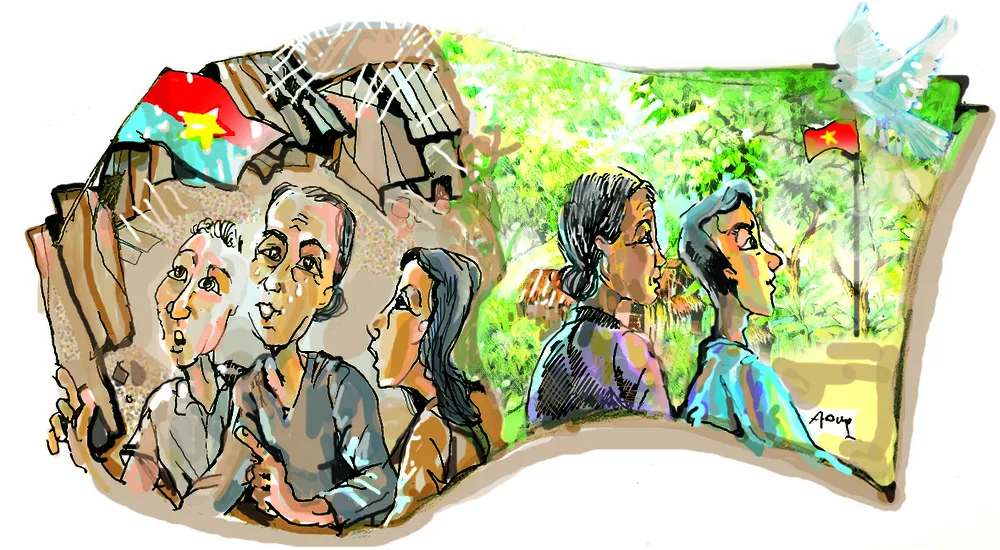
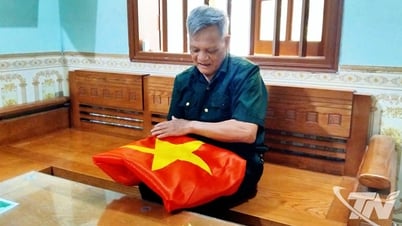
My grandmother sat on a bamboo bench, her back slightly hunched, her hand slowly stroking her worn-out shirt. The shirt was a pale blue, almost completely faded, with only overlapping stitches remaining like the marks of time. On her chest, a small flag remained intact, though its red color had faded with age.
She listened silently to the wind rustling through the leaves. Her gaze was distant, as if looking at the garden before her, yet also piercing through it, towards a place I could not reach.
I sat on the steps, leaning against a pillar. The afternoon sun gently caressed my hair, as if time itself wanted to linger and listen to an old story from decades ago.
"Grandma?", I called softly, asking, "Where were you on April 30th?"
The question was over, and the space seemed to fall silent. A breeze passed by, gently swaying the hem of the dress in her hand. She remained silent for a long time, as if choosing a single thread of memory from countless old ones.
“She… was down in the temporary shelter.” She spoke slowly, her voice like it was drifting through a thin layer of mist, and added, “That day… no one dared to say what would happen.”
***
She recounted that the sky wasn't clear that day, but rather a grayish haze. A thin layer of clouds hung high above, trapping the sunlight above, preventing it from reaching the ground as usual. The air was heavy, as if something invisible was pressing down on them. "Hearing the roar of gunfire, people rushed down to the bunkers," she said. "No one told anyone what to do, they just ran. For survival..."
The shelter was a dug-out hole in the ground, temporarily covered with wooden planks and a thick layer of earth. Inside, it was dark, damp, and cramped. Adults, children, and the elderly all huddled together, sharing every inch of air to breathe, to hear each other's heartbeats, to feel each other's skin still warm. The space was thick with the smell of people, earth, sweat, and the ever-present scent of anxiety.
“Sitting in there,” she continued, adding, “I could only hear my own heart beating, thump, thump…”
The sound of heartbeats. The sound of breathing. And also the sounds echoing down from the ground, vague and intermittent. Gunshots, footsteps, screams, crashing sounds…
“I remember an old woman,” she said, her voice slowing, “her hands fingering her rosary beads, her mouth constantly chanting prayers. No one could hear exactly what she was chanting; it could have been prayers for the safety of those seeking refuge, or prayers for the souls of the deceased—no one knew for sure. But everyone felt a sudden sense of peace.” Perhaps that was how people managed to stand firm on the brink of life and death.
Inside the bunker, no one knew what was happening outside. They didn't know how much longer it would be before they could get out. Or even if they could get out at all. There was only one thing they could do: wait.
Waiting for a signal. Waiting for a call. Waiting for something significant enough to pull me out of the darkness.
Then the whistle blew.
She paused, her eyes slightly closed, as if listening to the sound again in her memory. "It's not like the previous times," she said, then continued, "It's very long, several beats. But it doesn't sound frantic or anxious, but rather full of joy."
The siren echoed through the air, piercing the earth and falling into the bunker. Those inside looked at each other; no one dared to stand up immediately. After so many alarms, they had learned to be suspicious. A single signal was no longer enough to inspire immediate trust.
Then, from above, a voice called out.
"Go away! The war is over! Peace has come!"
She recounted that when she emerged from the bunker, the light blinded her. After a long period of darkness, the light became too intense. Peace arrived like light, so suddenly, so beautifully, that she had to stand still for a moment, allowing her eyes to adjust and her heart to the joy.
And then, when her vision cleared, she saw a scene she would never forget. Ruin lay strewn on both sides of the road. Houses were no longer intact. Corrugated iron roofs were torn apart, wooden walls tilted, and in some places, only bare empty spaces remained. Dust flew up, swirling in the air, blurring everything. The space was strangely silent. No more explosions, no more loud noises, only the sound of footsteps, slow, hesitant, as if afraid to break something else.
"But..." she paused, her voice suddenly brightening, "I saw a flag, my child!"
I looked at her, as if I could see the flag through her eyes.
"The red and blue flag," she said, "is riddled with holes like a honeycomb."
The flag was torn in many places, full of small holes, its edges frayed, like the unhealed wounds on a soldier's body, on a barren land that had endured thousands of tons of bombs. The flag hung there, on a leaning wooden pole, swaying in the wind, not intact. But at that moment, she found it strangely beautiful.
"She just stood there watching," she said, her voice faltering slightly, "and tears just started flowing."
Peace. There is peace now, my child.
Those two words, at this moment, are no longer something distant. They appear, very real, in the form of a flag riddled with bullet holes, in a recently traversed, ruined road, in the people standing amidst the silence of history.
"Then people left, everyone went home, even though the roofs had long been destroyed by artillery fire," she recounted. "Old and young, they walked together, and to have survived until peace came was a blessing..."
No cars. No means of transportation. Only bare, muddy feet. Adults led children. The strong supported the weak. They walked along familiar yet strange roads, past dilapidated houses, and across altered landscapes.
***
She fell silent for a moment after the long story.
The afternoon was drawing to a close. The sunlight was no longer a brilliant yellow, but had turned a softer hue, almost touching the twilight. The birdsong on the rooftops was fading.
I sat beside her, also silent for a moment. Something within me settled, deeper than usual. I looked at the shirt in her hands. The small flag on the chest, though old, was still there. I reached out and gently touched it. The fabric was rough, slightly textured, but warm with the color of hope. A strange feeling spread, as if I had just touched a part of the story.
"Grandma," I whispered, my voice getting softer, and then I asked, "Back then… were you scared?"
She smiled gently. Her smile bore the marks of time and the storms of life.
"Of course I was scared," she said, adding, "Who wouldn't be scared when they don't know if they'll live to see tomorrow? But at that time... people didn't have the right to choose. Only when there is freedom and independence do people truly have rights, my child."
She looked at me, her eyes deep and profound, as if containing a whole stream of time frozen in time.
"We have peace now thanks to it," she said. "It didn't come naturally. It didn't come easily, so we must know how to preserve it..."
I nodded in agreement.
Outside, the children ran by, their laughter echoing. Their laughter was pure and innocent, without a trace of worry. They knew nothing of the days their grandmother had described. And perhaps, that is precisely what those who lived through war wished for. They wished their children and grandchildren could live without the sound of gunfire, without having to flee for their lives. They wanted them to see planes overhead and rush out to greet them instead of hiding in bomb shelters.
I watched them, then looked at the flag on my shirt. In that moment, I seemed to understand more clearly than ever before that peace is not a given. It is the result of so much being lost in order to preserve one thing: freedom.
I clutched the garment tightly in my hands. A quiet thought formed: I had to do something. Maybe not something grand, just to live a life worthy of myself. To build. To preserve. To continue.
The wind blew. On the flagpole in front of the house, the red flag fluttered, free of shrapnel and tears.
A story that began in her dark bunker, traversed a historic day, and continues, within me.
Source: https://www.sggp.org.vn/la-co-hoa-binh-post848759.html
![[Photo] Secretary of the National Assembly Party Committee, Chairman of the National Assembly presides over the meeting of the Standing Committee and Executive Committee of the National Assembly Party Committee.](https://vphoto.vietnam.vn/thumb/1200x675/vietnam/resource/IMAGE/2026/06/03/1780480353201_ndo_br_bnd-2585-jpg.webp)
![[Photo] General Secretary and President To Lam presides over a meeting with the Central Organizing Committee.](https://vphoto.vietnam.vn/thumb/1200x675/vietnam/resource/IMAGE/2026/06/03/1780482764658_a1-bnd-4741-3342-jpg.webp)





































![[Video] Sunset at Lap An Lagoon – Where the sun sets over the fishing nets](https://vphoto.vietnam.vn/thumb/1200x675/vietnam/resource/IMAGE/2026/05/31/1780192137701_beach-landscape-sea-water-nature-grass-745871-pxhere-com.jpeg)








![[Photo] General Secretary and President To Lam attends the 14th Congress of the Vietnam Trade Union](https://vphoto.vietnam.vn/thumb/402x226/vietnam/resource/IMAGE/2026/06/04/1780543339765_anh-man-hinh-2026-06-04-luc-10-22-07.png)





















Comment (0)