


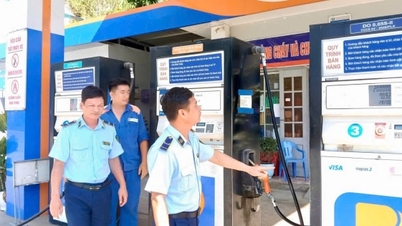
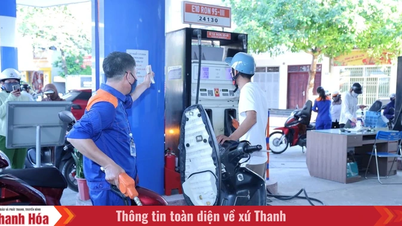
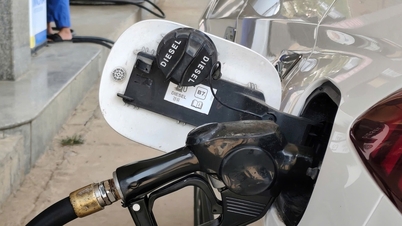
E10 bioethanol fuel officially went on widespread distribution from June 1st, marking a new step in Vietnam's energy transition and green transportation development. Photo: Ha Trang.
People are gradually getting used to the new fuel.
From June 1st, E10 bioethanol fuel will officially be widely distributed nationwide, marking another step forward in Vietnam's energy transition roadmap and its commitment to achieving net-zero emissions by 2050.
At several gas stations in Hanoi and other localities, many people said they were initially hesitant to choose E10 gasoline because it is a new type of fuel that has been widely distributed.
Mr. Vu Tuan Hung (Long Bien ward, Hanoi), the owner of a 2022 Honda Vision, said that he was initially quite hesitant to switch to E10 gasoline due to receiving conflicting information on social media.
“I filled up a few tanks to monitor the situation. So far, the car is running normally, with no unusual signs. What I care about most is that the quality of the gasoline must be well controlled so that we can use it with peace of mind in the long term,” Mr. Hung shared.

Mr. Vu Tuan Hung (Long Bien ward, Hanoi) said he has been using E10 gasoline and has not noticed any unusual signs during vehicle operation. Photo: Ha Trang.
Meanwhile, Ms. Ha Thi Lan Huong (Cau Giay ward, Hanoi), who uses a Toyota Vios, said that her family proactively sought information from the car manufacturer before switching to E10 gasoline.
"If it contributes to environmental protection without affecting the car, then this is a trend worth supporting. What we need is clear and official information to feel confident in our choices. Although there is guidance from car manufacturers, I find the information still limited and unclear," said Ms. Huong.
E10 gasoline, a blend of 90% mineral gasoline and 10% bioethanol, is expected to contribute to reducing greenhouse gas emissions and limiting dependence on fossil fuels.
Besides expectations regarding environmental benefits, many consumers remain concerned about the compatibility of E10 gasoline with existing vehicles and its practical effectiveness. According to assessments published by the Ministry of Industry and Trade , E10 gasoline is currently compatible with over 90% of gasoline-powered vehicles in circulation in Vietnam.
Most vehicles can use E10.
Not only regulatory agencies, but also many automobile and motorcycle manufacturers have issued official recommendations regarding the possibility of using E10 gasoline on their current vehicle models.
Toyota Vietnam stated that all Toyota models manufactured from 1997 to the present can use E10 gasoline without affecting performance or increasing maintenance costs.
Meanwhile, Honda Vietnam stated that most of the motorcycles and cars currently distributed in the market can use E10 gasoline as recommended by the manufacturer. Members of the Vietnam Motorcycle Manufacturers Association (VAMM) such as Yamaha, Piaggio, and SYM also assessed that most of their current models are compatible with this fuel.
However, in practice, some people report experiencing different sensations when switching from conventional gasoline to E10 gasoline.

Ms. Tran Thi Huong shared that initially, when using E10 gasoline, her motorbike felt a bit sluggish, but after a few days of operation, it seemed to run more smoothly. Photo: Ha Trang.
Ms. Tran Thi Huong (Soc Son commune, Hanoi), who uses a Honda Lead motorbike, said that after filling up with E10 gasoline for the first time, she felt a slight "loss of power" when accelerating on the first few stretches of road.
"When I first started using it, I noticed the car felt a bit sluggish compared to normal, so I was quite worried. However, after a few days of driving, I found the car to be running more smoothly," Ms. Huong shared.
According to the Ministry of Industry and Trade, some cases of vehicles experiencing reduced acceleration after switching to E10 gasoline may stem from dirt and rust in the fuel system being dissolved and carried away by ethanol, reducing the flow of fuel into the combustion chamber. This phenomenon usually only occurs during the initial phase of fuel conversion.
Meanwhile, from a technical perspective, Associate Professor Pham Huu Tuyen, Director of the Center for Research on Power Sources and Autonomous Vehicles (Hanoi University of Science and Technology), stated that ethanol, being a high-octane component, can help make the combustion process in engines more efficient when blended in appropriate proportions.
Citing research and testing results on biofuels, Mr. Tuyen argued that using E10 gasoline in compatible vehicles does not significantly alter engine performance and contributes to reducing environmental emissions.
Sharing the same view, Mr. Do Van Tuan, Chairman of the Vietnam Biofuel Association, said: E10 is a type of fuel that has been widely used in many countries around the world. According to him, with vehicles manufactured according to modern standards and fuel of guaranteed quality, E10 gasoline can be used safely and stably during operation.
Assessments from regulatory agencies, vehicle manufacturers, and the scientific community are considered important sources of information for the public when considering this new type of fuel.
Expectations from the green transition
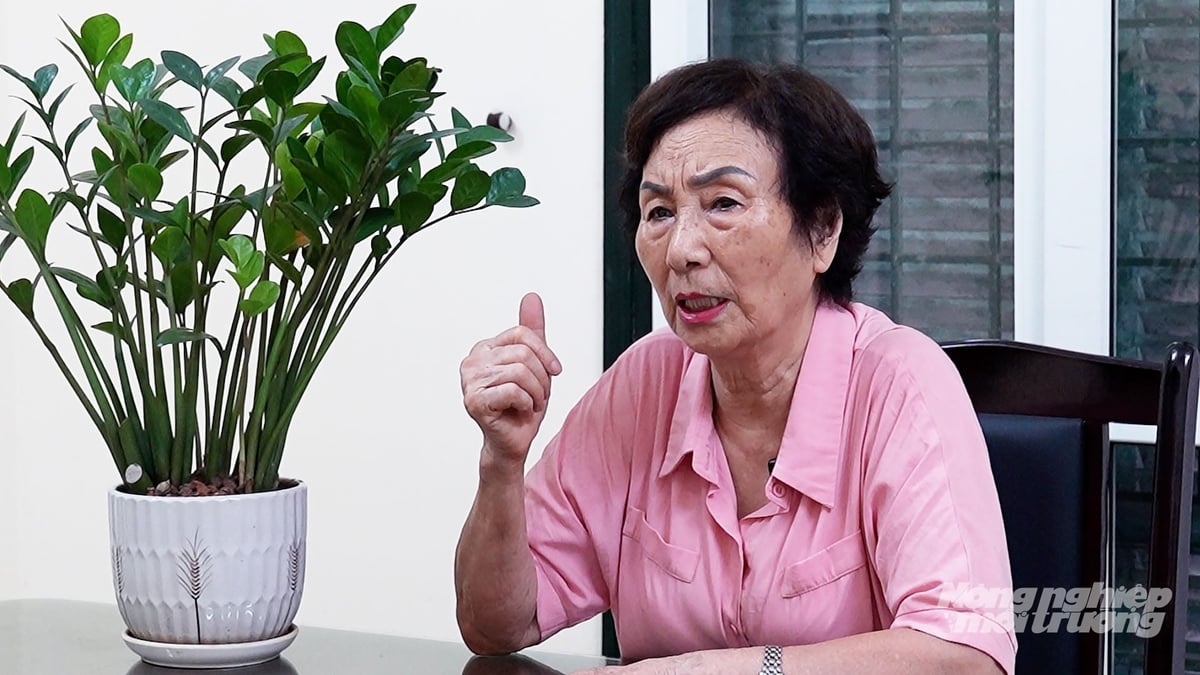
Associate Professor Bui Thi An believes that expanding the use of E10 gasoline is an inevitable trend in the energy transition process and in achieving Vietnam's green development goals. Photo: Thu Trang.
From a broader perspective, many experts believe that E10 gasoline is not simply a new type of fuel, but also a crucial link in Vietnam's energy transition strategy.
Speaking with reporters, Associate Professor Bui Thi An, former Member of Parliament in the 13th term and President of the Hanoi Women Intellectuals Association, said that the widespread use of E10 gasoline is an inevitable trend in the context of Vietnam promoting green development and fulfilling international commitments on emission reduction.
According to her, the use of biofuels helps gradually reduce dependence on fossil fuels, while also contributing to a reduction in emissions from transportation.
"Expanding the use of E10 gasoline is a necessary step in the roadmap towards achieving net-zero emissions. This is a trend that many countries have been pursuing to build a greener economy and achieve more sustainable development," Ms. An stated.
According to Ms. An, E10 gasoline not only has environmental benefits but also opens up development opportunities for the agricultural sector, as ethanol is produced from raw materials such as cassava, corn, and other agricultural products.
"If properly organized, this will be a direction that both contributes to increasing the value of domestic agricultural products and creates more momentum for the development of a circular economy," Ms. An said.
However, many experts believe that for E10 gasoline to truly become a popular choice in daily life, regulatory agencies need to continue improving fuel quality monitoring mechanisms, strengthening inspections throughout the entire supply chain, and providing complete, transparent, and scientific information to the public. In addition, coordination with vehicle manufacturers and fuel distributors to guide usage and address consumer concerns is also considered crucial in building trust in this new fuel.
After its initial rollout, E10 gasoline is gradually being adopted and experienced by the public. While more time is needed to comprehensively assess its effectiveness on a large scale, initial signals suggest that this biofuel is opening up many promising prospects for the green energy transition in Vietnam.
Source: https://nongnghiepmoitruong.vn/nguoi-dung-noi-gi-sau-nhung-binh-xang-e10-dau-tien-d814727.html

![[Photo] Secretary of the National Assembly Party Committee, Chairman of the National Assembly presides over the meeting of the Standing Committee and Executive Committee of the National Assembly Party Committee.](https://vphoto.vietnam.vn/thumb/1200x675/vietnam/resource/IMAGE/2026/06/03/1780480353201_ndo_br_bnd-2585-jpg.webp)
![[Photo] General Secretary and President To Lam presides over a meeting with the Central Organizing Committee.](https://vphoto.vietnam.vn/thumb/1200x675/vietnam/resource/IMAGE/2026/06/03/1780482764658_a1-bnd-4741-3342-jpg.webp)










































![[Video] Sunset at Lap An Lagoon – Where the sun sets over the fishing nets](https://vphoto.vietnam.vn/thumb/1200x675/vietnam/resource/IMAGE/2026/05/31/1780192137701_beach-landscape-sea-water-nature-grass-745871-pxhere-com.jpeg)




![[Photo] General Secretary and President To Lam attends the 14th Congress of the Vietnam Trade Union](https://vphoto.vietnam.vn/thumb/402x226/vietnam/resource/IMAGE/2026/06/04/1780543339765_anh-man-hinh-2026-06-04-luc-10-22-07.png)



























Comment (0)