

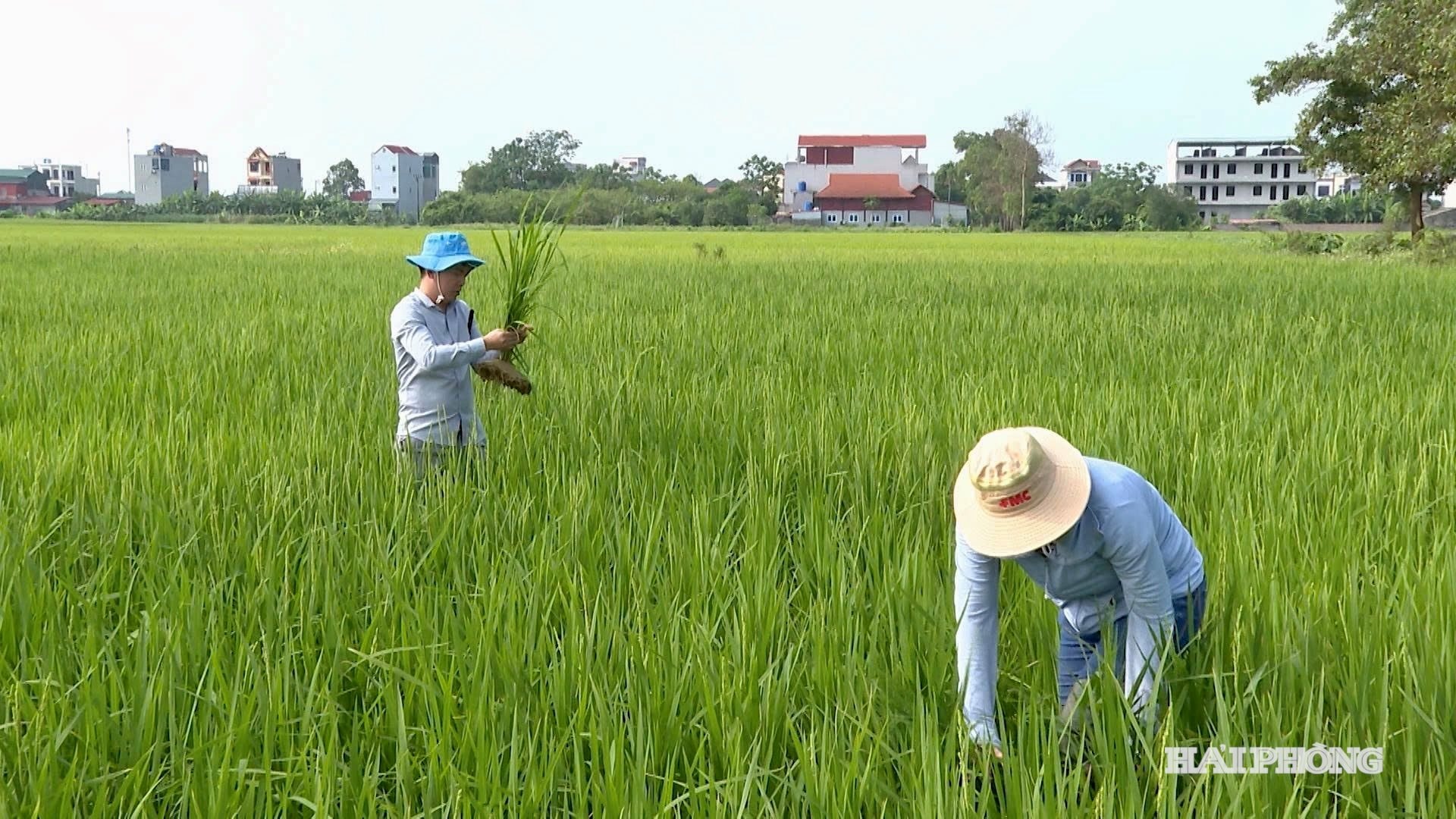
Rice black stripe dwarf disease is particularly dangerous, spreading rapidly and affecting large areas, severely impacting yields, and even causing crop failure if not controlled promptly. Currently, there is no specific treatment for rice black stripe dwarf disease. The disease is transmitted through the white-backed planthopper, so the risk of an outbreak is very high if the planthopper density is high and the pathogen persists in the fields from the spring crop.
To proactively control and prevent the risk of disease outbreaks and spread, and to protect the rice crop, the Department of Agriculture and Environment requests that specialized agencies, units, and local authorities strengthen communication about the characteristics and severity of the disease. Immediately after harvesting the spring rice crop, field sanitation must be carried out, and a concentrated planting schedule for the summer rice crop should be arranged, ensuring at least 20 days' delay from the spring crop in areas with high disease pressure. Planting susceptible rice varieties should be limited, and advanced techniques in rice cultivation and pest management should be applied.

Farmers need to treat seeds before sowing and limit sowing in areas at risk of disease. Avoid sowing seedlings along roads or near strong light sources that attract planthoppers. Cover seedlings with netting to prevent white-backed planthoppers from entering and transmitting the disease from the sowing stage. In areas that have previously been infected with rice dwarf disease or are at high risk of infection, spray to control planthoppers 3-4 days before transplanting and on direct-seeded rice when the plants have 4-5 leaves. When rice seedlings are found to be infected with rice dwarf disease, thoroughly spray to control planthoppers and destroy all seedlings, sowing replacement seedlings if there is still time.
During the rice growth stage, if planthoppers carrying the black stripe dwarf virus are detected, insecticide spraying should be carried out promptly. In areas where planthoppers carrying the disease have not yet appeared but the density of planthoppers is high (2,000 or more per square meter ) , insecticide spraying is necessary. For rice before heading, if the number of planthoppers is 1,000/ m² or more, spraying is necessary. For rice after heading, spraying is also required. In rice fields with mild black stripe dwarf disease, thinning and uprooting infected plants should be carried out. In cases of severe infection, the entire field must be promptly destroyed and plowed under. Before plowing, insecticide should be sprayed to limit the spread of disease-carrying planthoppers over a wide area.
For the 2026 crop season, Hai Phong city plans to plant 77,200 hectares of rice, striving for a yield of 58.52 - 60 quintals/hectare.

Source: https://baohaiphong.vn/phong-benh-lun-soc-den-cho-lua-mua-tu-som-544593.html






















































![[Video] Sunset at Lap An Lagoon – Where the sun sets over the fishing nets](https://vphoto.vietnam.vn/thumb/1200x675/vietnam/resource/IMAGE/2026/05/31/1780192137701_beach-landscape-sea-water-nature-grass-745871-pxhere-com.jpeg)


























Comment (0)