In 1965, the Phu Ha Small-Scale Handicraft Cooperative was established, primarily specializing in carpentry. It brought together skilled craftsmen from the area to contribute to the resistance against the US and the nation-building effort. However, after experiencing ups and downs, the cooperative's production and business practices became unsuitable for the market economy , leading to its decline. In 2005, with the encouragement of the former Thanh Son town government, the carpentry households regrouped to establish the Phu Ha carpentry village, building upon the cooperative's foundation to foster unity and sharing among carpenters.
With the increasing market demand for wooden products and the dynamism of its craftsmen, Phu Ha woodworking village has developed steadily and achieved high revenue. Currently, there are more than 40 households engaged in woodworking in Phu Ha, providing regular employment for approximately 120 workers. The main products of the village are household wooden furniture, fine art wooden items, peeled wood, sawn timber, etc.
In addition, the craft village also has dozens of households engaged in other trades such as aluminum and glass fabrication, agricultural product processing, fermented meat production, and broom making. The village's revenue averages over 30 billion VND per year. The average income of workers is approximately 15 million VND per month for skilled craftsmen and about 7-8 million VND per month for apprentices.
Mr. Nguyen Van Tu, head of the craft village, shared: "The craft village has favorable transportation conditions as it is located in the center of the commune, making it convenient for transporting raw materials and finished products to Hanoi and other provinces such as Lao Cai, Son La, Lai Chau, Thanh Hoa, Ninh Binh... In addition, because it does not depend on agriculture , the craftsmen can focus on their craft, improving quality and diversifying products. Therefore, the products of the craft village have reached markets outside the province, contributing to creating stable jobs for local families and workers."



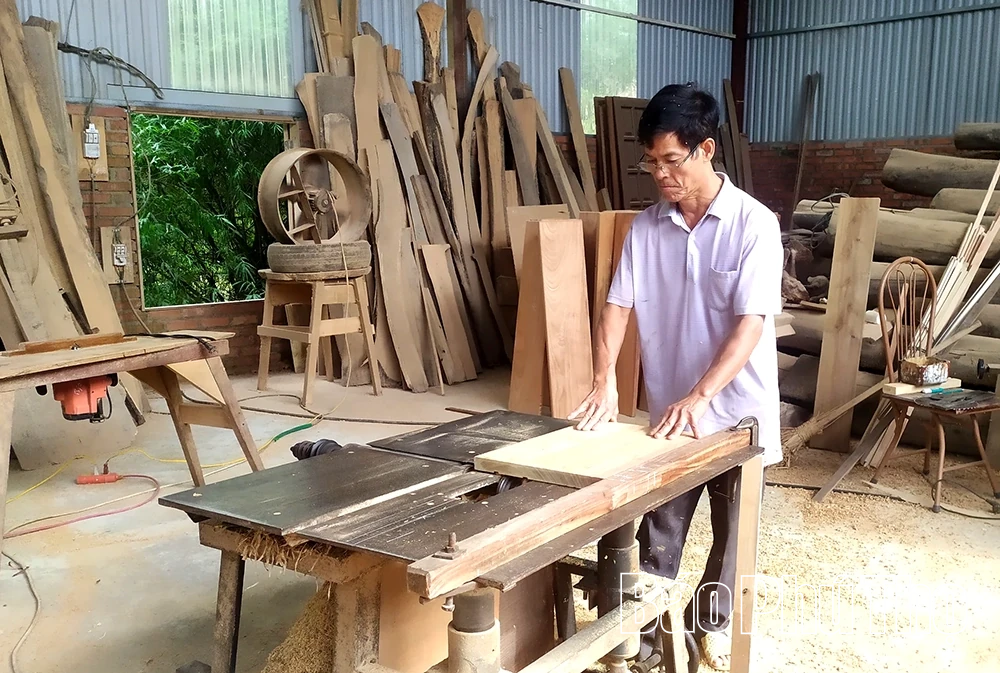
Mr. Nguyen Van Quy, from Phu Ha carpentry village in Thanh Son commune, specializes in producing stair treads and flooring according to customer specifications.
Mr. Nguyen Van Quy, owner of a furniture manufacturing facility in Phu Ha craft village, said: "Currently, the demand for wooden furniture is quite high, so we are not worried about a lack of orders. However, due to the lack of close cooperation between production households, especially for orders of plywood and industrial wood products for export, it is difficult to meet large orders. In addition, we hope Thanh Son commune will plan a specialized woodworking production area, creating conditions for relocating production facilities there to avoid dust and noise pollution in residential areas."
To create linkages, several households in the Phu Ha carpentry village have joined forces to establish two businesses and one cooperative, investing heavily in machinery and equipment for specialized production. These businesses and cooperatives are actively embracing digital transformation, promoting their products on e-commerce platforms, websites, and social media to expand their markets.
According to Mr. Quy, in the coming time, households in the craft village will focus on peeling and sawing wood, processing industrial plywood for export, and producing wooden furniture, as these are products with a wide consumer market and high economic efficiency. At the same time, this will contribute to the development of reforestation in Thanh Son commune and neighboring communes, thereby increasing income for many people in the mountainous areas.



Quan Lam
Source: https://baophutho.vn/nghe-moc-o-phu-ha-hom-nay-253799.htm