

Perhaps stemming from this goal, four important resolutions of the Politburo have just been issued and implemented: Resolution 57 of the Politburo on promoting science, technology and innovation; Resolution 59 on proactively and deeply integrating into the international community; Resolution 68 on strongly developing the private economic sector; and Resolution 66 on comprehensively reforming the work of drafting and enforcing laws. At this point, these four resolutions can be called the "Four Pillars" that will help Vietnam take off.
These resolutions are considered the "Four Pillars" because all four agree on the goal of building a solid foundation for Vietnam's rapid and sustainable development, aiming to become a developed, high-income country by 2045. This linkage not only provides general guidance but also clearly demonstrates interdependence in practice. If institutions lack transparency (Resolution 66), the private sector will struggle to develop (Resolution 68), science and technology will lack a creative environment (Resolution 57), and international integration will be ineffective (Resolution 59). Conversely, if innovation is not groundbreaking, the private sector will be weak, and international integration will be limited. Without proactive integration, the domestic institutions and driving forces themselves will struggle to undergo comprehensive reform.
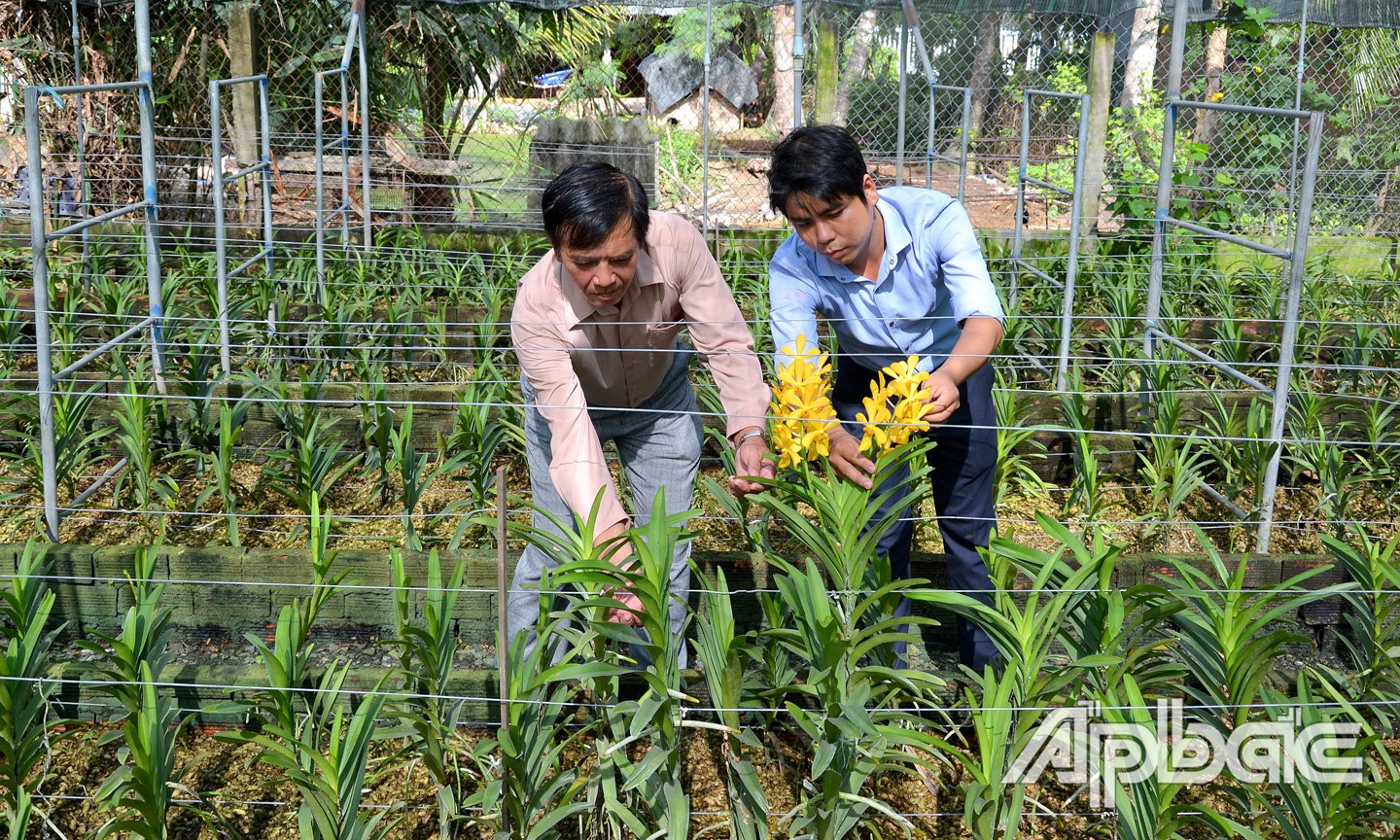 |
| Applying science and technology to agricultural production will lead to greater efficiency. |
However, what is most noteworthy is the common breakthrough of all four resolutions: a new development mindset, shifting from "management" to "service," from "protection" to "creative competition," from "passive integration" to "active integration," and from "decentralized reform" to "comprehensive, synchronized, and profound breakthrough." This represents a fundamental shift in thinking, building upon the achievements of the past 40 years of reform and aligning with global trends in the digital age.
Looking at the current situation and future demands, the "four pillars" are highly anticipated to bring about fresh new impetus, creating new momentum and propelling Vietnam forward. Based on this major policy, Tien Giang province is also planning more adaptable and effective steps for each pillar. One concrete example is that, immediately after the Politburo issued Resolution 57, the Tien Giang Provincial Party Committee and People's Committee issued an implementation plan with specific steps.
Based on that, Tien Giang province has set a goal that by 2030, its potential, level of science, technology, and innovation will reach an advanced level in many important fields and strengths of the province, belonging to the group of upper-middle-income provinces; the level and capacity of technology and innovation of enterprises will reach above the national average, with at least one enterprise achieving an advanced level.
At the same time, Tien Giang also set targets for ranking among the top 30 provinces and cities nationwide in terms of innovation (PII) and digital transformation (DTI); contributing 55% of total factor productivity (TFP) to economic growth; achieving a minimum of 50% of the export value of high-tech products; exceeding 80% of online public service usage by citizens and businesses; achieving 80% of cashless transactions; and having over 40% of businesses engaged in innovative activities within the province...
In addition, the province boasts advanced and modern digital technology infrastructure; gradually mastering several strategic and digital technologies such as artificial intelligence, the Internet of Things (IoT), big data, cloud computing, blockchain, semiconductors, 5G and 6G mobile communications, satellite communications, and several emerging technologies; 100% of users have access to fixed broadband with speeds above 1Gb/s; 5G mobile network services are widely available throughout the province; and the province attracts technology organizations and businesses to invest in research and production…
And it is evident that, in the coming period, Tien Giang will continue to build an effective roadmap for implementing the remaining "pillars" to align with the national goal of changing mindsets and visions in development. This is a long and difficult step, but it will yield positive results.
Looking at the overall picture, the Central Committee also emphasized that we are witnessing unprecedented profound changes globally in geopolitics, geoeconomics, strategic competition, the dramatic shift of economic centers, the explosion of science and technology, along with challenges related to climate change, energy security, and traditional and non-traditional security. These movements create both challenges and opportunities for all countries. Those who seize the opportunities and overcome the challenges will succeed. Otherwise, the results will be the opposite, and we will fall into the situation of "the slow ox drinks muddy water."
TT
Source: https://baoapbac.vn/su-kien-binh-luan/202505/nghi-ve-bo-tu-tru-cot-1043280/
![[Photo] General Secretary To Lam attends the inauguration ceremony of Si Pa Phin multi-level boarding school.](/_next/image?url=https%3A%2F%2Fvphoto.vietnam.vn%2Fthumb%2F1200x675%2Fvietnam%2Fresource%2FIMAGE%2F2026%2F01%2F31%2F1769840655651_ndo_br_z7486540481209-f37c7e00a962aec2a061c64b7db569ef-jpg.webp&w=3840&q=75)


![OCOP during Tet season: [Part 3] Ultra-thin rice paper takes off.](/_next/image?url=https%3A%2F%2Fvphoto.vietnam.vn%2Fthumb%2F402x226%2Fvietnam%2Fresource%2FIMAGE%2F2026%2F01%2F28%2F1769562783429_004-194121_651-081010.jpeg&w=3840&q=75)


![OCOP during Tet season: [Part 2] Hoa Thanh incense village glows red.](/_next/image?url=https%3A%2F%2Fvphoto.vietnam.vn%2Fthumb%2F402x226%2Fvietnam%2Fresource%2FIMAGE%2F2026%2F01%2F27%2F1769480573807_505139049_683408031333867_2820052735775418136_n-180643_808-092229.jpeg&w=3840&q=75)


Comment (0)