According to legend, the story of the Goddess states: "In Trang Bang, there was a girl named Ly Thi Thien Huong, daughter of Mr. Ly Thien and Mrs. Dang Ngoc Phung, originally from Binh Dinh, who came to Trang Bang to settle down" (Vuong Cong Duc (2014), Trang Bang Local History, Tri Thuc Publishing House, Hanoi , p. 621). From oral tradition, no one knows her family background to this day. However, the Trang Bang area is considered her birthplace. For nearly a hundred years, local people have built a shrine and daily offer incense to worship Linh Son Holy Mother - the goddess who protects the residents.
The temple, officially named "Linh Son Holy Temple," is now located in Loc An neighborhood, Trang Bang ward. It is dedicated to Linh Son Holy Mother (Ba Den) and was established by the people of Trang Bang in 1932. The temple is situated beside a spring well – a source of pure water that has nourished the entire region for generations, hence it is also known as "Ba Gieng Mach Temple" (Temple of the Spring Well Goddess). Initially, the small temple was built of wood with a tiled roof, housing a wooden statue of the Goddess, approximately 60cm tall, flanked by attendants. In 1999, the temple was renovated and retains its current architecture.
Architecturally, the temple is a well-built structure made of reinforced concrete and tiled roofing, covering an area of approximately 300 square meters , including a courtyard, a front hall, a main hall, and a kitchen. In the courtyard is an altar dedicated to the God of Heaven, a common folk belief in Southern Vietnam. In the center of the courtyard is a spring well, formerly the source of water for the local people. In folk belief, the well originates from Mount Ba Den, and a goddess resides there. Therefore, a temple dedicated to the goddess was built next to the well to pray for her blessing and the longevity of the spring water. The water from this spring well has contributed to the creation of the famous Trang Bang rice noodle soup. The broth of this dish is made with the sweet and refreshing flavor of the well water, creating an unforgettable taste.
On either side of the temple courtyard, to the right (when viewed from the outside) is the shrine dedicated to Thuy Long, also known as Ba Thuy, a goddess believed to govern the well. To the left is the shrine for wandering souls, a belief reflecting the profound humanitarian spirit of the Vietnamese people, offering alms and sharing food with restless spirits so they do not suffer from hunger and thirst and can find peace.
The temple's facade features a raised inscription of the temple's name, "Linh Son Holy Temple," flanked by a pair of Chinese characters: "Linh Hien An Tham Dan De Lac / Son Cao Vu Lo Nhan Uan Thinh. " The first line of each couplet, "Linh Son," represents the title of the Goddess, signifying divine intervention and profound blessings that bring peace and joy to the people; the high mountains and abundant rain create a flourishing and prosperous atmosphere. Below the couplet is an inscription indicating the year "April 11, 1970 - Canh Tuat." The facade is decorated with decorative wind chimes bearing the characters "Hanh" (Happiness) and "Tho" (Longevity), symbolizing wishes for blessings, good fortune, and long life. On the roof of the temple is a statue of two dragons vying for a pearl, belonging to the old Cay Mai Saigon pottery line.
The front hall is a spacious area. On ordinary days, it is used to receive guests in the right-hand section. On days of worship, this space becomes where offerings brought by the people are placed for offerings and rituals, and where folk performances of the "bong roi" ritual take place. In the front hall, there is a horizontal plaque bearing the temple's name, donated by Mr. Trinh Thach Ky in the year of Ky Mao (1999), the year the temple was renovated. The plaque reads "Linh Son Holy Temple" with the inscription "Ky Mao Nien Kiet Nhut" (auspicious day of the Ky Mao year) and "Moc An De Tu Trinh Thach Ky Kinh Phung" (disciple Trinh Thach Ky respectfully offers this offering); the plaque also bears the Vietnamese inscription "Construction 1932 - Renovation 1999," marking two important historical milestones of the temple. The two sides have a pair of couplets in the Linh Son style : "Linh Thieu's teachings are fulfilled in every prophecy / The mountain where the dragon rises is praised as magnificent," meaning that in this sacred place, all prophecies are answered; the mountain where the dragon rises is praised as magnificent.

Leading into the main hall, in front of the altar dedicated to the Goddess, is an altar dedicated to the King, or more fully, the King of Water and Land. This altar expresses gratitude and repays the country's kindness, stemming from love for the homeland, and is also a place of prayer for national peace and prosperity, and favorable weather. On either side of the altar are a pair of couplets : "Nhuận hữu cam tuyền nguyên viễn lưu kim cổ/ Đức tiêu tiêu chí đạo hạnh cao bạc vân thiên," meaning a sweet spring flows from ancient times to the present; virtue praises the supremely virtuous and noble person whose high moral character reaches the heavens.

In the center is the shrine dedicated to Linh Son Holy Mother (Ba Den), consisting of three statues of Linh Son Holy Mother and two attendants. The male attendant wears armor and holds a seal; the female attendant respectfully holds a fan. The statue of Ba Den has a benevolent face, wears a crown and robe, and holds a scepter. All three statues are reproductions of the original statues of the temple, but on a larger scale. The current shrine is donated by the family of Mr. Le Van Minh and Mrs. Tran Thi Ni in An Khuong neighborhood, An Tinh ward, in 2024. On either side are altars for the Left and Right deities, the Earth God, along with ancient religious artifacts and a large bronze bell (the name of the temple is engraved on the bell).

In particular, besides Quan Thanh De Quan, Thien Hau Thanh Mau, Quang Trach Ton Vuong, Phuoc Duc Chanh Than, etc., the Chinese people in Trang Bang highly revere Linh Son Thanh Mau. In 1951, the Hoa An association of the Seven Palaces Chinese community offered a horizontal plaque to the temple with the inscription "Thien Thu Thanh Mau," honoring the sacredness, nobility, and eternity of Lady Linh Son, along with the inscription "Cúng hạ tuế thứ Tân Mão niên bát ngoạt kiết nhựt tạo" (auspicious day in the eighth month of the year Tan Mao) and "Hong An Hoa An association of the Seven Palaces respectfully bows." Currently, this plaque is prominently displayed in the shrine dedicated to the Lady.

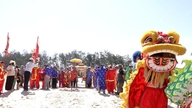
The annual festival honoring the Goddess is held on the 5th and 6th of May (lunar calendar) and includes rituals such as bathing the statue of the Goddess, changing her robes and headdress, offering sacrifices to the ancestors, chanting prayers for peace according to Buddhist customs, and folk performances of spirit mediumship to honor the Goddess. On the 6th of June, the main ceremony honoring the Holy Mother of Linh Son is performed by the Temple Management Board.
For many years, the ritual of offering sacrifices to the Goddess has been undertaken by folk artist Ngoc Phuong and artist Phan Thi Hong Diem (members of the Tay Ninh Provincial Association of Literature and Arts). On this occasion, the temple's management boards, as well as people from within and outside the locality, come to visit the Goddess in large numbers, sometimes reaching 200-300 people. Everyone who comes to the temple to worship the Goddess receives gifts from the temple's management board, such as cakes, sticky rice, fruit for offerings to the Goddess, or red envelopes with the temple's seal inside.
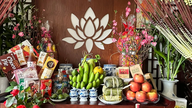

The shrine in her hometown is not only a folk religious institution, but also a cultural and historical symbol closely linked to the formation and development of the community in Trang Bang. Through worship, rituals, and folk performances, the shrine has become a space for preserving collective memory, reflecting gratitude towards ancestors and aspirations for a peaceful and prosperous life.
Preserving and promoting the value of the temple contributes to safeguarding historical memory, fostering pride in the homeland, and creating spiritual strength for the community in the present and future.
Source: https://baotayninh.vn/ngoi-mieu-noi-que-ba-149473.html
![[Photo] General Secretary and President To Lam attends the 13th National Congress of the Ho Chi Minh Communist Youth Union](https://vphoto.vietnam.vn/thumb/1200x675/vietnam/resource/IMAGE/2026/06/25/1782356968989_ndo_br_1-jpg.webp)

![[Photo] General Secretary and President To Lam receives Palestinian Ambassador Saadi Salama](https://vphoto.vietnam.vn/thumb/1200x675/vietnam/resource/IMAGE/2026/06/25/1782365384740_a1-bnd-9423-8322-jpg.webp)