


The most familiar proverb about the custom of decorating for Tet (Lunar New Year) shows the intertwining of offerings in the ancestral altar, with each item revealing its specific purpose. The food offered to ancestors is also a product of farming and animal husbandry, encompassing everything farmers produce in the fields or in the barns: Green sticky rice cakes, embodying the philosophy of heaven and earth, are placed on the altar between couplets written in black ink on red paper, creating a harmonious color combination.

At the center of the altar during Tet (Lunar New Year) is a plate of five fruits symbolizing the five elements with various colors and flavors: the green of bananas (wood), the yellow of pomelo or Buddha's hand citron (earth), the red of chili peppers or the reddish-orange of tangerines and kumquats (fire)... or homophones such as in the South with custard apple, fig, coconut, papaya, and mango symbolizing "enough to use." The altar always has a set of three or five ritual objects, candles, etc., all cleaned thoroughly. Families with ancestral lineage may open the red silk curtain or screen covering the ancestral tablets and incense burners, which may be "cleaned" (cleaned around the incense burner with fragrant water and the incense sticks removed), ready for the New Year's ancestral worship. On either side of the altar, long sugarcane stalks are sometimes placed, symbolizing ladders for ancestors to descend to earth to celebrate Tet.

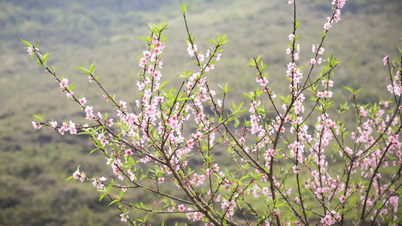
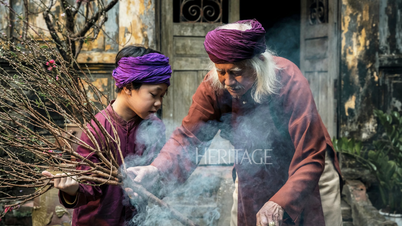
In the past, people erected New Year's poles, drew bows and arrows in lime in their yards, displayed peach blossom branches in their homes, or set off firecrackers—all to ward off evil spirits. These items were all associated with legends; for example, people believed that two gods who specialized in eliminating demons and monsters lived under a giant peach tree on a mountainside. When the gods ascended to heaven at the end of the year, people would cut peach branches and place them on their ancestral altars, drawing images of these gods on red paper and hanging them in front of their doors to deter evil spirits from approaching during Tet (Lunar New Year).

The New Year's pole is erected (or planted) in the courtyard of a house. It is a bamboo pole cut down to the base, with the leaves still intact. Offerings are hung on it, such as earthenware bells that make sounds when the wind blows. Planting the New Year's pole signifies that the land has an owner, and evil spirits are not allowed to covet or disturb it. A bundle of pandan leaves or a sickle-shaped branch is also tied to the top of the pole to scare away evil spirits.

Additionally, people would draw bows and arrows with their arrowheads pointing east and sprinkle lime powder on the ground in front of their doors during Tet to ward off evil spirits. The legend of the New Year's pole reflects a survival instinct between ancient humans and foreign invaders or natural disasters, which they believed were caused by evil spirits, but this was symbolized by simple objects from the countryside.
Heritage Magazine

































































Comment (0)