

(NLĐO) - Just 64.5 light-years from Earth, scientists have identified a giant planet with a toxic and foul-smelling atmosphere.
According to Science Alert, the newly discovered "smelly" planet, named HD-189733b, is a "hot Jupiter" with temperatures reaching thousands of degrees Celsius.
It is one of the most extreme exoplanets in our Milky Way galaxy.
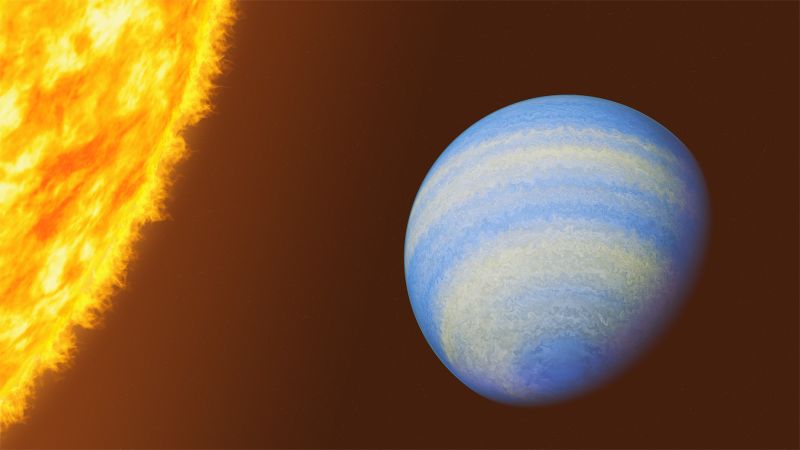
Image depicting the "foul-smelling" and toxic exoplanet HD 189733b - Graphic: JOHN HOPKINS UNIVERSITY
Astrophysicist Guangwei Fu from Johns Hopkins University (USA), a co-author, said that HD-189733b was first identified in 2005, but at that time scientists did not fully understand its nature.
Now, the atmosphere of the giant planet is clearly visible through the "all-seeing eye" of the world's most powerful space telescope, the James Webb.
From there, "death" revealed itself.
Published in the scientific journal Nature Astronomy, the authors report that James Webb found evidence of abundant hydrogen sulfide ( H₂S ) in the planet's atmosphere.
Besides hydrogen sulfide, they also found water, carbon dioxide ( CO2 ), and carbon monoxide (CO).
Apart from water, the three gases mentioned above are certainly not friendly to life – something the authors did not expect to find in this scorching world.
However, the presence of H₂S makes the planet special.
In our solar system, a large planet, Uranus, is also full of this gas. And luckily, it's far enough away that no one would even consider setting foot on it.
Because H₂S not only has a strong, distinctive rotten egg smell, but it is also a toxic gas; even low concentrations can cause eye irritation, headaches, nausea, and other symptoms.
At high to very high concentrations, inhaling H₂S gas can cause nerve paralysis, cardiac arrest, and death within minutes or even immediately.
Nevertheless, given that it's a very distant planet, this discovery is exciting, showing just how diverse and bizarre the world of planets can be.
They also studied the metallicity of the atmosphere, the concentration of elements heavier than hydrogen and helium. They discovered that the world's metallicity is 3-5 times higher than that of its parent star, a finding that reveals something about how exoplanets form.
Located just 64.5 light-years from Earth, it's a fascinating world to continue studying.
"These findings support our understanding of how planets form by creating more solid material after the initial core formation and then naturally reinforcing it with heavy metals," the authors said.
Source: https://nld.com.vn/lo-dien-hanh-tinh-tu-than-ngui-khong-khi-du-nhiem-doc-196240711112233151.htm



































































































Comment (0)