

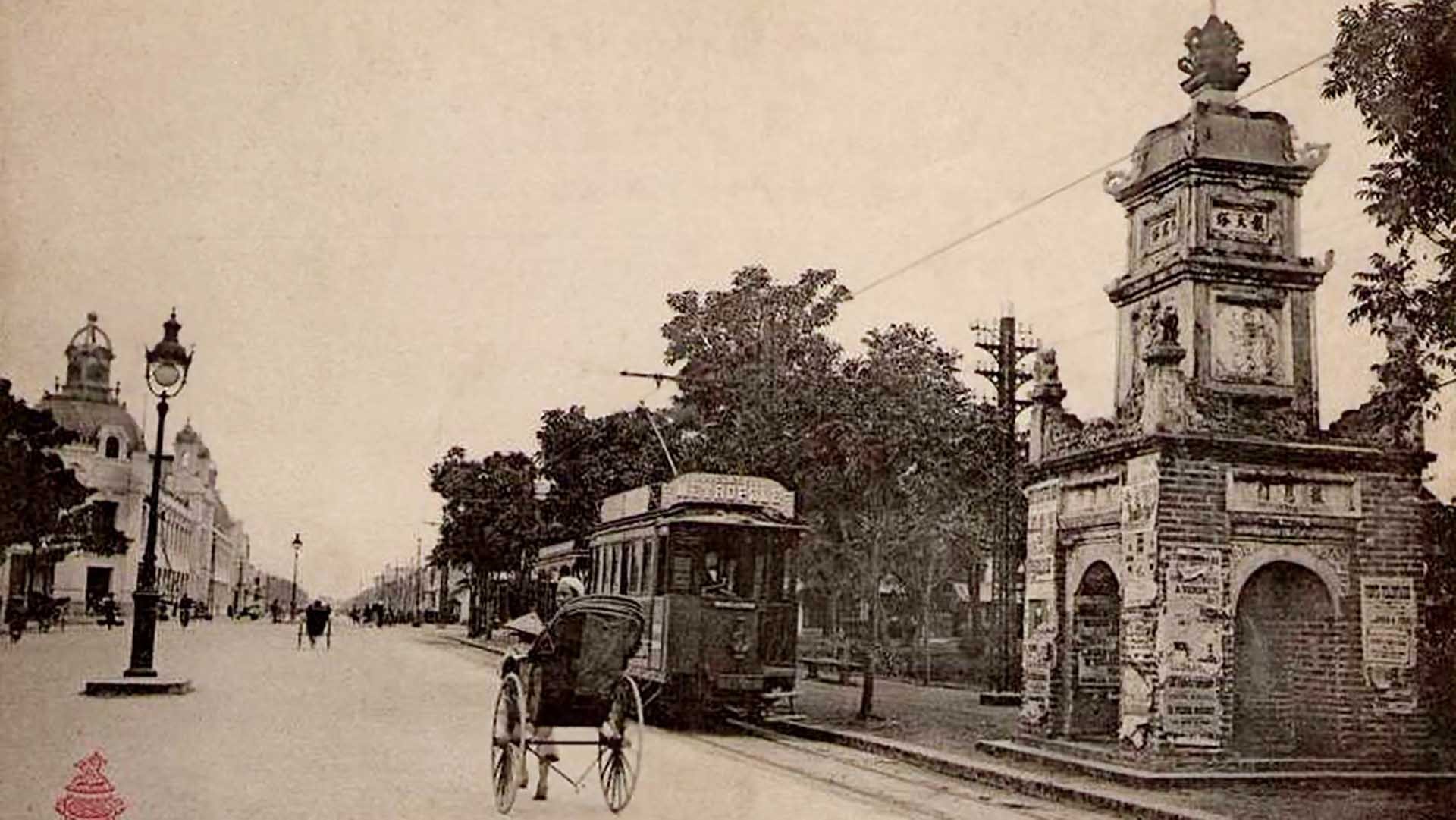
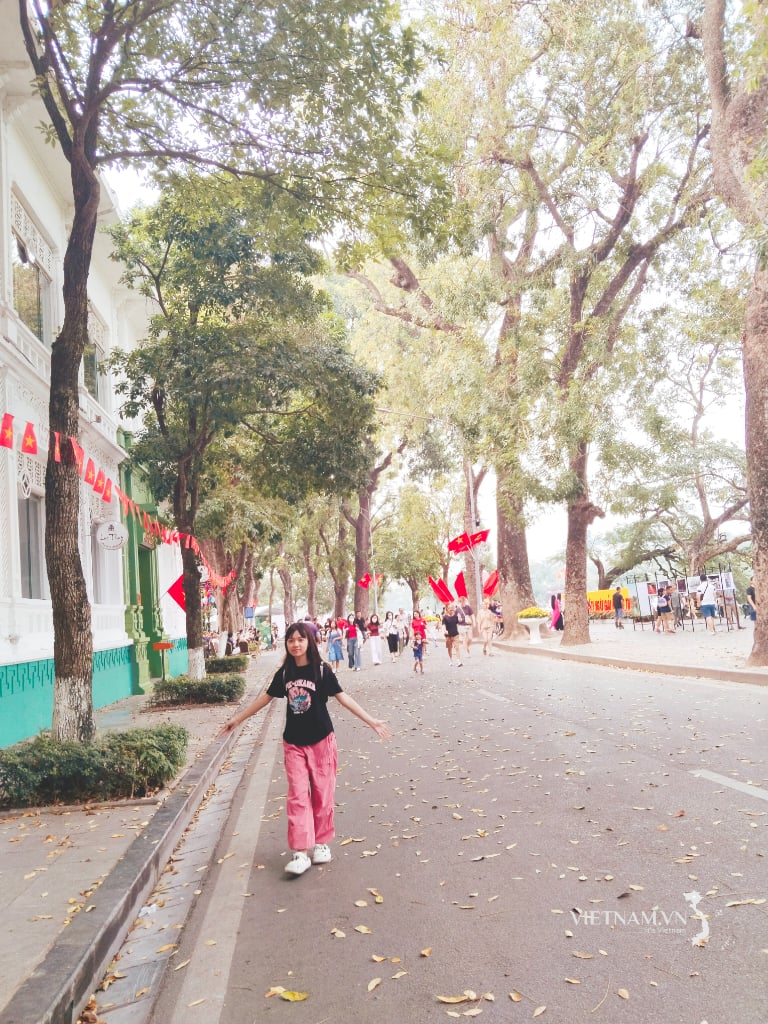
Every time I visit the old Hanoi Post Office , built during the French colonial era (formerly known as the "telegraph office"), and see the Hoa Phong Tower near Hoan Kiem Lake across Dinh Tien Hoang Street, I am reminded of the tragicomic events that took place around this area during the French colonial period.
 |
The French first occupied Hanoi in 1873. They forced us to cede a concession area, located near the Red River, called Don Thuy, originally our naval base, whose boundaries today are Le Thanh Tong Street and Pham Ngu Lao Street (the area of the Friendship Hospital and Military Hospital 108). This served as a springboard for the French to expand and build the Western Quarter at the eastern and southern ends of Hoan Kiem Lake.
The French occupied Hanoi for the second time in 1882. They temporarily established civilian command centers on Hang Gai Street (near the banyan tree in the middle of the street) and at O Quan Chuong Gate ( military command centers were located near the Post Office). After the Hue court surrendered and signed the 1883 treaty recognizing French protection, the first French Resident of Hanoi, Bonnal, immediately thought of clearing the area around Ho Guom Lake, which was full of stagnant ponds, thatched houses, and sewers, and building a wide road around the lake... It wasn't until 1893 that the road was inaugurated on New Year's Eve with many festivities. However, the people did not participate, being busy at home worshipping their ancestors.
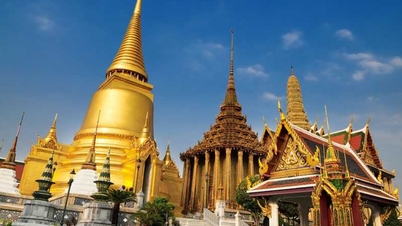
Urban planning has destroyed many valuable temples and pagodas, especially Bao An Pagoda located on the Post Office site. Only traces remain, such as Hoa Phong Tower near the lake, formerly the place where trams going to Mo Market stopped. The pagoda was also known as Sung Hung Pagoda, built in 1848 with local funds donated by the Governor-General of Hanoi, Nguyen Dang Giai. It was a large pagoda with 36 buildings, the main hall built in the middle of a lotus pond, hence its other name, Lien Tri Pagoda (Lotus Pond Pagoda).
The front of the temple gate faces the Red River, while the back features many towers near Hoan Kiem Lake. In 1883, the French established a base there, using it as the headquarters for the logistics of their expeditionary army. The temple was damaged, and when the road around the lake was built, it was completely destroyed. Inside the temple, there is a depiction of the underworld (the Ten Courts of Yama), where demons punish the wicked, so the French called Bao An Temple the Temple of Torture (Pagode des sup-plices).
French army doctor Hocquard, who accompanied the expeditionary force to pacify Northern Vietnam (1884-1886), described Bao An Pagoda as follows:
“From afar, this temple attracts attention with its many bells, gates, and pagodas. In a large hall, amidst beautifully gilded columns, there are rows of up to two hundred statues: statues of saints, male and female deities (of Buddhism). In the center of the main hall, in a prominent position, sits a seated Indian Buddha, 1.5 meters high, gilded from head to toe. The Buddha looks down, his right hand resting on his knee. Two close disciples, one old and one young, stand attending on either side. Around this central group of statues, there are many statues placed on different pedestals on either side of the corridor, like attentive listeners to the scriptures. Among these deities and Buddhas are officials in ceremonial robes, holding incense burners or scepters, and ascetics meditating, who, though not yet enlightened, possess the power to tame wild animals: tigers and buffaloes kneel at their feet. The main statue is typical of Indian statues in its clothing and hair. The Northern Vietnamese Buddha is exactly like the Buddha I have seen in Sri Lanka and Singapore. The secondary statues are different, bearing a certain style.” "The way China... This temple has fallen into ruin..." (Hocquard - A Campaign in Tonkin - Paris, 1892).
After conquering Hanoi and Tonkin, the French administrative offices temporarily set up shop at Thuy Fort while awaiting new construction.
In his book "Hanoi, First Half of the 20th Century," the renowned Hanoi scholar Nguyen Van Uan describes the formation of the area below the eastern bank of Hoan Kiem Lake (near the Post Office). According to the plan, this area was divided into two zones. The upper zone housed the Governor's Office (now the Hanoi People's Committee), the treasury, and the Union (Solidarity) Club.
The lower block housed the Post Office (on the land of Bao An Pagoda) and the Governor-General's Palace, extending to Trang Tien Street. Between the two blocks was the Paul Bert flower garden, later the Chi Linh flower garden. Paul Bert was the name of the Resident-General of Tonkin and Annam. He was a renowned scientist known for his work in physiology and a politician who served as Minister of Education. He came to Vietnam with good intentions, but according to the colonial ideology of the time, colonialism was seen as a means of civilizing backward nations.
He arrived in Vietnam a few years before passing away in Hanoi (in 1886). A statue of Paul Bert was sent from France to replace the Statue of Liberty. While waiting for the Jura stones, Paul Bert's birthplace, to be used as pedestals, the two statues lay side by side on the grass. The people of Hanoi composed a humorous folk song: "Mr. Paul Bert married a French woman..."
The statue of Paul Bert, with his arms outstretched shielding a small Annamese figure seated at his feet, evoked feelings of humiliation in any Vietnamese person at that time. The statue of Dam Xoe was moved to the Cua Nam intersection. This was a miniature version of the giant Statue of Liberty in America, a work by the French artist Bartholdi, the model of the Statue of Liberty being a gift from France to America. Ironically, however, when it was brought to Vietnam, they beheaded several patriots from the Can Vuong movement at the foot of the statue. At the end of the flower garden was the Bandstand, where the military band played music for the French on Sunday afternoons...
Source


![[Image] The appearance of the Bien Hoa-Vung Tau expressway before its opening.](https://vphoto.vietnam.vn/thumb/1200x675/vietnam/resource/IMAGE/2026/03/25/1774430324663_ndo_br_2-resize-6064-jpg.webp)




































































Comment (0)