The small house, nestled in an alley off Nguyen Thai Hoc Street (Quy Nhon Nam Ward), is tranquil, its only sound being the gentle scraping of paint on composite mask blanks. The walls are covered with theatrical masks, each displaying a different expression: fierce with sharp, slanted eyes, the dignified bearing of a loyal minister, or the soft, graceful features of a female lead...

Mr. Tran Ngoc Van paints masks for traditional Vietnamese opera.
PHOTO: BAO MINH
Sitting at a small table, Mr. Tran Ngoc Van quietly applied each brushstroke to the unfinished mask. Occasionally, he would pause, squint, examine the work, and then continue. "Painting a mask for traditional opera isn't just about matching colors beautifully. You have to capture the essence of the character before you can apply the brushstrokes," he said.
Memories carried on the sound of the ceremonial drums.
Traditional Vietnamese opera (Hát Bội) began in his childhood in the old Bình Định countryside. Back then, whenever the drums of the ceremonial procession echoed from the village square, the children would drop their games and rush to watch. As the velvet curtain opened, the characters with their brightly colored faces appeared, captivating young Trần Ngọc Vân with every movement on stage. That memory stayed with him for many years afterward.
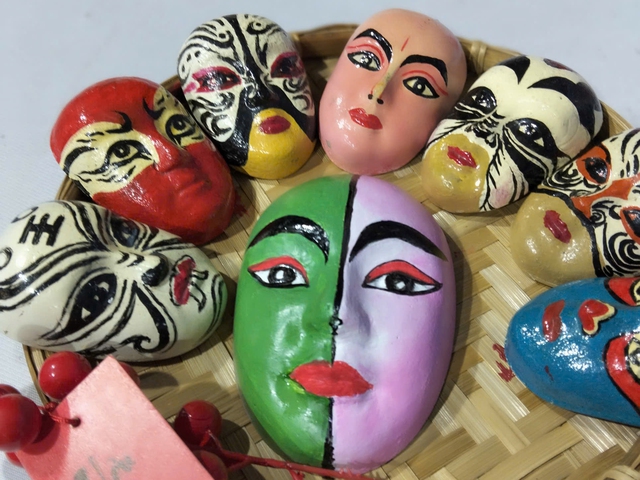
Colorful traditional opera masks are painted on composite materials.
PHOTO: TRAN VAN

At the age of 17, he volunteered for military service. After leaving the army in 1985, he pursued higher education and then studied theater and film in Hanoi . Upon returning to his hometown, he found his calling in journalism at Quy Nhon Radio Station and then Quy Nhon Cable Television. His years working in television took him to many places, exploring historical sites, traditional craft villages, and the rich layers of folk culture in this martial arts land.
Later, when he switched to working in tourism , he still maintained the habit of telling stories of his homeland through culture. "On trips taking tourists to experience local culture, I often take them to see traditional opera performances and then visit the homes of the artists to interact with them. Foreign tourists are very interested; they constantly ask about the meaning of the colors on the faces of each character. From that, I came up with the idea of making traditional opera masks as souvenirs that bear the distinctive mark of Binh Dinh," Mr. Van recounted.
But what troubled him most was what lay outside the stage. To have a perfect performance, the artists had to sit for hours backstage, meticulously applying makeup and paint their faces from before sunset. After nearly two hours of makeup, they embraced the fate of their characters in the play for three to four hours on stage. When the curtain closed at midnight, after only 15 to 20 minutes of removing the makeup, the elaborate brushstrokes and colors containing the soul of the entire play vanished in an instant. "It was beautiful, but its existence was too short," Mr. Van said slowly.
In traditional Vietnamese opera, facial expressions are almost a language in themselves. Those knowledgeable in the craft can recognize a character's personality just by looking at them: a red face symbolizes loyalty, a black face represents integrity, and a white face suggests deceit and treachery… He wanted to preserve that beauty in his own way.
Searching for the "essence" of the character.
He traveled extensively, visiting traditional opera troupes, following their performances, and meeting with the artists to take photographs, meticulously documenting every detail of their makeup. However, the journey to preserve the soul of traditional opera was far from easy. Without formal art schooling or sculpture training, he had to learn everything from scratch.
After much consideration of different materials, Mr. Van chose composite because of its lightness, durability, and ability to retain color for a long time, suitable for preserving the expressive features of traditional Vietnamese opera faces. However, when he presented his idea to someone to make molds, he only received negative responses due to the small quantity. Undeterred, he decided to experiment on his own. He bought cement to make test molds, and learned composite mixing formulas online. In the early days, accidents happened constantly. Once, while struggling to mix the materials, he smelled a strong burning odor, thinking the rice cooker on the stove had caught fire. Only when he returned to his workbench did he realize with horror that the composite block was emitting thick smoke because he had added too much catalyst. After that close call, he began carefully recording every ratio as a life lesson.
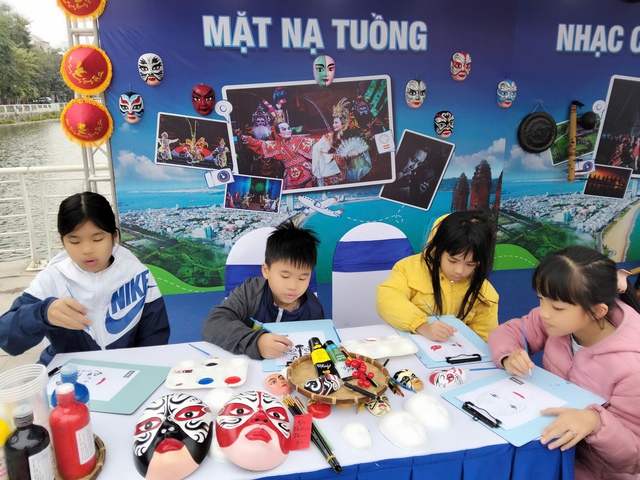
Students experience drawing traditional Vietnamese opera masks under the guidance of Mr. Vân.
PHOTO: TRAN VAN



According to Mr. Van, painting masks for traditional Vietnamese opera is not simply about coloring them beautifully, because even a small brushstroke or a few incorrect lines can distort the character's expression and personality. To create a complete work, from mold making and casting to color coordination, the artist must pour their whole heart and soul into it. "When painting, you have to truly feel the soul of the character, you have to understand why one character has slanted eyes and another has a wrinkled face, only then will the mask have spirit and soul," Mr. Van shared.
What's special is that these masks aren't for sale. He uses them as gifts for his tourists to introduce the art of traditional Vietnamese opera and to show appreciation to the families of artists who have preserved the craft for generations.
Not content with just creating masks in his small house, he also wanted to pass on that love to the younger generation. He organized many free mask-painting workshops for students in Quy Nhon and An Nhon; established the "Dong Tam - Connecting Love" art class to teach painting for free to 25 children with special circumstances; and provided materials for art students to conduct research on the art of traditional Vietnamese opera (hat boi) makeup. To spread the value of this heritage in depth, he established the Face Art Binh Dinh Club, inviting many traditional opera artists such as People's Artist Xuan Hoi, People's Artist Phuong Thao, and artisan Hoang Viet to participate in exchanges. At these meetings, young people not only get to paint on white masks themselves, but also hear the stories behind each character.
Concluding his story about the ups and downs of an amateur searching for the soul of traditional theater, Mr. Vân bent down to his familiar small table. In his hands, the unfinished mask gradually revealed its essence through each meticulous brushstroke. He softly said, "I'm not thinking about preservation at all. I just hope this mask serves as a reminder that Bình Định's traditional theater still exists."
Source: https://thanhnien.vn/nguoi-luu-than-sac-hat-boi-tren-mat-na-185260617141437896.htm
![[Photo] Opening Ceremony of the 13th National Congress of the Ho Chi Minh Communist Youth Union](https://vphoto.vietnam.vn/thumb/1200x675/vietnam/resource/IMAGE/2026/06/24/1782286753905_ndo_br_1-8510-jpg.webp)

![[Photo] Overview of the renovation and upgrading of the Ho Chi Minh Museum - Ho Chi Minh City Branch](https://vphoto.vietnam.vn/thumb/1200x675/vietnam/resource/IMAGE/2026/06/24/1782287051250_ndo_br_01-jpg.webp)
![[Image] Paris's oldest bridge goes viral after transforming into a giant cave.](https://vphoto.vietnam.vn/thumb/1200x675/vietnam/resource/IMAGE/2026/06/24/1782283441197_ndo_br_dsc05314-jpg.webp)