Amidst the country's suffering under the yoke of French colonialism and feudalism, and with a bleak national future, the Communist Party of Vietnam was born, illuminating that dark picture with the miraculous light of its correct ideology and struggle. And within that miraculous light, there was the ideology and aspiration to save the nation, the intellectual height and cultural depth, and the soul of "the most beautiful Vietnamese person": Ho Chi Minh.
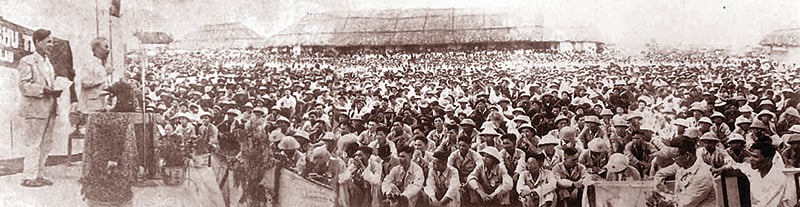
The Foundation Builder
Faced with the question of the nation's survival, Nguyen Tat Thanh (Nguyen Ai Quoc - Ho Chi Minh), an outstanding son of the nation, carrying within him a profound love for his country and people, set out to find a way to save the nation. Through a journey across many continents, immersing himself in the rhythm of the times, and overcoming many hardships and dangers, he came to the conclusion that capitalism and colonial imperialism were the root of all suffering for workers and laborers in both the home countries and the colonies. With a burning desire to win independence and freedom for his people and his country, he studied the revolutionary struggles of the people in many countries around the world . From typical bourgeois revolutions in Europe and America to the Russian proletarian revolution, with his intellectual genius and keen insight, he embraced the great October Revolution in Russia, approached Marxism-Leninism, and determined the path to national liberation.
In early 1919, he joined the French Socialist Party. In June 1919, under the new name Nguyen Ai Quoc, he, on behalf of Vietnamese patriots, submitted to the Versailles Conference the Eight-Point Petition of the Annamite People demanding that the French government recognize the democratic freedoms and equal rights of the Vietnamese people. In July 1920, he read Lenin's "First Draft of the Theses on the National and Colonial Questions," published in the newspaper L'Humanité. This also provided him with the answer to the path of struggle for true independence and freedom for his nation and his people. From December 25 to 30, 1920, he attended the 18th Congress of the French Socialist Party as a delegate to Indochina. At the conclusion of the Congress on December 30, 1920, Nguyen Ai Quoc endorsed the establishment of the French Communist Party and became one of its founders, as well as the first communist of the Vietnamese nation.
Deeply aware of the role of revolutionary organization and theory, after becoming a communist, he actively studied and developed the theory of national liberation based on the proletarian revolution of Marxism-Leninism to disseminate it in Vietnam. Particularly during the period 1921-1930, he continued his activities within the French Communist Party, researching, supplementing, and perfecting the ideology of national salvation; while actively spreading Marxism-Leninism to the Vietnamese workers' movement and patriotic movement. He focused on preparing the organization and personnel, establishing the Vietnam Revolutionary Youth Association (1925), organizing many training courses for cadres in Guangzhou, China; and simultaneously sending cadres to study at the University of the East (Soviet Union) and the Whampoa Military Academy (China).
His activities strongly promoted the revolutionary movement in our country. The combination of Marxism-Leninism, Ho Chi Minh's revolutionary thought with the workers' movement and the patriotic movement led to the formation of the first communist organizations in Vietnam. This was a great step forward for the national movement. However, the separate existence and operation of the three communist organizations dispersed the strength and power of the revolutionary movement, which was incompatible with the interests of the revolution and the organizational principles of the Communist Party.

As an envoy of the Communist International with full authority to decide on all matters related to the revolution in Indochina, Nguyen Ai Quoc convened a unification conference in Kowloon, Hong Kong (China), for representatives of the Annam Communist Party and the Indochina Communist Party. The conference decided to unify the Annam Communist Party and the Indochina Communist Party into the Communist Party of Vietnam (February 3, 1930). Simultaneously, it adopted the Party's first Political Program and Strategy.
The birth of the Communist Party of Vietnam was the result of the movement, development, and unification of the revolutionary movement throughout the country; the meticulous preparation in all aspects by leader Nguyen Ai Quoc; and the unity and consensus of pioneering fighters for the benefit of the class and the nation. In particular, the birth of the Party with its first political program opened a new era for the Vietnamese revolution – the era of struggle for national independence and advancement towards socialism. The Party's first program defined the most fundamental aspects of the Vietnamese revolutionary path; met the urgent needs of history; and became the banner for gathering, uniting, and consolidating communist organizations, revolutionary forces, and the entire nation.
Independence and freedom were the main ideas of the first political platform. And Nguyen Ai Quoc, the person who outlined the platform, also played a decisive role in founding the Communist Party of Vietnam.
"May we continue to strive forward with Him."
Before departing to the "world of the righteous," in his Last Will and Testament to the entire nation, President Ho Chi Minh first and foremost focused his attention on the Party: "First, let's talk about the Party: Thanks to its close unity, its wholehearted dedication to serving the class, the people, and the Fatherland, from its founding to the present day, our Party has united, organized, and led our people in vigorous struggle, progressing from one victory to another. Unity is an extremely precious tradition of the Party and of our people. Comrades from the Central Committee to the branches must safeguard the Party's unity and solidarity as carefully as they safeguard the pupil of their eye." At the same time, he also instructed, "Within the Party, practicing broad, regular, and serious self-criticism and criticism is the best way to consolidate and develop the Party's unity and solidarity. There must be mutual affection and camaraderie. Our Party is a ruling party. Every Party member and cadre must truly internalize revolutionary ethics, truly be thrifty, honest, upright, and selfless. We must safeguard our Party." "He must be truly pure, worthy of being a leader and a truly loyal servant of the people."
These few brief lines encapsulate and crystallize the noblest values in Ho Chi Minh's thought and morality. His admonitions have become the guiding principles for our Party throughout the process of steering the Vietnamese revolutionary ship, overcoming countless obstacles to reach the shores of independence, freedom, and happiness we enjoy today.
"Unity is an extremely precious tradition of our Party and our people." Through the harsh trials in imperialist prisons, facing the bayonets and guns of the enemy, or on the battlefield, the steadfast and indomitable communists have always set a shining example of solidarity, mutual affection, and camaraderie. It is this communist spirit that has bound Vietnamese revolutionaries together into a steel vanguard, trusted by the people, admired by friends, and feared by the enemy. And, thanks to unity within the Party and the unity of the entire nation, the strength has enabled our Party to overcome all challenges, maintain faith, and raise high the banner of leadership over the Vietnamese nation in the current context.
“We must keep our Party truly clean, worthy of being the leader and the truly loyal servant of the people.” Today, facing the demands of the new revolution, it is necessary to strengthen the work of Party building and rectification, linked with the fight against corruption, waste, and negative phenomena “continuously, without rest, without forbidden zones, without exception.” At the same time, we must resolutely prevent, repel, and strictly handle cadres and Party members who have degenerated in political ideology, morality, and lifestyle, exhibiting “self-evolution” and “self-transformation”; and uphold the revolutionary moral standards of cadres and Party members in the new period… Proof of the determination to build and rectify the Party is that since the beginning of the 13th Party Congress term, the Party has disciplined more than 140 cadres and Party members under the management of the Politburo and the Secretariat. This includes both current and retired officials, and has dealt with many cases and incidents that occurred many years ago. These results have affirmed the political fortitude, steadfastness, and consistency of the Party, the State, and the People; at the same time, they contribute to making our Party more united, stronger, and cleaner, consolidating the trust and confidence of cadres, Party members, and the People in the Party and the State.

...
President Ho Chi Minh once said: "The Party is not an organization for seeking power and wealth. It must fulfill the task of liberating the nation, making the country prosperous and strong, and bringing happiness to the people." Throughout 95 years of leading the Vietnamese revolution, the Communist Party of Vietnam has always placed the national interest and the interests of the people above all else. From this, it has always lived up to the ethics, conscience, responsibility, and essence of a true revolutionary party – a party whose foundation was laid and developed by President Ho Chi Minh.
Tuan Kiet
Source: https://baothanhhoa.vn/nguoi-sang-lap-ren-luyen-dang-ta-238487.htm
![[Image] Overview of the construction site for the underground station of metro line 5 at the Hanoi Ring Road 1 intersection.](https://vphoto.vietnam.vn/thumb/1200x675/vietnam/resource/IMAGE/2026/07/03/1783065595682_ndo_br_z7974930852369-100ca093c306e72675f1d3700966a86b-jpg.webp)