Not only are prices consistently at the top, but Vietnam's rice variety research is also forcing Thailand, a "rice powerhouse," to catch up. The position of Vietnamese rice in the global market has been increasingly strengthened and enhanced in recent years.
Thai farmers are flocking to plant Vietnamese rice varieties.
Four months ago, the Bangkok Post of Thailand published an article reflecting the anxiety and "strong reaction" of many people when a Vietnamese rice variety unexpectedly appeared in the country's rice fields.
Thais love Vietnamese fragrant rice because it has many outstanding advantages.
CONG HAN
While Vietnam's rice exports are dependent on a few traditional markets, Thailand, on the other hand, has diversified its output. This helps them maintain stability in their export operations. Observing Indonesian bidding processes, one can see that Thailand would rather decline a bid than lower its selling price. Of course, this is an issue that needs further analysis, but it partly shows that they are not dependent on a single market. For Vietnam, the rice industry reacts very sensitively to market information, so many businesses easily fall into difficulties if they do not have good supply sources or contracts with reputable partners. (Expert Phan Mai Huong)
However, on August 13th, the same newspaper published information praising the superiority of Vietnamese rice varieties. Mr. Charoen Laothamatas, President of the Thai Rice Exporters Association (TREA), stated: Thai specialty fragrant rice varieties such as Pathum Thani and KB 79 are facing extinction as farmers are gradually abandoning them in their production processes. They are replacing these varieties with Vietnamese rice varieties called Khao Hom Phuang, or essentially Jasmine 85. The reason is that the yields of Thai rice varieties are currently very low; specifically, Pathum Thani yields only 800-900 kg/rai (1,600 m2), while Vietnamese fragrant rice varieties reach 1,200-1,500 kg/rai. One notable point is that the Thai variety has a growing period of up to 4 months (120 days) and can only be grown once a year, while the Vietnamese variety has a shorter harvest time of only 90-100 days and can be grown year-round. "Up to 80% of packaged rice sold in Thailand is Khao Hom Phuang rice from Vietnam. Farmers are rushing to plant Vietnamese rice varieties," said Mr. Charoen. The head of Thailand's rice industry also recommended that the government invest in research and development of new varieties, and simultaneously legalize Vietnamese varieties for people to use alongside local varieties to accelerate the development process. Expert Phan Mai Huong, co-founder of the rice market website SS Rice News, said that according to her information, Thailand started planting Vietnamese fragrant rice varieties nearly two years ago and the planted area is currently expanding rapidly. This is a real production demand, so the government has not yet officially commented. In recent times, Thailand's rice variety research and development has lagged behind Vietnam. They have some new varieties, but they are still "hard" and haven't achieved the softness and fluffiness of Vietnamese rice, so they haven't been accepted by the market. Meanwhile, traders need to serve the market in the best and fastest way possible, so they want the Thai government to accept and legalize these varieties through direct cooperation and exchange with the Vietnamese government. "Currently in Vietnam, I see many high-quality varieties that could be used for cooperation and transfer. However, it's difficult to answer the question of feasibility. Basically, Thailand has very strict regulations on breeding and seed production, and even domestically, the private sector is not allowed to research and develop varieties. Therefore, choosing a direction that serves development needs or protects the integrity of the national rice brand will be discussed extensively," Ms. Huong stated.
Vietnamese rice prices return to their peak.
In another positive development, the Vietnam Food Association (VFA) announced on August 12th that the price of 5% broken rice from Vietnam increased by $8, reaching $570 per ton. Conversely, the price of the same grade from Thailand decreased by $4 to $561 per ton, and similarly, Pakistan's price decreased by $7 to $548 per ton. Thus, Vietnamese rice prices have returned to the top of the rankings after about half a year of losing their position to Thailand and, at one point, Pakistan.
Vietnam's rice exports reached a record high, but this is unsustainable due to continued dependence on a few traditional markets.
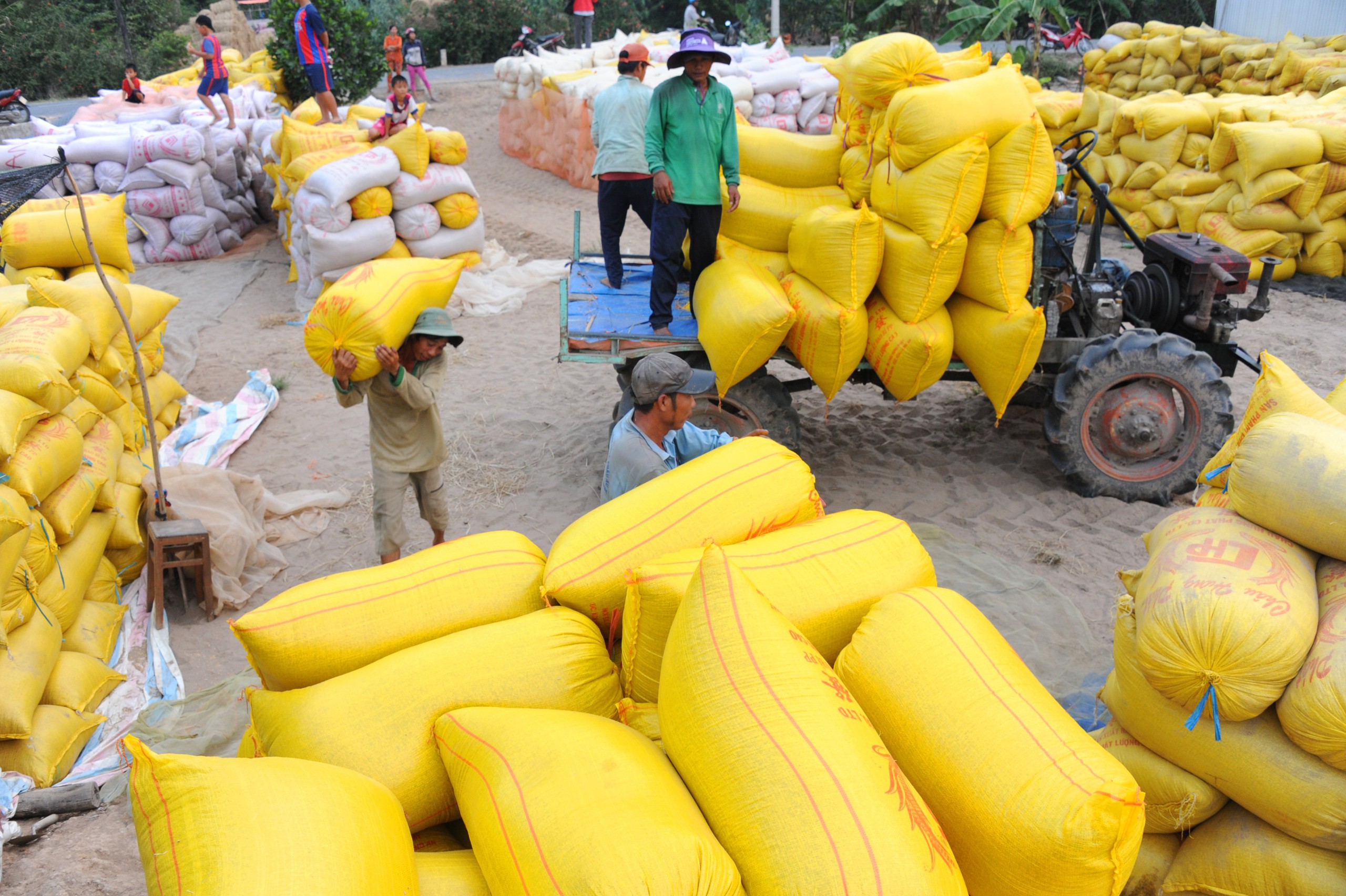
Record Exports: According to the General Department of Customs, in the first seven months of 2024, Vietnam's rice exports reached 5.3 million tons and a value of US$3.3 billion; compared to the same period in 2023, this represents an 8.3% increase in volume and a 28% increase in value. These are record figures in the history of Vietnam's rice exports. The Philippines remains the main consumer market, accounting for 43.6% of the market share, equivalent to 2.3 million tons and a value of US$1.4 billion. Indonesia ranks second with a market share of nearly 15%, equivalent to over 778,000 tons and a value of US$481 million. In the Philippine market, Vietnamese rice is facing fierce competition from Thailand. The Nation newspaper of Thailand reported that, taking advantage of Philippine demand, Thailand has boosted its supply and successfully exported 300,000 tons of rice in the first half of 2024, a 388% increase compared to the same period last year. Thailand also reached an agreement to supply an additional 130,000 tons in the last six months of 2024.
As of August 15th, the price of 5% broken rice from Vietnam increased by $5 to $575/ton, while the price of Thai rice remained stable at $561/ton, and Pakistani rice decreased by $2 to $542/ton. "The recent rapid increase in the price of 5% broken rice from Vietnam, being $15-20/ton higher than Thailand's, reflects the market reality," Ms. Huong confirmed. According to many businesses, the rapid increase in Vietnamese rice prices is due to several companies recently winning large-scale tenders in the Indonesian market. In addition, Philippine traders have also increased imports after a period of delay awaiting the policy of reducing import tariffs from 35% to 15%. Both of these markets are Vietnam's largest customers and are expected to increase imports to record highs of 4.3 million tons for Indonesia and 4.6 million tons for the Philippines. Furthermore, other markets also have increased rice imports to ensure national food security. Even Japan is facing a 14% increase in rice prices due to supply shortages caused by the heatwave. Rice prices in Japan have reached their highest level in 11 years. Japan recently announced it will import 21,000 tons of rice in 2024. Mr. Pham Thai Binh, Chairman of the Board of Directors of Trung An High-Tech Agriculture Joint Stock Company (Can Tho), predicts that the rice price trend will continue to be positive until the end of this year. By the end of July, Vietnam had exported more than 5 million tons of rice. Compared to the record export figure of 8.1 million tons in 2023, we only have about 3 million tons left for the remaining 5 months of 2024. Currently, the summer-autumn rice harvest is coming to an end. From now until the end of the year, we have one more autumn-winter crop. Neither of these crops has the largest production volume of the year. From this perspective, we can see that we don't have much rice left to export, so we can be confident about the price. Because the supply is limited, the concern many people have about India lifting its rice export ban, if it happens in the coming months, will likely have little impact on the Vietnamese market.




























































































Comment (0)