

In 2002, I was hired to work at the Department of Physiotherapy and Rehabilitation, now the Department of Rehabilitation, Military Central Hospital 108, when I was just 24 years old. Back then, I was very young, the youngest person in the department, unmarried, and entering the hospital environment with the bewilderment of a newly graduated technician.
Upon my arrival, I was greeted by Ms. Yen, then the Head of Administration, from the Military Personnel Department. She guided me to the office to meet Dr. Nguyen Quang Vinh, a Specialist Doctor and Distinguished Physician, the Head of the Department, to assign me my duties. My first impression of him was his warmth and approachability, his gaze and smile like that of a father or uncle to his long-lost child. This quickly dispelled my feelings of strangeness, awkwardness, and nervousness. After inquiring about my circumstances, he taught me, "In this profession, you must be patient, observe patients carefully, and take care of your own health."
 |
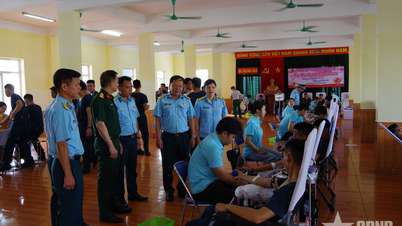
Teacher Nguyen Quang Vinh (fourth from the left) at the meeting commemorating the 72nd anniversary of the Traditional Day of the Central Military Hospital 108 (April 1, 2023). |
Although always caring and supportive of his subordinates, he was very strict in his work. For him, responsibility and dedication were paramount; every technique in caring for and treating patients, no matter how small, had to be performed according to proper procedures and techniques. He himself had been a doctor who had treated wounded soldiers on the battlefield under conditions of scarcity of both personnel and resources. The quick decisions he had to make amidst bombs and bullets, where even a small mistake could affect a person's life, had instilled in him caution, precision, and a high sense of responsibility in his profession. This strictness didn't create pressure, but rather helped us understand that the medical profession doesn't tolerate any carelessness.
During briefings and party branch meetings, he often emphasized the word "responsibility": responsibility to patients, to comrades, and to the honor of a military officer. He diligently maintained the daily afternoon newspaper reading routine for many years. He personally read the newspapers aloud to the officers and staff in the department, especially articles from the People's Army Newspaper and other official publications. According to him, military medical officers must be politically steadfast and sensitive to current events; reading newspapers is not only to update information but also to strengthen their resolve, maintain their stance, and enhance their sense of responsibility in performing their duties.
The afternoon newspaper reading sessions thus became a regular practice that continues to this day. For important topics, the professor would pause to analyze and relate them to the practical work of the department, helping each officer and staff member understand their position within the overall mission of the hospital and the Army. It is through these seemingly simple activities that the spirit of discipline and organizational awareness within the department has been increasingly strengthened.
From assigning on-call duties and checking patient records to monitoring technical procedures, he personally supervised and reminded everyone. There was no room for arbitrariness. Discipline was maintained on the foundation of setting a good example. He was always the first to arrive and the last to leave, always ready to be present when the department had difficult cases. I still remember the case of patient NTH (from Nam Dinh), a relatively young woman who suffered a severe knee injury after an accident, almost losing her ability to walk and becoming completely dependent on her family. As the main breadwinner, having to stop working caused her to fall into a state of depression and pessimism. Understanding the situation, he personally went to the ward to visit and talk with the whole family to understand the patient's circumstances and feelings. Not only did he analyze the specific recovery plan to strengthen their belief, but he also directed the development of a realistic treatment plan, assigning doctors and technicians to closely monitor each stage. The family was meticulously guided on how to care for the patient, coordinate exercises, and create a strong emotional support system for the patient. That attentive and dedicated care helped her gradually regain her willpower, cooperate actively, and progressively recover her mobility.
In his work, he was not only attentive to patients but also cared about his colleagues in the department. As the youngest and living far from home, I often received more inquiries and encouragement from him. His concern was quiet and simple: he would ask about my living conditions, if I was stressed, and if I had any difficulties, and we could discuss them together to find solutions.
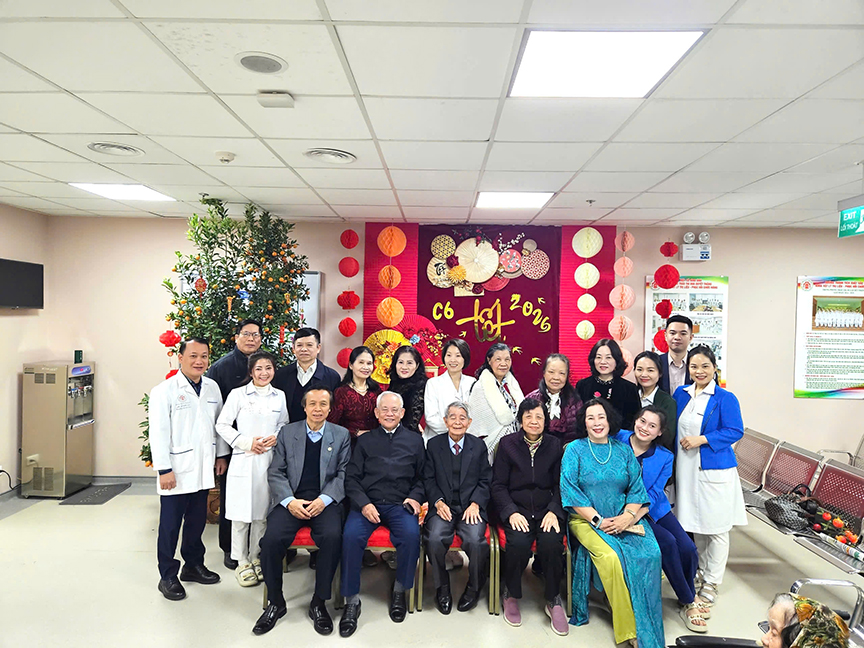 |
| Mr. Nguyen Quang Vinh (second from the left in the row) attends the meeting to extend New Year greetings to former and current staff members on the occasion of the Lunar New Year 2026 (Year of the Horse). |
It was from that care and trust that I received professional lessons in a very natural way. One memory I still remember clearly to this day is when my teacher was unwell, suffering from high blood pressure and a headache. He came into the therapy room and gently asked me to help massage his head, face, and neck. While treating him, he endured the pain while instructing me on how to manage patients with high blood pressure, noting which areas needed attention to help the patient feel more comfortable. I still remember his words from that day…
Even after leaving his position, he frequently returned to visit, discuss work, and show concern for the lives and professional development of his colleagues. For him, his commitment to the department extended beyond a single term; it was a responsibility and affection that had become an integral part of his life.
Looking back on that time, I understand that there are people who don't need to talk much about themselves. Their lives and personalities are reflected in the way they practice their profession, in the principles they steadfastly uphold, and in the quiet lessons that subsequent generations carry with them throughout their careers. For me, Specialist Doctor Level 2, Distinguished Physician Nguyen Quang Vinh is one such person – a mentor during my early years at the Central Military Hospital 108.
Source: https://www.qdnd.vn/nuoi-duong-van-hoa-bo-doi-cu-ho/nguoi-thay-trong-trai-tim-toi-1027818

![[Photo] The General Secretary, President and his wife lay flowers at the Ho Chi Minh Monument in Manila.](https://vphoto.vietnam.vn/thumb/1200x675/vietnam/resource/IMAGE/2026/05/31/1780219759477_anh-man-hinh-2026-05-31-luc-16-29-07.png)









![[Video] Sunset at Lap An Lagoon – Where the sun sets over the fishing nets](https://vphoto.vietnam.vn/thumb/340x192/vietnam/resource/IMAGE/2026/05/31/1780192137701_beach-landscape-sea-water-nature-grass-745871-pxhere-com.jpeg)

























































Comment (0)