Returning to the traditional craft of the countryside.
After graduating with a degree in Tourism , Ms. Ngo Thi Lien chose to return to her hometown of Phu Vinh, Phu Nghia commune, Chuong My district, Hanoi, to dedicate herself to the traditional rattan and bamboo weaving craft, instead of seeking opportunities in big cities.
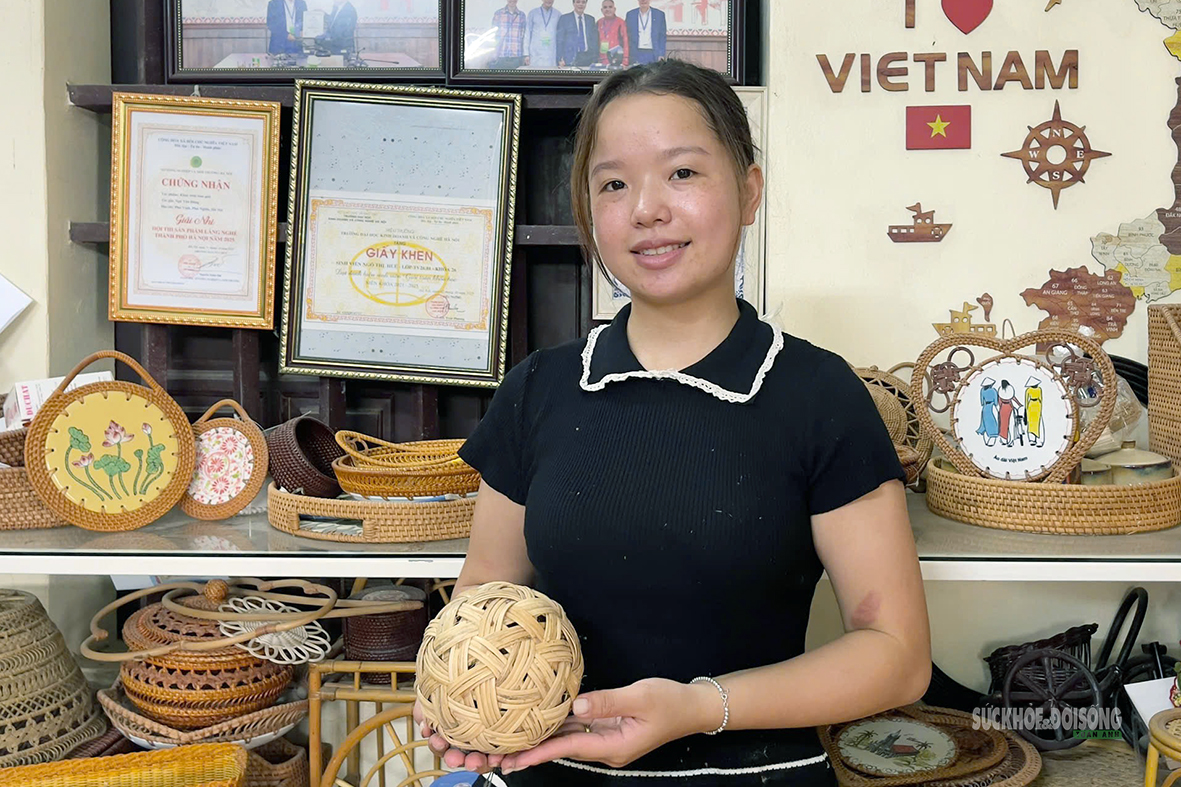
Ms. Ngo Thi Lien, a young woman from Phu Vinh craft village, chose to return to her hometown to continue the traditional rattan and bamboo weaving craft. Photo: Thu Phuong
Born into a family with generations of experience in the craft, Lien has been familiar with rattan, bamboo, and simple handcrafted processes since childhood. For her, rattan and bamboo weaving is not just a means of livelihood, but also a family memory and a part of her hometown's identity that needs to be preserved.
"I was born and raised in a family with a tradition of rattan and bamboo weaving, so I've been involved in this craft for about 20 years," Ms. Lien shared.
Armed with knowledge of tourism and market acumen, the young artisan aspires to find new directions for traditional products. After two years of establishing her production facility, she has developed numerous product designs to serve the market, while also creating jobs for local workers.
Meticulous attention to detail in every step.
To create a complete rattan and bamboo product, the craftsman must go through many stages: selecting raw materials, preliminary processing, treatment, weaving and shaping, finishing, and packaging.

Craftsmen in Phu Vinh process and shape rattan and bamboo products using traditional and semi-traditional tools in their workshop. Photo: Bao Chau
Of these steps, weaving is considered the most difficult. While handling the raw materials can rely on experience and technique, weaving the finished product depends heavily on the craftsman's hands, patience, and aesthetic sense.

Each product is meticulously crafted and finished by hand by skilled artisans before being released to the market. Photo: Thu Phuong
Each bamboo strip must be even, strong, and perfectly shaped. Even a small deviation can affect the beauty and durability of the product. It is this meticulous attention to detail that creates the unique character of Phu Vinh rattan and bamboo weaving.

After shaping, rattan and bamboo products are air-dried to ensure durability and maintain their shape. Photo: Bao Chau

The finished products are packaged and prepared for shipment to sales points and display spaces. Photo: Thai Hoang



A traditional craft village with over four centuries of history.
The Phu Vinh rattan and bamboo weaving village has a history of over 400 years. From woven products used in daily life, the people here have developed the craft into a handicraft industry with significant economic and cultural value.

Artisans from Phu Vinh craft village showcase traditional rattan and bamboo products crafted by the skillful hands of local artisans. Photo: Thu Phuong
According to statistics from the People's Committee of Phu Nghia commune, there are currently about 11,347 people living on rattan and bamboo weaving; about 90% of households in the area participate in the production and business of handicraft products. The average income of the people is about 70 million VND/person/year.
Not only serving the domestic market, Phu Vinh rattan and bamboo weaving village currently has over 500 product types, exported to approximately 50 countries and territories. This is one of Hanoi's typical handicraft villages, contributing to promoting the image of Vietnamese culture to the world .
Despite its enduring vitality, the rattan and bamboo weaving craft in Phu Vinh still faces many difficulties. According to Ms. Lien, the workforce in the craft village is currently mainly composed of older people, while there are not many young people participating in and inheriting the craft.
Furthermore, many production facilities face limitations in capital, making it difficult to invest in machinery, equipment, or technological innovation. This impacts their ability to expand scale, increase productivity, and meet the increasingly demanding requirements of the market.
However, young people like Ms. Lien still choose to stick with the craft, finding ways to combine handicraft production with experiential tourism, bringing tourists closer to the product-making process.
Vietnamese products reach international tourists.
Not only are Phu Vinh's rattan and bamboo products present in workshops, but they are also showcased in exhibition spaces, tourist attractions, and handicraft cultural complexes. Here, many foreign visitors express their delight at the rustic yet exquisite beauty of the products.

Phu Vinh's rattan and bamboo products are on display in a diverse range, from household items and decorative objects to handcrafted souvenirs. Photo: Thai Hoang
Edward, a tourist from London, was impressed by the sturdiness and meticulousness of each stitch. He said the product made him think of a meaningful handcrafted gift for his loved ones.

Edward, a tourist from London, expressed his delight at Vietnamese handicrafts. Photo: Thai Hoang
Meanwhile, Tom, a Canadian tourist who has lived in Vietnam for nearly 10 years, believes that Phu Vinh's rattan and bamboo weaving has a very unique character. According to him, the sophistication in every detail shows the high skill of Vietnamese artisans.


Tom, a Canadian tourist, appreciated the exquisite craftsmanship and unique character of Vietnamese rattan and bamboo products. Photo: Bao Chau
The positive reception from international tourists shows that rattan and bamboo products not only have practical and decorative value, but also carry a cultural story. This also motivates artisans to continue creating, innovating designs, and expanding their market.
The aspiration to take Phu Vinh to greater heights.
For Ms. Lien, the journey of preserving the craft has only just begun. She hopes to expand the market, build more workshops, and develop an experiential tourism model right at the production facility.
"My biggest wish is for traditional craft products to be branded, copyrighted, and expanded to more international markets," said Ms. Lien.
Amidst the hustle and bustle of modern life, where many traditional craft villages face the risk of disappearing, the return of young people holds special significance. With their love for the craft, innovative thinking, and desire for integration, they are contributing to continuing the story of Phu Vinh rattan weaving – a story of simple yet durable bamboo strips carrying Vietnamese culture far and wide.
Source: https://suckhoedoisong.vn/nguoi-tre-giu-lua-may-tre-phu-vinh-169260620064927843.htm
![[Photo] General Secretary and President To Lam attends the 13th National Congress of the Ho Chi Minh Communist Youth Union](https://vphoto.vietnam.vn/thumb/1200x675/vietnam/resource/IMAGE/2026/06/25/1782356968989_ndo_br_1-jpg.webp)

![[Image] Schools organize meetings and introduce teaching models to students admitted to grade 10.](https://vphoto.vietnam.vn/thumb/1200x675/vietnam/resource/IMAGE/2026/06/25/1782368077271_ndo_br_z7970052192242-1ec8daeb77a6eed1a4e9f58c564ddd3e-jpg.webp)
![[Photo] General Secretary and President To Lam receives Palestinian Ambassador Saadi Salama](https://vphoto.vietnam.vn/thumb/1200x675/vietnam/resource/IMAGE/2026/06/25/1782365384740_a1-bnd-9423-8322-jpg.webp)