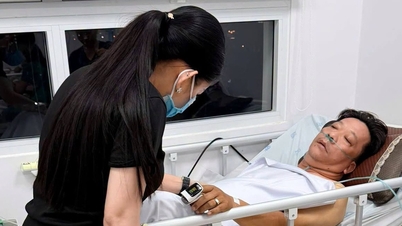
She was in a deep coma, had lost her reflexes, and her level of consciousness had dropped to 6 points, while a normal person's level is 15 points.
The CT scan revealed a massive intracranial hematoma occupying almost the entire left cerebral hemisphere, causing widespread cerebral edema, severe midline shift, and compression of the brainstem. This is a typical sign of an acute hemorrhagic stroke.

|
In Vietnam, young people account for nearly one-third of all stroke cases, with an average increase of about 2% per year. |
Doctors quickly identified the cause as a ruptured cerebral vascular malformation, a "ticking time bomb" that had existed in the patient's body for a long time but had never been treated.
According to Dr. Nguyen Duc Anh, a specialist in neurosurgery and spinal surgery, the ruptured malformation caused massive bleeding in the brain parenchyma, leading to a critical increase in intracranial pressure. Delaying treatment could result in death or a vegetative state.
A race against time was immediately triggered. The surgical team initiated intensive neurosurgical resuscitation, provided mechanical ventilation support, and prepared for an emergency craniotomy.
The biggest challenge lay not only in the size of the hematoma but also in its deep location, close to the ruptured blood vessel, in the context of cerebral edema and increased intracranial pressure. Every maneuver required absolute precision to both control bleeding and preserve as much healthy brain tissue as possible.
After nearly four hours of intense effort, the entire hematoma was removed, the bleeding points were controlled, and the vascular malformation was completely resolved.
Loan has overcome the critical stage. In the following days, she continued to receive intensive treatment to reduce brain edema, stabilize hemodynamics, and prevent complications.
You may also like

Young people are underestimating the effects of menstrual cramps.Many young people believe that menstrual cramps are a normal physiological phenomenon. Many choose to endure the pain or use painkillers when it is prolonged or intensifies. However, according to experts, if menstrual cramps significantly affect daily life, it could be a warning sign of gynecological problems that need to be detected early. As her consciousness improved, the patient began early rehabilitation with individualized exercises to restore motor and cognitive function. After a month, Loan's health progressed positively, raising hopes of returning to a normal life.
The story above is not only a successful emergency case, but also serves as a warning about the alarming rate of strokes in young people. According to recent studies, the rate of strokes in the 15- to 39 age group is rapidly increasing in many countries.
In Vietnam, young people account for nearly one-third of all stroke cases, with an average increase of about 2% per year. Notably, many cases have no clear medical history, and the cause stems from congenital cerebral vascular malformations or cerebral aneurysms that develop silently over time.
According to Dr. Nguyen Duc Anh, hemorrhagic strokes often have more severe consequences than other types of stroke. The majority of survivors face long-term functional impairment, even cognitive disorders or permanent disability.
The danger is that cerebral vascular malformations often have no specific symptoms and are only detected when complications have already occurred.
Therefore, screening using modern imaging techniques such as MRI, CT, or digital subtraction angiography plays a crucial role in early detection and risk assessment.
Besides congenital factors, an unhealthy lifestyle also contributes to the increased risk of stroke at a younger age. A diet high in salt and saturated fats, lack of exercise, prolonged stress, metabolic disorders, smoking, and alcohol abuse all damage blood vessel walls, increasing the risk of stroke even at a young age.
Experts emphasize that stroke is a race against time. With each passing minute, millions of nerve cells can be irreversibly damaged. Treatment is most effective within the "golden hour," therefore, when symptoms such as facial drooping, weakness or paralysis of the limbs, difficulty speaking, or sudden severe headache appear, patients need to be taken to the hospital as soon as possible.
Stroke rates among young people are increasing alarmingly globally. According to research published in the journal Frontiers in Neurology (2025), the stroke rate in the 15- to 39 age group rose to 25.45 cases per 100,000 people in 2021, with 101 countries reporting rates higher than the global average.
In Vietnam, strokes among young people are increasing by about 2% annually and now account for nearly one-third of all stroke cases, indicating a clear trend towards younger patients.
Experts believe that the causes stem not only from unhealthy lifestyles such as unbalanced diets, lack of exercise, and prolonged academic and work stress, but also from genetic factors and underlying cerebral vascular malformations.
Notably, many cases progress silently, only being detected when severe complications have already occurred. However, the risk of stroke in young people can be significantly reduced if risk factors are proactively controlled early on.
Maintaining a healthy lifestyle, reducing salt and saturated fat intake, increasing consumption of green vegetables and fruits, ensuring adequate intake of all energy-producing nutrients; exercising regularly for at least 150 minutes per week; getting enough sleep; and limiting prolonged stress are all important in protecting vascular health.

Strengthening the friendship between Vietnam and the United States.On July 3rd, as part of the Pacific Partnership - Friends of the Pacific 2026 program, the U.S. Army Pacific delegation, led by Lieutenant General Joel Vowell, Deputy Commander of the U.S. Army Pacific, paid a courtesy visit to the Quang Tri Provincial Military Command. In addition, regular monitoring of blood pressure, blood sugar, and blood lipids is necessary because many metabolic disorders develop silently. Limiting smoking and alcohol consumption also helps reduce damage to blood vessel walls, thereby lowering the risk of stroke.
According to Dr. Nguyen Duc Anh's recommendations, young people should have regular general health check-ups and stroke risk screenings every 6-12 months using specialized methods such as blood tests, vascular ultrasound, MRI or CT scans to detect potential abnormalities early and intervene promptly.
According to Dr. Nguyen Van Tuyen, Director of the Institute of Neurology and Head of the Stroke Department at Military Central Hospital 108, stroke at all ages is a fierce race against time. With each passing minute, billions of nerve cells can be irreversibly damaged.
Thrombolytic therapy is only effective within the first 3-4.5 hours, while mechanical thrombectomy is usually preferred within 6 hours. Delays can severely reduce the chances of survival and recovery.
Worryingly, strokes in children and young adults are easily overlooked due to atypical and difficult-to-describe symptoms. Manifestations such as severe headache, weakness or paralysis of the limbs, blurred vision, difficulty speaking, seizures, or sudden collapse, even if fleeting, require close monitoring and prompt medical attention.
According to experts, there is currently no foolproof method to prevent stroke in children, but early detection remains the most important key to minimizing damage and protecting lives.
Source: https://baodautu.vn/nguoi-tre-khoe-manh-van-co-the-dot-quy-d464774.html