

 |
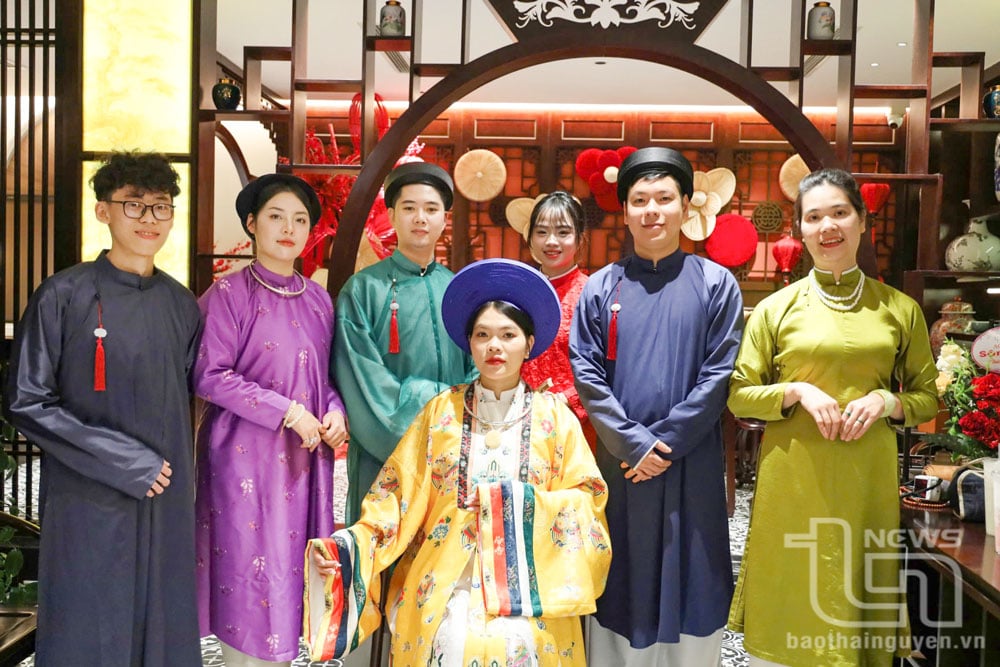
| A group of young people from Thai Nguyen pose in traditional Vietnamese clothing. |
Once overshadowed by the wave of modernization, traditional Vietnamese clothing is gradually regaining its prominence thanks to public attention, especially the strong influence of the media. More and more images of traditional attire are appearing on digital platforms and in artistic products.
Several popular music videos have helped audiences rediscover the beauty of traditional costumes, such as "Anh ơi ở lại" (Chi Pu) set in the Nguyen Dynasty royal court; "Để Mị nói cho mà nghe" (Hoang Thuy Linh) deeply rooted in Mong culture; and "Không thể cùng nhau suốt kiếp" (Hoa Minzy) recreating the image of Empress Nam Phuong. Director Victor Vu's film "The Last Wife" continues to make waves by using hundreds of traditional costumes to realistically portray the life of a 19th-century mandarin.
Alongside the emergence of traditional costumes in popular art, terms such as áo tấc, nhật bình, ngũ thân, giao lĩnh, viên lĩnh, phượng bào… have gradually become more familiar to the public. Many activities honoring traditional costumes have been organized, showing the growing interest of the community in traditional cultural values.
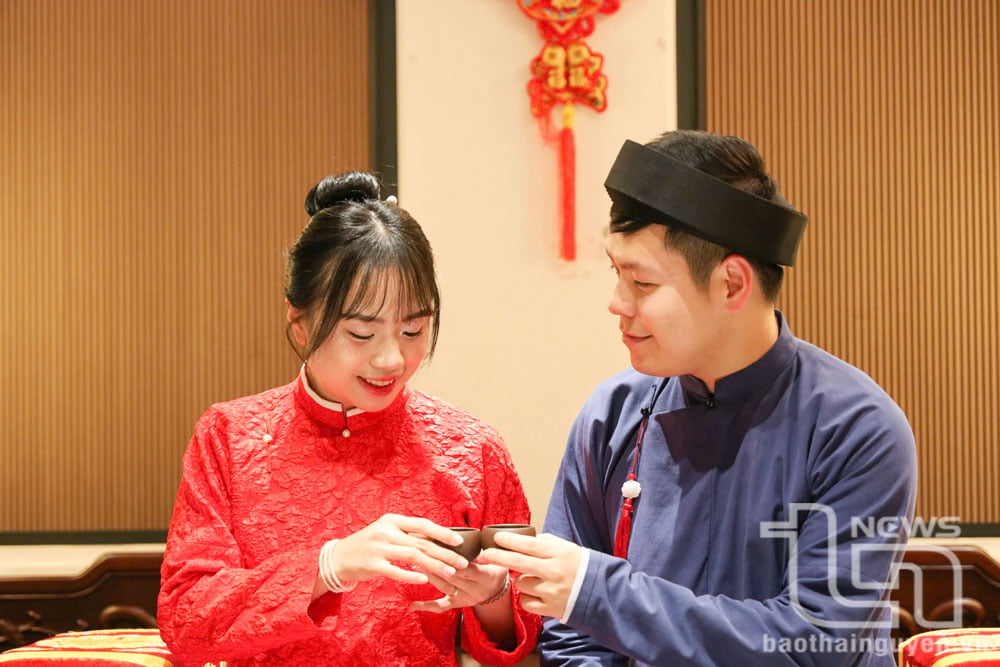 |
| Young people from Thai Nguyen pose in traditional Vietnamese clothing. |
One late afternoon, in a nostalgic-style tea house on Ga Street (Thai Nguyen City), a group of young people who love traditional Vietnamese clothing gathered. In the cozy atmosphere, under the soft yellow light, they admired and discussed the old costumes. On the table, besides fragrant cups of tea, were traditional costumes in elegant colors. A blue five-panel dress was neatly placed next to a vibrant red Nhật Bình dress, along with a few books researching Vietnamese clothing. Everyone carefully observed each stitch, marveling at the exquisite beauty of the patterns and fabrics.
Ms. Nong Thi Thuy Hoa, a teacher at Luong Ngoc Quyen Primary School (Thai Nguyen City) , lovingly held a traditional Vietnamese dress in her hands and shared: "I started learning about traditional costumes three years ago, initially out of curiosity, but the more I researched, the more I felt the cultural depth in every stitch. Each outfit is not just clothing, but also a part of history, reflecting the customs and lifestyle of ancient Vietnamese people. That's why I want to spread this love to my students, helping them understand history better through these costumes."
According to Ms. Hoa, to own a traditional costume, one can either have it custom-made or buy one ready-made. In Thai Nguyen, there are several designers specializing in traditional costumes, but most enthusiasts usually order them from Hanoi to ensure accuracy in style and material.
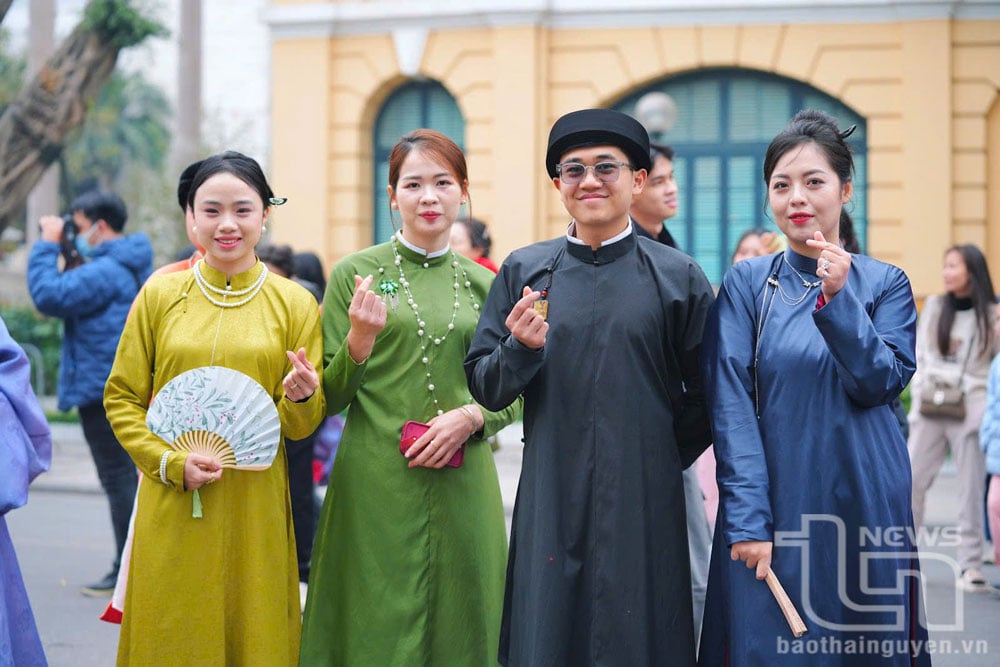 |
| Young people from Thai Nguyen participated in the "Hundred Flowers Walking" event held in Hanoi. |
Sharing the same passion, Ms. Mai Nguyet Nga (Tan Thinh Ward, Thai Nguyen City) gently touched the traditional five-panel dress she brought. She excitedly said: "Many people think traditional costumes are only for special occasions or performances, but in reality, if you know how to combine them, traditional clothing can absolutely be present in everyday life. I'm lucky to be one of the 400 people participating in the parade, and it's wonderful to see Vietnamese traditional costumes shining on the streets of Hanoi, no longer confined to the stage or films."
Mr. Tran Hoang Viet, from Quyet Thang commune (Thai Nguyen City), has a different perspective on traditional costumes. For him, it's not just a hobby but also a research journey. "I always want to reconstruct traditional costumes based on the most accurate historical documents. This helps people have a more authentic view of the clothing of our ancestors, avoiding inaccuracies or excessive modernization. Traditional costumes are not only beautiful but also reflect the sophistication and meticulousness of our ancestors in every detail," Mr. Viet said.
The story of traditional clothing continues to unfold in the tea house setting. The five-panel robes, the daily-wearing robes, and the traditional tunics are no longer unfamiliar items but have gradually become a part of the lives of the young people here. Beyond simply wearing traditional clothing, this group of young people also regularly organizes gatherings, photo shoots, and participates in cultural events to spread their love for traditional attire.
In Thai Nguyen, although the movement to appreciate traditional costumes is still new, with the passion and enthusiasm of young people, traditional values are gradually being vividly revived. Driven by their love for national culture, they continue the journey of preserving heritage, so that Vietnamese traditional costumes are not just a distant memory but become a source of pride in the hearts of every Vietnamese person.
Source: https://baothainguyen.vn/van-hoa/202503/nguoi-tre-tran-trong-co-phuc-viet-cf8146d/



















































Comment (0)