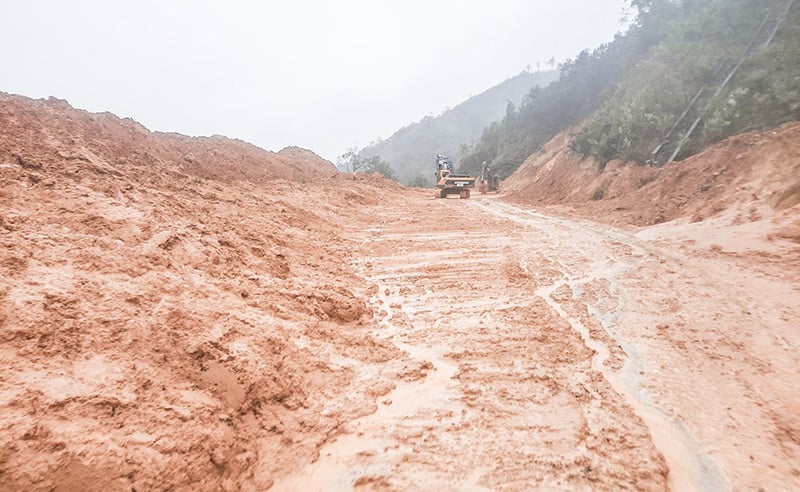
Reporting from a landslide-affected area in 2020 - Photo: MA
Reporting during that historic rainstorm was a life-or-death journey. We, a team of reporters from various media outlets, traveled along the Ho Chi Minh Highway through the districts of Dakrong and Huong Hoa, where rocks and soil cascaded down from the mountains like raging waves. Houses, buildings... everything was buried deep underground. The roads to the mountainous communes were constantly cut off by dozens of landslides, one after another, like a domino effect; before one could be repaired, another would collapse.
Along the more than 60 km stretch of road, we recorded 27 landslides of varying sizes. In some sections, the road was so damaged that only two trips a day were passable, each lasting only about two hours. Every step into the isolated area was a gamble with fate.
On November 13, 2020, amidst a torrential downpour that seemed to blanket the entire mountain forest, information from residents of Huong Son commune about alarming cracks appearing on the summit of Ta Bang mountain prompted us to set out to investigate.
At that moment, Lieutenant Colonel Cao Son Hai, Head of the Drug Crime Investigation Team of the Huong Hoa District Police, tried his best to dissuade them. He had just completed a grueling journey searching for the bodies of victims in the landslide in Ta Rung village and bringing the bodies of his comrades back to the unit from Huong Viet commune.
I still clearly remember his words: “During the march to Ta Rung, the task force followed the hillside to avoid the flood, only to find out later that the mountaintop had cracked open by more than 20 cm, with water gushing into the mountain. We were like walking through the jaws of death.” I understood his warning, but a sense of responsibility compelled me to go. Images and information from the scene could save many lives if a timely warning was given. Mr. Ho Len, a local resident with extensive experience in the forest, agreed to guide me.
When we were only about 1 km from the scene, I suddenly noticed that the water flowing down from the mountain was much less, clearer, and if I smelled it carefully, I could detect a slightly pungent, earthy smell. Len immediately scooped up some water, smelled it, and shouted, "We have to turn back down the mountain immediately!"
Without time to ask any questions, we hastily retreated. And just as our experienced guide had suspected, a few minutes later, a deafening "boom" echoed behind us. Turning back, we were stunned to see that where we had just stepped, an entire section of the mountain had collapsed. Thousands of tons of earth and rocks cascaded down, burying everything. If we had been a few minutes slower, we probably wouldn't have had the chance to tell this story.
Len then said, "When the water in the mountain changes color, the flow weakens, and there's a smell of fresh earth, it means the mountain's interior is absorbing water, the cracks are widening, and landslides will occur soon after. That's the survival instinct of a forest dweller."
Another occasion was a business trip on March 27, 2011, to A Vao commune, Dakrong district, to investigate illegal gold mining in Khe Ho, Khe Poc, and Khe Dang. I went with Phan Thanh Binh, a reporter from the People's Police Newspaper. We had to cling to the slippery cliffs of a mountain called Doc Dung (Standing Slope)—the name says it all. Before the trip, according to local people, we had to minimize our luggage as much as possible and climb the mountain without looking back because it would be easy to lose balance and fall into the ravine.
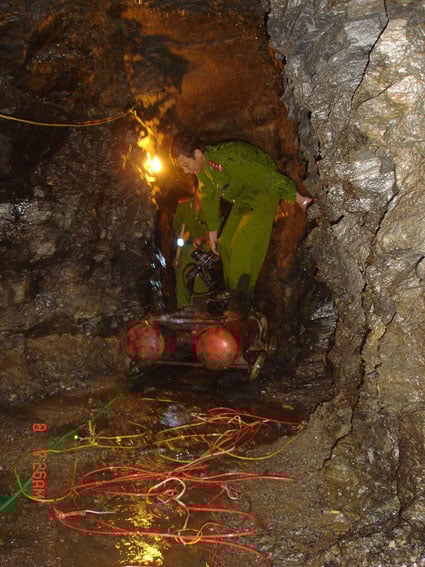
Reporters accompanied a raid by the Dakrong District Police deep into the gold mine tunnels in 2011 - Photo: MA
After more than 30 minutes of clinging to clumps of grass and tree roots, we reached the summit. From here, looking down, the high-voltage power lines at the foot of the hill were just faint specks of light. But that was only the beginning. We continued to follow the vines down the mountain, hiding in the dense forest. The roar of the engine signaled that we were getting close to the area where the illegal gold miners were operating.
Unexpectedly, behind a thick bush, we saw a group of young men injecting drugs. The situation was so sudden and breathtaking that both sides froze for a few seconds. I immediately regained my composure, pretending to be serious: "We've surrounded the area and are requesting to be taken to see the drug dealer." Fortunately, the group didn't react but silently led us to a nearby camp.
At the shack, Binh and I introduced ourselves as police officers on an investigation mission and demanded that they stop the illegal logging. In reality, if just one person in that group lost control, we could have lost our lives in the forest.
Two days later, we returned to the area with the Dakrong District Police's anti-gold mining operation. After a warning shot and the command, "Everyone stand still," some of the "gold thieves" quickly fled into the forest, while others took refuge in long trenches, nearly 200 meters long, that dug deep into the mountainside. A few who were slow were apprehended on the spot.
We followed Captain Choang into a deep cave, the electric lights inside illuminating dozens of deliberately discarded explosive charges with their detonators attached. About 50 meters further in, a burning smell, accompanied by thick black smoke, assaulted our formation, causing everyone to cough violently.
From inside, the group set fire to flammable materials soaked in oil, blowing black smoke back to prevent the raiding team from penetrating further. More dangerously, they also left behind dozens of explosive devices, threatening the lives of the officers.
Captain Nguyen Thanh Hong stated: "This is a new tactic used by illegal gold miners to evade law enforcement. The deeper they go, the more sophisticated and dangerous the traps become."
Initial investigations revealed that this group of people were all heavy drug addicts, having come from Thai Nguyen to work for a ringleader of an illegal gold mining operation.
Later, when the murder of the agarwood gatherers occurred in Huong Lap forest, I truly shuddered at the thought. If we hadn't remained calm that day, or if just one detail had been wrong, the consequences could have been unimaginable.
The life of a journalist is not just about typing and holding a camera; sometimes, it involves facing danger when reporting on natural disasters, crime, or illegal resource exploitation. There isn't always time to choose safety. There are times when, in a split second, survival instinct and a sense of responsibility must go hand in hand, and often, responsibility prevails.
Now, every time I pass by places that were once landslide sites or read news about a recent landslide somewhere in the mountains, my heart feels uneasy. Not only because of my past experiences facing life-threatening situations, but also because I know that somewhere, there are still young reporters embarking on journeys like the one I once experienced, with dedication, courage, and the belief that their pens can sometimes contribute to minimizing damage to the lives and property of the people and the State.
Minh Anh
Source: https://baoquangtri.vn/nha-bao-va-nhung-phut-giay-sinh-tu-194487.htm

























































































Comment (0)