

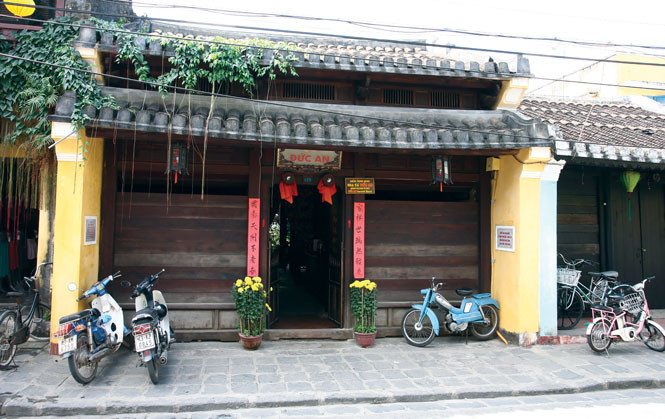
Front view of the Duc An ancient house.
The cradle of revolution
The Duc An Ancient House is located at 129 Tran Phu Street (Hoi An City, Quang Nam Province). The building was constructed in 1830, during the reign of Emperor Minh Mang of the Nguyen Dynasty. The house was passed down from the Phan family's ancestor to his descendants, and eight generations have been born and raised in this house to this day.
"Đức An" means "preserving morality for peace." Đức An was also the name of the Phan family's bookstore, established in the late 19th century, specializing in selling Sino-Vietnamese books and stationery in Quang Nam province. At that time, patriotic figures resisting the French, such as Huynh Thuc Khang, Phan Chu Trinh, and Tran Quy Cap, often came here to buy and read books with progressive ideas. In the early 20th century, as the patriotic movement against the French spread throughout Quang Nam province and the country, the Đức An bookstore continued to be a place for disseminating patriotism to the people and intellectuals.
In 1908, the anti-tax movement in Quang Nam and other central provinces failed. The Duc An bookstore temporarily ceased operations and switched to selling traditional medicine. By 1923, the Duc An house once again became a meeting place for patriotic intellectual youth. In October 1927, the Vietnam Revolutionary Youth Association of Hoi An was established at the Duc An house. On March 28, 1930, the Provisional Provincial Party Committee announced the establishment of the Quang Nam Provincial Party Committee of the Communist Party of Vietnam . The Duc An house continued to serve as a meeting place and communication center for the Party.
The Duc An House is also the birthplace of the patriot Cao Hong Lanh. Born in 1906, his real name was Phan Hai Tham, his alias was Nam Them, and he was the youngest son of the fourth generation in the Phan family. During his activism, he was sentenced in absentia to 15 years in prison by the French colonial authorities. Throughout his life, he followed the revolution, holding many positions in the Party and the State, and was always a source of pride for the Phan family in Hoi An. He passed away in Hanoi in 2008.
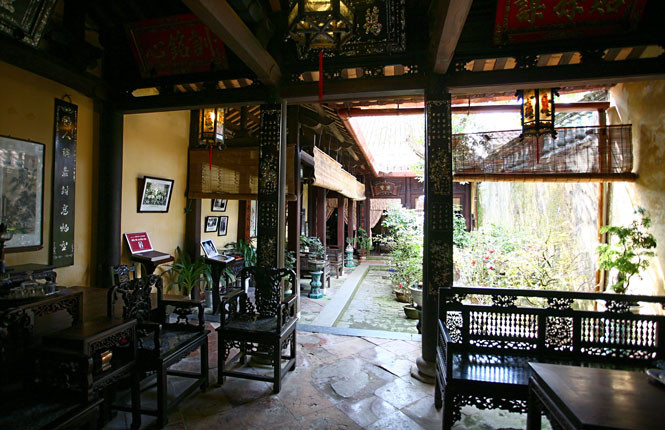
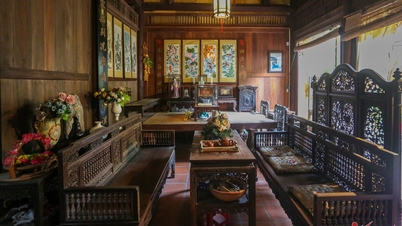
The interior of the Duc An ancient house is spacious and airy.
The old house has a distinctive architecture.
The Duc An ancient house has a tube-like structure, similar to most houses in Hoi An's old town, with a 7-meter wide and 40-meter long facade, facing Tran Phu Street. The house has a symmetrical layout with a central entrance and two windows on either side, used for business purposes. Above the entrance are two peepholes – a typical detail of Hoi An's old houses. The house has multiple layers of space with different functions. The outermost section is the business area, still preserving an old medicine cabinet system. The next section is a place of worship and memorial space, displaying images and artifacts related to the patriot Cao Hong Lanh. Next to it, beside the courtyard, is a corridor leading to the family's living quarters.
The Duc An ancient house features a typical Vietnamese architectural style found in coastal and riverside towns in the early 19th century. The house's frame is built in the style of the Central Vietnamese "ruong" houses. It is surrounded by brick walls and has a yin-yang tiled roof. The front wooden frame has a "stacked beam - false support" and "stacked pillar roof" structure, designed to bear weight and expand the space. The central house, the family living area, also has a stacked beam structure, but with two overlapping roofs extending to the back, creating a large upper floor connected to an open courtyard. This is a unique "stacked roof, hidden upper floor" house style that remains in Hoi An.
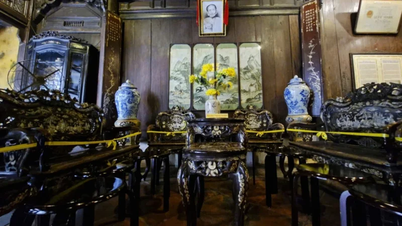
The Duc An House still preserves many ancient artifacts and books. Along with its almost perfectly preserved architecture, this ancient house is a part of the soul of Hoi An. Particularly noteworthy is the collection of ancient horizontal plaques and couplets inside, displaying remarkable messages such as: "Duc An Hieu" (Duc An shop), "Phan Tong Duong" (Phan family ancestral temple), "My Hoan Luan" (grand and magnificent architecture), "Am Ha Tu Nguyen" (Drinking water, remembering the source)...
Ms. Tran Hoang Mai, a tourist from Thua Thien Hue province visiting Duc An ancient house, shared: “This is a very beautiful ancient house. This heritage needs to be preserved and protected because it contains the spiritual values of Hoi An.” Mr. Phan Ngoc Tram, a sixth-generation descendant of the Phan family and the current owner of Duc An ancient house, said: “Although there are floods here every year and it has undergone several renovations, Duc An ancient house still retains almost entirely the cultural values left by our ancestors. Our generation of descendants of the Phan family will do our best to preserve and protect this house, worthy of being a historical monument, a place that marks the land and people of Hoi An.”
Source: https://hanoimoi.vn/nha-co-duc-an-dau-an-lich-su-pho-hoi-494690.html

![[Photo] National Assembly Chairman Tran Thanh Man attends the policy seminar to promote Vietnam-Türkiye cooperation.](https://vphoto.vietnam.vn/thumb/1200x675/vietnam/resource/IMAGE/2026/04/16/1776351415367_vna-potal-chu-tich-quoc-hoi-tran-thanh-man-du-toa-dam-chinh-sach-thuc-day-hop-tac-viet-nam-tho-nhi-ky-8705791-jpg.webp)






















![[Image] Bridges and roads connecting the eastern part of Ho Chi Minh City](https://vphoto.vietnam.vn/thumb/1200x675/vietnam/resource/IMAGE/2026/04/16/1776328595108_ndo_br_bh-vt5-jpg.webp)




















![[Infographic] Details of the Hanoi-Quang Ninh High-Speed Railway Project](https://vphoto.vietnam.vn/thumb/402x226/vietnam/resource/IMAGE/2026/04/16/1776338188424_anh-man-hinh-2026-04-16-luc-18-16-10.png)
![[Photo] National Assembly Chairman Tran Thanh Man meets with the Speaker of the Georgian Parliament](https://vphoto.vietnam.vn/thumb/402x226/vietnam/resource/IMAGE/2026/04/16/1776338494029_anh-man-hinh-2026-04-16-luc-18-21-21.png)















Comment (0)