

The Ministry of Planning and Investment is drafting a Decree on the establishment, management, and use of the Investment Support Fund. The most important question is, which investors will benefit from these support policies?
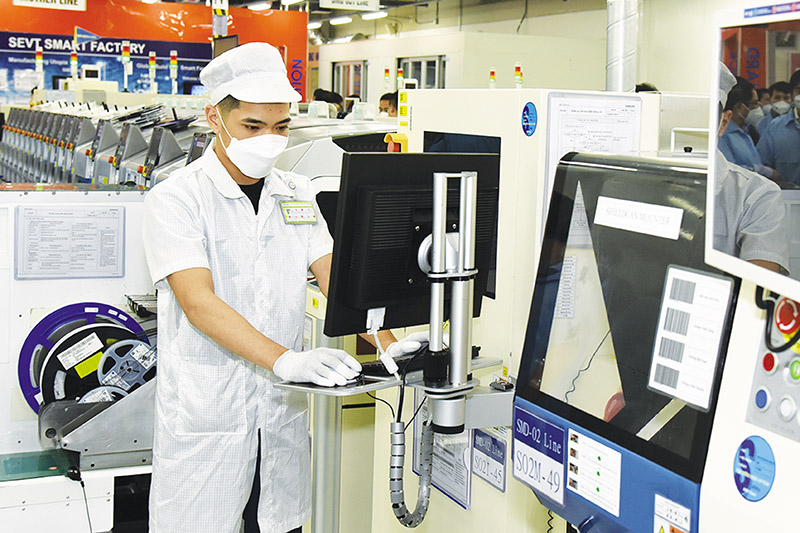 |
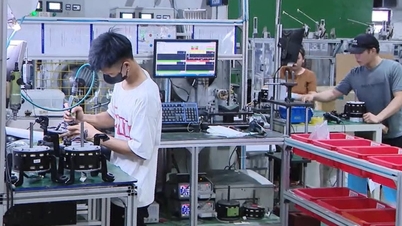
| Production line at a Samsung Group factory in Vietnam. Photo: Duc Thanh |
Concerns about eligible beneficiaries.
The draft Decree on the establishment, management, and use of the Investment Support Fund has just been released by the Ministry of Planning and Investment for public comment. During the consultation workshop on the draft, held yesterday (March 5th), many participating investors expressed concerns about its scope of application.
“American businesses affected by the global minimum tax are from many different sectors, not just high-tech. If the regulation only supports businesses in the high-tech sector, it would be too narrow,” said Virginia B. Foote, Vice President of the American Chamber of Commerce in Vietnam (AmCham).
According to Ms. Virginia, it is also necessary to clarify the regulations regarding the criteria for "enterprises with R&D (research and development) center investment projects," because some enterprises invest in R&D activities but do not build a separate R&D center. In this case, will the investor receive support, and if so, how?
Meanwhile, a representative from NIDEC, a company making large-scale investments in high-tech parks, suggested that investment support should be considered on a group-wide scale. “NIDEC has 13 subsidiaries in Vietnam, so when considering support, the total investment scale of these companies should be taken into account. This is the only way to ensure that businesses are encouraged to invest deeply in the Vietnamese market,” the NIDEC representative stated.
The above recommendations stem from a proposal by the Ministry of Planning and Investment in the Draft Decree that the beneficiaries of support from the Investment Support Fund will be enterprises with investment projects in the field of high-tech product manufacturing; high-tech enterprises; and enterprises with investment projects in R&D centers. In addition, these enterprises must also meet one of the following criteria: achieving an investment capital scale of over VND 12,000 billion, achieving revenue of over VND 20,000 billion per year, or completing the disbursement of at least VND 12,000 billion within 3 years…
Furthermore, according to Mr. Do Van Su, the Drafting Committee plans to add eligible recipients for support to include overseas investment enterprises that meet criteria regarding investment capital, revenue, and disbursement progress, as well as state-owned enterprises that lead the economy and meet criteria regarding total assets, financial efficiency, brand, and management capacity.
Explaining this, Deputy Minister of Planning and Investment Nguyen Thi Bich Ngoc said that the draft was not intended to compensate investors affected by the global minimum tax, but rather to provide support without discrimination, regardless of whether the business is domestic or foreign, existing or new, if it meets the set criteria.
"There will be no 'give and take' system. Everything will be regulated transparently and clearly, in accordance with international practices and OECD regulations; the processes and procedures will also be designed to facilitate both investors and government agencies," Ms. Ngoc said.
The support policies will be stable and long-term.
A series of investment support policies, ranging from support for R&D activities and the production of high-tech products to support for labor training costs and the cost of creating fixed assets, have been proposed in the Draft.
 Vietnam established the Investment Support Fund not to support businesses affected by global minimum tax rates, but rather to create stability in the investment environment and to focus on investment-attracting sectors that Vietnam is encouraging.
- Ms. Nguyen Thi Bich Ngoc, Deputy Minister of Planning and Investment
However, commenting on the draft, Mr. Hong Sun, President of the Korean Chamber of Commerce in Vietnam (KorCham), argued that the level of support is not clear enough to attract investment. “The conditions for receiving support are still limited. The criteria regarding the scale of investment projects to receive this support are very high; they should be broadened and relaxed so that more businesses can receive support,” Mr. Hong Sun said.
Mr. Nakajima Takeo, Chief Representative of JETRO Hanoi, also suggested that investment support should be given to small-scale businesses that make significant contributions to the supply chain and to the high-tech sector in Vietnam.
Sharing the same concern, Mr. Pham Minh Cao, Deputy Director of External Relations at Hyosung, worried about the regulation requiring project funds to be disbursed within 3 years. “Since we are investing in the biotechnology sector, we might not be able to disburse the funds within 3 years. It might take 5-10 years to fully disburse the 12,000 billion VND, because we have to invest and conduct research simultaneously,” Mr. Pham Minh Cao said.
From another perspective, Mr. Cao also proposed supporting investment on an overall group-wide scale. Hyosung has invested over $4 billion in Vietnam and plans to invest another $1.5 billion in Ba Ria - Vung Tau, but it is possible that, considering each project individually, it may not meet the 12,000 billion VND criterion, and therefore will not be eligible for support under the Draft.
Meanwhile, what concerned Ms. Dong Hong Hanh, representative of Samsung Vietnam, was the possibility of investors receiving support from the end of 2025 or the beginning of 2026. According to Ms. Hanh, a clear support roadmap should be studied, primarily to stabilize the investment environment, because Vietnam has never applied a policy of providing financial support.
Concerned about the mechanism for receiving support, Mr. Vu Tu Thanh, Deputy Executive Director of the US-ASEAN Business Council, posed a scenario where a business pays additional taxes and receives investment support from Vietnam, but the "parent" country does not approve, still considering the investor to be entitled to tax exemptions. What would happen then?
In response to this question, Deputy Minister Nguyen Thi Bich Ngoc stated that during the drafting of the Decree, international practices and OECD regulations were reviewed to ensure that no businesses would have to return to their "parent" country. "The OECD has established a global minimum tax policy, but it has not yet provided specific guidelines. Countries have to both develop their own policies and consult with the OECD. The ultimate principle is to follow the OECD's principles," Ms. Ngoc said.
"For now, we will focus our resources on supporting the high-tech sector," Ms. Ngoc said, affirming that these policies are stable and will be applied long-term.
Besides the Investment Support Fund, according to Deputy Minister Nguyen Thi Bich Ngoc, Vietnam is also reviewing the investment incentive mechanism to amend and develop a comprehensive policy. Once completed, regulations on investment incentives and support will be incorporated into this policy, ensuring consistency, comprehensiveness, and completeness.
Source
![[Photo] National Assembly Chairman Tran Thanh Man attends the policy seminar to promote Vietnam-Türkiye cooperation.](https://vphoto.vietnam.vn/thumb/1200x675/vietnam/resource/IMAGE/2026/04/16/1776351415367_vna-potal-chu-tich-quoc-hoi-tran-thanh-man-du-toa-dam-chinh-sach-thuc-day-hop-tac-viet-nam-tho-nhi-ky-8705791-jpg.webp)














![[Image] Bridges and roads connecting the eastern part of Ho Chi Minh City](https://vphoto.vietnam.vn/thumb/1200x675/vietnam/resource/IMAGE/2026/04/16/1776328595108_ndo_br_bh-vt5-jpg.webp)

























![[Infographic] Details of the Hanoi-Quang Ninh High-Speed Railway Project](https://vphoto.vietnam.vn/thumb/402x226/vietnam/resource/IMAGE/2026/04/16/1776338188424_anh-man-hinh-2026-04-16-luc-18-16-10.png)

![[Photo] National Assembly Chairman Tran Thanh Man meets with the Speaker of the Georgian Parliament](https://vphoto.vietnam.vn/thumb/402x226/vietnam/resource/IMAGE/2026/04/16/1776338494029_anh-man-hinh-2026-04-16-luc-18-21-21.png)

















Comment (0)