

Businesses join hands
According to the Ministry of Construction , among the 108 social housing projects registered for completion in 2024, Ho Chi Minh City registered 6 projects with a scale of 3,765 apartments; Binh Duong 20 projects with a scale of 4,500 apartments; Can Tho 2 projects (1,535 apartments); An Giang 4 projects (1,907 apartments). Bac Ninh province registered 5 projects with a scale of 6,000 apartments; Hai Phong 8 projects (3,925 apartments); Quang Ninh 3 projects (1,600 apartments); Hanoi 3 projects (1,181 apartments); Bac Giang 2 projects (2,428 apartments); Ha Nam 4 projects (1,666 apartments) and Da Nang 3 projects (1,880 apartments).
Most recently, Vinhomes commenced construction on two large-scale projects, each spanning over 100 hectares, in Hai Phong and Nha Trang within just one week. These include the Happy Home social housing project, with an estimated total investment of nearly 3,800 billion VND, located in subdivision 3 of the Cam Ranh Bay waterfront urban area. Expected to be completed by the end of 2026, this is the largest social housing project in Khanh Hoa province. The project covers nearly 88 hectares, comprising almost 3,600 low-rise social housing units and a commercial housing area with nearly 540 townhouses and terraced houses with gardens. In addition, there are numerous commercial and service facilities such as shopping malls, supermarkets, markets, service areas, offices, and other social infrastructure items.
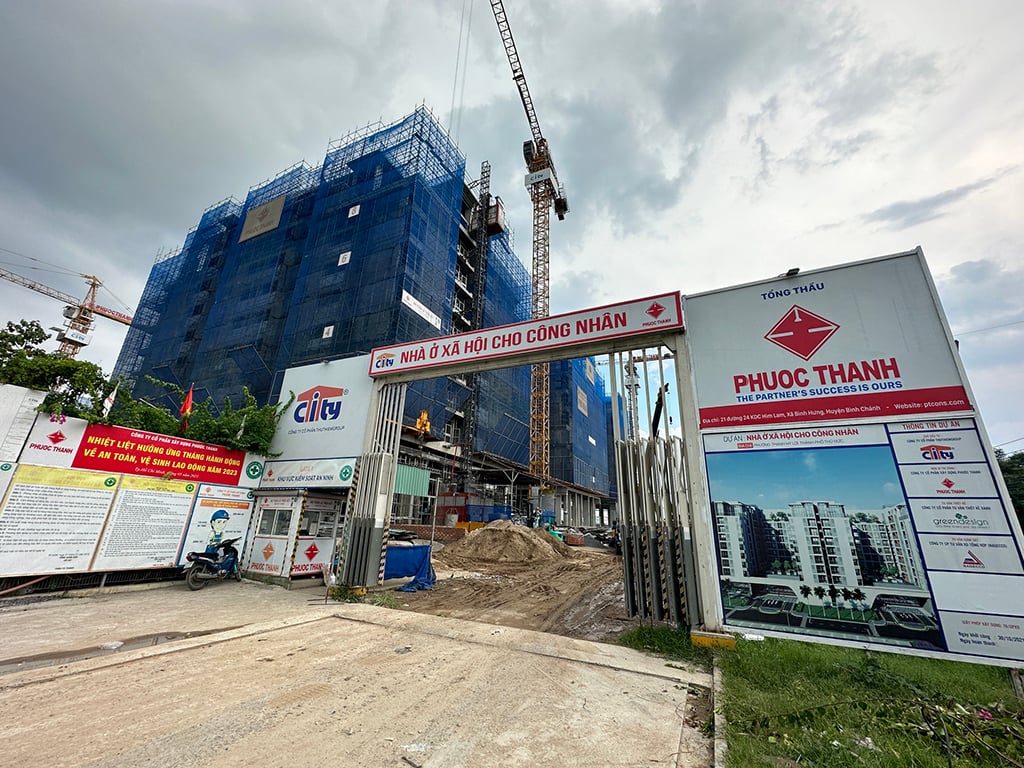
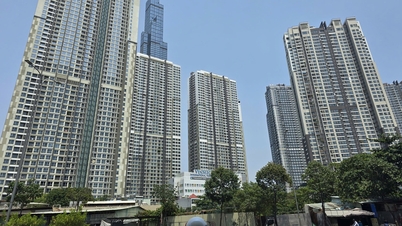
Businesses are joining hands with the government to implement social housing projects.
Previously, the group also commenced construction on its first social housing project under the Happy Home brand in Hai Phong, covering over 28 hectares with a total investment of over 5,800 billion VND. Upon completion, it will provide 27 apartment blocks with approximately 4,004 units, accommodating nearly 10,000 people. Prior to that, in July 2022, Vinhomes also broke ground on two social housing projects with 3,500 units in Quang Tri and Thanh Hoa.
Mr. Nguyen Viet Quang, General Director of Vingroup, said that the Happy Home social housing project is the 4th social housing project implemented by Vinhomes nationwide and the 2nd project to be started since the beginning of 2024.
Not only Vingroup, but in Ho Chi Minh City, all six social housing projects registered for completion in 2024 are invested in by private enterprises. For example, Hung Thinh Group announced the construction of 150,000 social housing units, contributing to alleviating the housing shortage for workers and low-income earners. According to Mr. Nguyen Dinh Trung, Chairman of Hung Thinh Group, one of the biggest challenges in social housing is how the government and businesses can work together to find comprehensive solutions and create conditions for everyone to have access to housing. Most people in large cities aspire to own a home and live there for almost their entire lives. Therefore, owning a home is a major turning point, a dream, even a lifelong asset. The government has policies to support people in owning homes, and banks have policies to provide loans with low interest rates. Businesses in the supply chain, from building materials, design, construction, development, etc., are linking together to create quality homes at affordable prices. The key is to have groundbreaking, open mechanisms that facilitate the development of supply sources. These houses are expected to cost less than 20 million VND/m2. However, despite the strong commitment and the plan being launched at the beginning of 2022, according to Mr. Trung, the legal procedures are still "nowhere near completion."
Binh Duong is one of the pioneering provinces in building and implementing social housing and worker housing models, yielding the most effective results. Specifically, in the period 2011-2015, Binh Duong attracted 82 social housing development projects, with a total floor area of 3.8 million m², accommodating 238,325 people, with a total investment of 19,034 billion VND. In the period 2016-2020, Binh Duong invested in 1.33 million m² of floor area out of 2 million m², achieving 65% of the plan. To achieve this, Binh Duong mobilized many businesses to participate in investing in the construction of social housing and worker housing. A prime example is Becamex IDC, a state-owned enterprise, which was entrusted by the province with the responsibility of building social housing. Therefore, with the existing advantages in capital, land, and infrastructure, it has contributed to providing comprehensive, suitable, and low-cost social housing projects for workers.

Despite the dedication and effort put into them, social housing projects still face many obstacles related to legal procedures.
Help the market recover.
To accelerate the program to build 1 million social housing units, Mr. Nguyen Van Dinh, Vice Chairman of the Vietnam Real Estate Association, proposed policy incentives, specifically regarding Value Added Tax (VAT), suggesting that the government should consider maintaining it at 5%. Regarding profit margins for social housing projects, he suggested increasing them to 15% or awarding bonuses based on actual performance in social housing development, or using equivalent forms to offset costs and motivate investors to continue investing in and developing the social housing segment.
In Ho Chi Minh City, regarding obstacles in the investment procedures for social housing, Mr. Bui Xuan Cuong, Vice Chairman of the People's Committee of Ho Chi Minh City, stated that Resolution 98 will be applied to the implementation. Accordingly, in the coming time, the city will focus on resolving the difficulties and obstacles in the implementation process of social housing projects. To accelerate the progress of social housing and worker housing construction, the People's Committee of Ho Chi Minh City has assigned specific tasks to each department, sector, and relevant agency to resolve administrative procedures and difficulties. Specifically, the Vice Chairman of the People's Committee of Ho Chi Minh City assigned the Department of Construction to lead the research and resolution of issues for social housing projects with clear and complete legal status, so that investors can start implementation soon. For projects with complex legal status and obstacles, thorough research is needed, and solutions must be proposed to ensure strict adherence to procedures and legal regulations. For each specific project that is stalled at a particular department or agency, Mr. Cuong assigns that unit to handle it thoroughly.
According to experts, the project to build at least 1 million social housing units for low-income earners and industrial zone workers, approved by the Prime Minister, along with specific solutions for localities and banks, is increasing people's access to affordable housing. Especially with nearly 300 projects scheduled for implementation in the near future, the demand for social housing will spread to other real estate segments, helping the market recover.
Businesses want local authorities to clear land and create clean land funds for bidding and selecting investors. In addition, it is necessary to clarify the mechanism for resolving the value that investors have paid for commercial land and converting it into social housing. Specifically, there needs to be decrees and circulars issued by relevant ministries and agencies, and strong involvement from local authorities in each stage of the procedures to accelerate the construction of social housing.
Mr. Nguyen Van Dinh , Vice President of the Vietnam Real Estate Association
Source link

![[Photo] Prime Minister Pham Minh Chinh receives the Chinese Ambassador to Vietnam](https://vphoto.vietnam.vn/thumb/1200x675/vietnam/resource/IMAGE/2026/04/05/1775397481797_ndo_br_dsc-5512-jpg.webp)















































































Comment (0)