

I remember that when the first poems "sent from the South" by the three poets were written under extremely difficult circumstances, Văn Công was among those three poets.
In 1963, while I was attending Chu Van An High School in Hanoi , we students had the honor of welcoming a delegation from the National Liberation Front of South Vietnam to our school. The entire Chu Van An school was buzzing with excitement at this incredibly moving reception. Among the delegation was the poet Thanh Hai, representing the liberation arts of South Vietnam. The names Thanh Hai, Van Cong, and Giang Nam have since been etched in the memories of us students.
The war dragged on, until we students joined the army and fought on the battlefields of the South. Only by going there did we realize how harsh and dangerous life on the battlefield truly was.
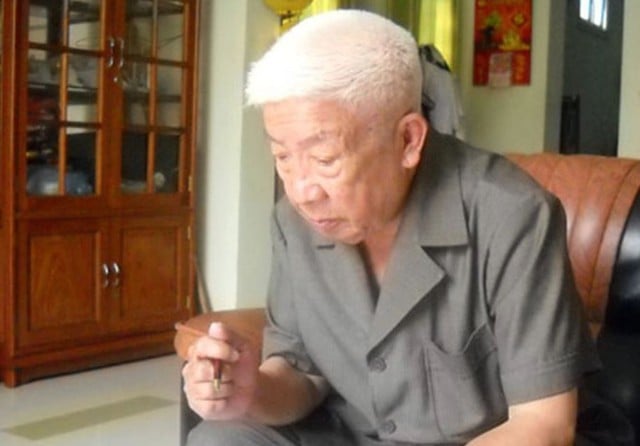
Poet Văn Công (1926 - 2021)
PHOTO: ARCHIVE of Nghe An Newspaper
It wasn't until after the peace treaty , in 1987, that I had the opportunity to meet the poet Van Cong. That year, in response to the "renovation" movement, the Central Vietnam literary and artistic community organized a seminar on the theme "Literature and Renovation" in Nha Trang. I was invited to attend, and on this occasion, I brought my whole family to Nha Trang for a visit.
At the seminar, I met the poet Van Cong, who was then a leading official in Phu Khanh province. Poet Van Cong attended the seminar, and he was very impressed with me after hearing my presentation, "How should poetry be reformed?".
After the conference, my family and the poet Nguyen Thuy Kha wanted to go to Da Lat to visit the poet Bui Minh Quoc, who was then the Chairman of the Lam Dong Provincial Association of Literature and Arts. We wanted to go, but transportation was difficult at that time, so I met with Mr. Van Cong and asked if he could help us get a car to Da Lat. I was very happy that poet Van Cong immediately agreed and provided a car to take us to Da Lat.
It was only after meeting and asking for his help that I realized how simple and generous the poet Van Cong truly is. Our trip to Da Lat was very enjoyable, and I am grateful to poet Van Cong for his assistance.
Deserves to be posthumously awarded the State Prize for Culture and Arts.
More than once, writer Nguyen Chi Trung – my "boss" at the Military Region 5 Creative Writing Camp – told me about the early days of the resistance against the French on both sides of Ca Pass. Poet Tran Mai Ninh and writer Nguyen Chi Trung were on the other side of Ca Pass, while poets Van Cong and Huu Loan were on this side. From the battles on both sides of Ca Pass, poet Tran Mai Ninh wrote the poem " Remembering the Immortal Blood ," and poet Huu Loan wrote the famous poem "Ca Pass ."
"Under the tree"
by the poisonous stream
Perched precariously on the watchtower
like the border
Hair and beard
wide shoulder cover
Unaware
villagers
Collection day
gibbon howling
Night watch
"Meeting a wandering tiger..."
Generations of poets have always continued, and patriotic poetry, from the resistance against the French to the resistance against the Americans, has traveled a long road, but patriotism and love for the people have become an unchanging constant. Poet Văn Công had the honor of participating in both resistance wars from the very beginning. Văn Công, Trần Mai Ninh, and Hữu Loan were part of the southward advance army; and Phú Yên and Khánh Hòa were battlefields where they directly fought.
Compared to the resistance against the French, which, though arduous, was full of romantic spirit, the first five years (1955-1960) of the resistance against the Americans were far more brutal. The poet Van Cong participated in that first, fierce period. From then on, he struggled to write poetry. And his poems reached the North during the "crossing the Truong Son Mountains" before Highway 559 was built.
In 1965, the Nguyen Dinh Chieu Literary Prize of the National Liberation Front of South Vietnam was awarded for the first time to 54 writers and poets who participated in the resistance in the South. Among those awarded was the poet Van Cong.
In 1958, the poet Van Cong wrote the poem "The Communist ," which is one of his outstanding poems that was translated into French and published in Paris in 1968.
"Communists must fall from the sky."
Or did it sprout from the ground?
No! That's not it!
Also black hair, red blood
They rose up from suffering.
Now, rereading that poem, having personally experienced the era of "Law 10/59" and the guillotine sweeping across South Vietnam, we can truly empathize with each line, as if written in the blood of the poet Van Cong. We also cannot forget the poem "Beloved Tuy Hoa ," which won first prize in the Thong Nhat Newspaper, was included in the poetry collection " The Song of the South ," published in 1960, and quoted in the textbook on revolutionary literature of the South by the Faculty of Literature - Hanoi University and Hanoi Pedagogical University.
"We braved the raging flames and smoke."
Oh, Cham Towers! Clouds entwined with wild winds!
Rice plants break their panicles, and the rice in Dong Cam fields is oozing milk.
The leaning wall glared at the enemy…
Tuy Hoa! I'll be there tomorrow.
The dust settled, and birds and butterflies flew about freely.
The summit of Yan Tower is bathed in moonlight intertwined with electric lights.
"The Da River estuary, sails spread out, heading here..."
When writing about his hometown of Tuy Hoa, Phu Yen, Van Cong's poetry is full of beautiful imagery, shimmering with love and aspirations for a peaceful reunification.
Returning to the "trio of poets" Van Cong, Thanh Hai, and Giang Nam, poets Thanh Hai and Giang Nam have received the State Prize for Literature and Arts, while only poet Van Cong has not. I think it's not that he hasn't, but rather that he won't. I sincerely hope the Vietnam Writers Association will soon resolve this issue so that poet and communist Van Cong can be posthumously awarded the State Prize that he truly deserves.
Source: https://thanhnien.vn/nha-tho-nguoi-cong-san-van-cong-185250410162345724.htm

















































Comment (0)