Lao Bao Prison is located at the end of Le The Tiet Street in Lao Bao town, Huong Hoa district. It is about 2km from National Highway 9, built in the middle of a valley. It is approximately 80km from Dong Ha and over 20km from Khe Sanh. Lao Bao Prison was formerly considered a remote and dangerous area. To the north was Tran Cao fort, dedicated to the Nguyen dynasty; to the west was the Se Pon River; and to the east were towering mountains.
During the Nguyen Dynasty, Lao Bao Prison served as a garrison guarding and protecting a portion of the western border of Dai Nam (Vietnam). Built in 1908, Lao Bao Prison covered approximately 10 hectares and was completely isolated from other populated areas. At that time, it was primarily used to imprison common criminals along with patriotic individuals who opposed the French during the Can Vuong movement.
A dark period at Lao Bao prison!
From 1929 to 1930, Lao Bao prison was expanded to hold more communist prisoners. The French colonialists used it to imprison communists active in Quang Tri. Notable figures included Tran Huu Duc, Le The Tiet, Le The Hieu, Doan Lan, Tran Cong Ai, and also activists from Central Vietnam such as Nguyen Chi Thanh, To Huu, and even Laotians .
By the 1960s, the National Liberation Front of South Vietnam had transformed this area into a revolutionary base during the Khe Sanh Road Campaign. In an attempt to destroy this stronghold, the US imperialists used their air force to heavily bomb the Lao Bao prison, and subsequently, the site was almost completely erased, becoming a desolate wasteland.

The American empire used its air force to bomb Lao Bao prison, almost completely erasing this historical site.
When it was first built, Lao Bao Prison consisted of only two rows of wooden buildings with tiled roofs, divided into two sections, Lao A and Lao B. Each row was about 5 meters wide, 15 meters long, and 2 meters high. Each building could hold up to 60 prisoners. Later, the prison was expanded with many smaller buildings such as a water filtration tower, a kitchen, five prison cells, and toilets. Each cell was more than 6 meters wide and 30 meters long, capable of holding up to 180 prisoners.


In particular, the solitary confinement area has 13 cells, each 1 meter wide and over 2 meters high. Lao Bao Prison was secured by a system of sturdy walls over 3 meters high and numerous bunkers at the corners of the walls. Prisoners here could only see the sky above and could not see the surroundings outside Lao Bao Prison.

Later, the site was expanded to include several smaller buildings such as a kitchen, a water filtration tower, five prison cells, and toilets.
Besides the main detention cells, the prison also contained other extremely cruel places of confinement such as torture chambers, interrogation rooms, and morgues located in the southeastern corner of the prison, as well as the wire workshop, carpentry workshop, and barracks. The punishments and brutal torture methods employed by the French colonialists, such as shackles and chains, were incredibly cruel in suppressing and killing our patriotic forces.
By 1945, Lao Bao prison held over 350 exiled political prisoners. Many Communist Party members died from the brutal torture inflicted on their bodies. Furthermore, the harsh climate, the proliferation of mosquitoes, flash floods, and other factors turned the place into a living hell for the revolutionary prisoners.
Visiting the Lao Bao Prison historical site.
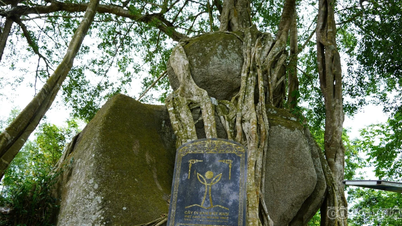
Having existed for over 40 years, Lao Bao Prison has suffered significant damage over time. Currently, many structures have been restored and preserved by the Quang Tri provincial government. Some of the structures you can visit when you come to the prison include the exhibition hall, the monument complex, and the memorial stele.
Visiting this place, you will clearly feel the brutality of the French colonial era. But even more clearly, you will see the indomitable spirit and fierce struggle of the revolutionary soldiers of our people at that time. Despite the hardships and difficulties, they remained steadfast in their love for their homeland, for their country, to fulfill their ideals! This is truly a lesson for us – future generations living in peace – reminding us of a period of bloody war, and how war heroes fell to protect the independence and freedom of our nation!




Lao Bao Prison has welcomed many visitors from all over the country. If you have the opportunity to go to the western part of Quang Tri, you can visit Lao Bao, Khe Sanh, and Ta Con Airport. Along with other historical sites such as Quang Tri Ancient Citadel, Vinh Moc Tunnels, and the banks of Hien Luong - Ben Hai River, it has become one of the must-see destinations for tourists visiting Quang Tri!
Source: https://dulichquangtri.vn/diem-du-lich/nha-tu-lao-bao-dia-nguc-tran-gian/

![[Image] National conference summarizing one year of operation of the overall organizational model of the political system, the three-tiered government model.](https://vphoto.vietnam.vn/thumb/1200x675/vietnam/resource/IMAGE/2026/07/01/1782882811691_ndo_br_1-jpg.webp)